

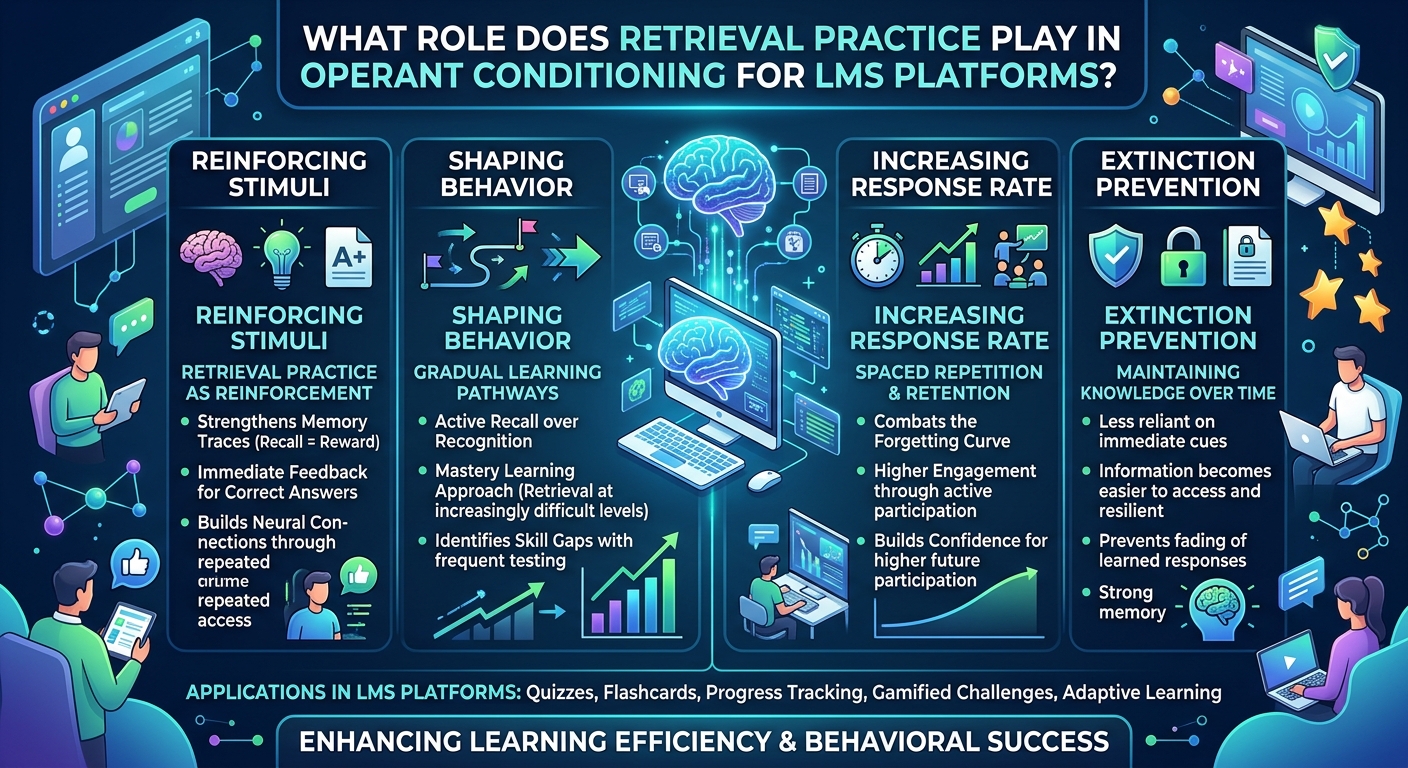
The Power Duo: How Retrieval Practice and Operant Conditioning Shape Learning on LMS Platforms
For Vice Presidents, Directors, and Senior Managers in Learning & Development, the relentless pursuit of effective training strategies is a constant. In an era where digital learning is paramount, understanding the core psychological principles that drive knowledge retention and behavioral change is critical. This article delves into the transformative synergy between retrieval practice and operant conditioning, exploring their indispensable role within modern Microlearning LMS and enterprise learning management systems.
From ensuring compliance in highly regulated sectors like pharmaceutical sales training and healthcare academy training, to optimizing performance in dynamic environments such as training for oil and gas or retail staff training, the goal remains consistent: to cultivate enduring knowledge and drive desired behaviors. Let’s uncover how these evidence-based learning theories, when integrated into a sophisticated learning management system, become a powerhouse for your organization’s talent development.
Understanding the Core Concepts
Retrieval Practice: Beyond Rote Memorization
At its heart, retrieval practice is the act of actively recalling information from memory. It’s not merely reviewing notes or re-reading material; it’s the deliberate effort to bring learned content to mind. This process strengthens memory traces, making future retrieval easier and more efficient. Think of it as exercising a muscle: the more you use it, the stronger it becomes. For a Learning content management system, this translates into features that compel learners to actively recall, rather than passively consume, information.
- Quizzes and self-assessments
- Flashcards and spaced repetition
- Scenario-based questions
- Elaborative interrogation and self-explanation prompts
The science is clear: active recall dramatically improves long-term retention compared to passive study methods. This is particularly vital for complex information found in investment banking prep course materials or online medical billing and coding training, where accuracy and retention are non-negotiable.
Operant Conditioning: Reinforcing Desired Behaviors
Introduced by B.F. Skinner, operant conditioning explains how behavior is shaped by its consequences. It’s a fundamental principle in behavioral psychology that posits that behaviors followed by rewarding outcomes are more likely to be repeated, while behaviors followed by unpleasant outcomes are less likely to occur. In the context of an lms learning management system, this involves:
- Positive Reinforcement: Providing a reward (e.g., points, badges, positive feedback) for a desired action (e.g., correctly answering a question, completing a module).
- Negative Reinforcement: Removing an undesirable stimulus (e.g., a looming deadline) after a desired action (e.g., submitting an assignment early).
- Punishment: Delivering an unpleasant consequence to decrease an undesirable behavior (used sparingly and carefully in learning environments, often as constructive feedback for incorrect answers).
The strategic application of operant conditioning within an enterprise learning management system can motivate learners, encourage persistent engagement, and ultimately drive the adoption of specific skills and behaviors crucial for roles from personal training insurance agents to professionals undertaking american bankers association training.
The Synergy: Retrieval Practice Meets Operant Conditioning in LMS
When retrieval practice and operant conditioning are combined within a sophisticated learning management software, their impact multiplies. Retrieval practice acts as the “behavior” to be reinforced, while the immediate feedback and rewards provided by the LMS serve as the “consequences” that shape future learning actions.
Consider a learner answering a challenging question about compliance regulations in training for mining. The act of retrieving the correct information is the desired behavior. If the learning management solutions immediately provides positive affirmation and perhaps points (positive reinforcement), the learner is more likely to engage in retrieval practice again, strengthening both the memory and the learning habit. Conversely, if an incorrect answer is met with corrective feedback and an opportunity to review the material (a form of negative reinforcement if framed as removing the “unknown” or “incorrect” state), the learner is guided toward the correct response and motivated to improve.
How LMS Platforms Facilitate This Powerful Combination
Modern learning management system platforms are purpose-built to integrate these principles seamlessly:
- Interactive Quizzes & Assessments: Regular, low-stakes quizzes are prime examples of retrieval practice. An online learning management system can provide instant feedback, a key component of operant conditioning, reinforcing correct answers and guiding learners on incorrect ones.
- Spaced Repetition Systems: By leveraging algorithms, an Adaptive Learning system schedules retrieval practice at optimal intervals, reinforcing learning just as knowledge begins to fade. This intelligent scheduling serves as a consistent positive reinforcement for knowledge retention.
- Gamification: Through badges, leaderboards, points, and virtual rewards, a Gamified LMS directly applies positive reinforcement to motivate learners through challenging content, such as advanced modules in investment banking prep course or complex scenarios in training for retail employees.
- Scenario-Based Training: Platforms supporting scenario-based learning require learners to apply knowledge in realistic situations, promoting retrieval practice. The outcomes of their choices (positive or negative, simulated consequences) act as powerful conditioning stimuli.
AI’s Role in Elevating Retrieval Practice and Operant Conditioning on LMS
Artificial intelligence is rapidly enhancing the effectiveness of these learning theories within cloud based learning management system environments. AI moves beyond static delivery to dynamic, personalized learning experiences.
How can artificial intelligence personalize learning experiences through repeated retrieval?
AI-driven algorithms can analyze a learner’s performance on retrieval practice questions, identifying areas of strength and weakness. Based on this data, the system can then dynamically adjust the difficulty, frequency, and type of retrieval questions presented. This ensures that each learner receives a tailored experience, focusing retrieval efforts where they are most needed. For instance, an AI Powered Authoring Tool can automatically generate varied retrieval prompts based on content, ensuring diverse exposure and reinforcing specific learning objectives for pharmaceutical sales training.
What advanced analytical capabilities can AI bring to tracking learner engagement and reinforcement patterns?
AI in an LCMS can process vast amounts of data on learner interactions, not just correct/incorrect answers, but also response times, patterns of hesitation, and even emotional responses (if using advanced sensors). This allows L&D leaders to gain deeper insights into which types of reinforcement are most effective for different learner segments, optimizing the conditioning process to maximize engagement and skill acquisition across an entire organization.
How might intelligent systems help design more effective corrective feedback in a learning context, without being demotivating?
AI can move beyond simple “correct” or “incorrect” feedback. By understanding the common misconceptions or knowledge gaps associated with specific questions, an intelligent system can provide personalized, constructive feedback that not only explains the correct answer but also guides the learner through the reasoning process. This targeted remediation acts as a refined form of operant conditioning, gently redirecting behavior without resorting to demotivating “punishment.” It ensures that learners in critical sectors like healthcare academy training fully grasp complex procedures.
Real-World Applications Across Industries
The integration of retrieval practice and operant conditioning through a robust learning management system like MaxLearn LMS holds profound implications for diverse industries:
- Compliance: For highly regulated fields, constant recall of policies and procedures is essential. Regular, reinforced retrieval practice ensures adherence and reduces risk across all segments, from training for oil and gas safety protocols to intricate financial regulations for american bankers association training.
- Sales: Whether it’s pharmaceutical sales training or training for retail employees, sales professionals need to rapidly recall product features, objection handling techniques, and customer engagement strategies. Retrieval practice combined with positive reinforcement for successful simulated sales scenarios builds confident, effective teams.
- Banking & Finance: An investment banking prep course benefits immensely from spaced retrieval practice to master complex financial models and regulatory knowledge. Positive reinforcement through an LMS motivates learners to tackle challenging material.
- Healthcare: Online medical billing and coding training and general healthcare academy training demand precision. Retrieval practice ensures critical information is always accessible, while conditioning reinforces best practices in patient care and administrative accuracy.
- Heavy Industry (Oil & Gas, Mining): Training for mining and oil and gas often involves safety-critical information. Retrieval practice ensures rapid recall in high-pressure situations, and operant conditioning helps embed safety protocols as habitual behaviors.
Benefits for L&D Leaders
For L&D professionals, the strategic implementation of retrieval practice and operant conditioning within their learning management system translates into tangible benefits:
- Enhanced Retention & Performance: Employees retain information longer and apply it more effectively.
- Measurable Behavioral Change: Training directly influences desired actions and habits.
- Increased Engagement: Interactive and rewarding learning experiences keep learners motivated.
- Improved ROI on Training: More effective learning means a greater return on your L&D investment.
- Reduced Risk: Especially in compliance-heavy industries, robust retention leads to fewer errors and better adherence to standards.
Conclusion
The convergence of retrieval practice and operant conditioning within advanced MaxLearn LMS platforms is not just an academic concept; it’s a strategic imperative for modern L&D. By actively engaging learners in recalling information and reinforcing correct responses, organizations can move beyond transient knowledge acquisition to foster deep, lasting understanding and profound behavioral shifts. As L&D leaders, embracing these psychological foundations through intelligent learning management solutions empowers you to build a truly skilled, adaptive, and high-performing workforce, ready to meet the challenges of any industry.
No responses yet