

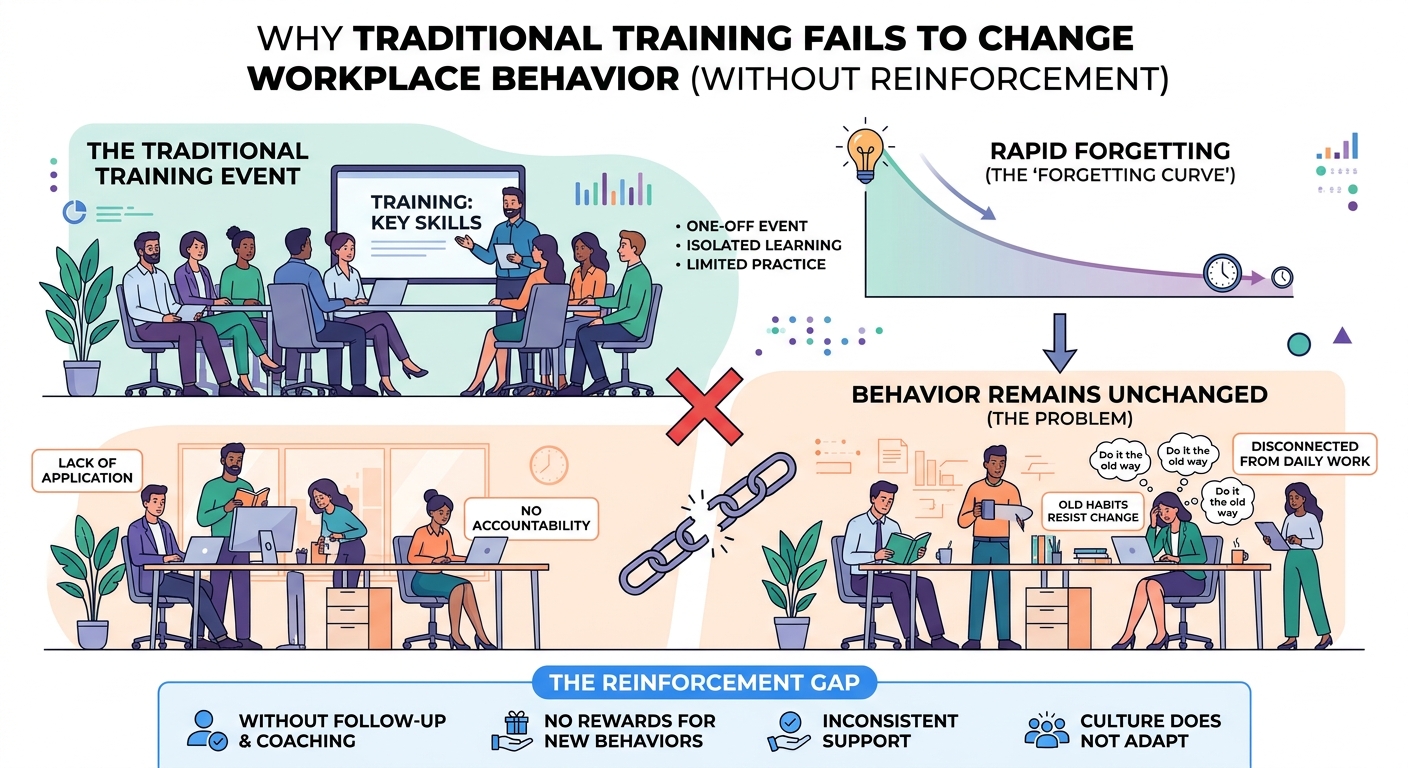
Why Traditional Training Alone Falls Short in Driving Lasting Workplace Behavior Change
In the dynamic landscape of modern business, organizations across sectors like Compliance, Sales, Banking, Finance, Insurance, Retail, Pharma, Healthcare, Hospitality, Oil and Gas, and Mining invest heavily in employee development. From pharmaceutical sales training to specialized training for oil and gas personnel, the goal is consistent: to enhance skills, improve performance, and ultimately, change workplace behavior for the better. Yet, many Vice Presidents, Directors, and Senior Managers in L&D departments often find themselves grappling with a perplexing question: why do even well-designed traditional training programs frequently fail to produce sustainable behavioral shifts without ongoing reinforcement?
The answer lies in understanding the inherent limitations of one-off learning events and the powerful psychology behind habit formation. This article will delve into the core reasons why traditional training, in isolation, struggles to instigate lasting change and illuminate the indispensable role of continuous reinforcement, bolstered by modern Learning Management System (LMS) and Learning Content Management System (LCMS) technologies, in truly transforming your workforce.
The Illusion of Completion: Where Traditional Training Stumbles
Traditional training, often characterized by workshops, seminars, or lengthy e-learning modules, typically aims to impart new knowledge or skills within a finite timeframe. While valuable for initial exposure, its effectiveness as a standalone solution for behavior modification is often limited. Here’s why:
- The Forgetting Curve is Real: Pioneered by Hermann Ebbinghaus, the forgetting curve illustrates how quickly individuals forget newly learned information if it’s not reinforced. Employees might absorb concepts during a healthcare academy training session or an american bankers association training seminar, but without subsequent recall prompts and application opportunities, much of that knowledge simply evaporates.
- Lack of Contextual Application: Learning in a classroom or simulated environment doesn’t always translate seamlessly to the complexities of real-world scenarios. A sales representative might master product features during pharmaceutical sales training, but applying that knowledge effectively during a nuanced client interaction requires practice and immediate feedback in the actual work context.
- Passive Learning vs. Active Engagement: Many traditional methods are inherently passive, relying on lectures or presentations. True behavioral change demands active engagement, critical thinking, and problem-solving – elements often missing in static, content-delivery focused training.
- No Immediate Feedback Loop: Without timely and constructive feedback, learners cannot identify areas for improvement or understand if their new behaviors are correct and effective. This is particularly crucial in high-stakes environments like training for mining or online medical billing and coding training, where precision is paramount.
- The “One-and-Done” Mentality: Treating training as a singular event, rather than an ongoing process, is perhaps the biggest pitfall. Behavior change is a journey, not a destination, requiring sustained effort and consistent reinforcement over time.
The Indispensable Bridge: Reinforcement for Lasting Change
If traditional training is the seed, reinforcement is the continuous watering and sunlight that allows it to grow into deeply rooted behavior. Reinforcement closes the “knowing-doing” gap, ensuring that learned information transforms into habitual actions. It’s about:
- Spaced Repetition: Regularly revisiting key concepts and skills at increasing intervals to combat the forgetting curve. This can be achieved through short quizzes, flashcards, or interactive scenarios.
- Practice and Application: Providing ample opportunities for employees to practice new skills in a safe environment, then apply them in their daily tasks. For instance, retail staff training could include role-playing customer service scenarios.
- Coaching and Mentorship: Offering ongoing guidance from managers or peers who can provide real-time feedback and support.
- Performance Support Tools: Making resources readily available at the moment of need, such as job aids, checklists, or quick reference guides for complex tasks like those in investment banking prep course operations.
- Recognition and Rewards: Acknowledging and incentivizing desired behaviors to encourage their repetition and integration into daily routines.
AI-Enhanced Learning: Fueling Continuous Reinforcement
Modern learning management system (LMS) and learning content management system (LCMS) platforms, especially those leveraging artificial intelligence, are revolutionizing how organizations provide effective reinforcement. These advanced learning management solutions move beyond simple content delivery to create dynamic, personalized, and continuously reinforcing learning experiences.
How can technology enhance learning retention?
Cutting-edge cloud based learning management system platforms utilize algorithms to track learner progress, identify knowledge gaps, and automatically deliver relevant content at optimal intervals. This systematic approach ensures that key information from training for retail employees or personal training insurance modules is revisited just as the forgetting curve begins to take hold, significantly boosting retention. Features like a Microlearning LMS break down complex topics into bite-sized, digestible modules, perfect for spaced repetition and on-the-job application.
What role does artificial intelligence play in personalized training paths?
AI is central to enterprise learning management by creating truly Adaptive Learning experiences. Instead of a one-size-fits-all approach, an lms learning management system powered by AI can assess an individual’s existing knowledge, learning style, and performance data to tailor a unique learning path. For example, an AI Powered Authoring Tool can rapidly generate custom scenarios for pharmaceutical sales training, focusing on the specific challenges a salesperson faces, thus making reinforcement highly relevant and impactful.
Can intelligent systems predict training effectiveness?
Yes, advanced learning management software can analyze vast amounts of data – from completion rates and quiz scores to interaction patterns and real-world performance metrics – to predict the likelihood of behavioral change. This predictive capability allows L&D leaders to intervene with additional reinforcement or different learning strategies *before* issues arise, ensuring maximum return on investment for initiatives like training for mining safety protocols or investment banking prep course proficiency.
How do smart platforms ensure continuous skill development?
Beyond initial training, intelligent platforms facilitate ongoing skill development through continuous feedback loops, performance support, and proactive content delivery. A Gamified LMS can transform routine learning into engaging challenges, encouraging consistent participation. Furthermore, Risk-focused Training modules can be automatically pushed to employees based on emerging threats or compliance updates, ensuring that critical behaviors are always aligned with organizational needs, from financial regulations in banking to health protocols in hospitality.
Integrating Reinforcement Across Industries with MaxLearn LMS
The imperative for continuous reinforcement spans every industry:
- Compliance & Finance: For online medical billing and coding training or american bankers association training, regular refreshers and scenario-based assessments are vital to maintain adherence to complex regulations and prevent costly errors. A robust MaxLearn LMS can automate these recurring training cycles.
- Sales & Retail: Pharmaceutical sales training or training for retail employees benefits immensely from spaced repetition of product knowledge, sales techniques, and customer service protocols, ensuring that staff are always prepared for customer interactions. Effective training for retail staff drives better customer experiences.
- Heavy Industries (Oil & Gas, Mining): Training for oil and gas and training for mining demand constant reinforcement of safety procedures. Microlearning modules delivered via mobile devices ensure critical information is accessible at the point of need, reinforcing safe behaviors in hazardous environments.
- Healthcare: Healthcare academy training requires continuous updates on best practices, new technologies, and patient care protocols. Adaptive reinforcement ensures medical professionals stay at the forefront of their field.
Conclusion: Moving Beyond the One-Time Event
Traditional training serves a crucial role in foundational knowledge transfer, but its power to instigate and sustain meaningful behavioral change in the workplace is severely limited without robust, ongoing reinforcement. For L&D leaders aiming to truly transform their organizations – whether it’s enhancing retail staff training, improving investment banking prep course outcomes, or fortifying personal training insurance adherence – the shift from a “one-and-done” mentality to a continuous learning ecosystem is paramount.
By embracing intelligent learning management solutions that incorporate microlearning, gamification, adaptive paths, and AI-powered tools, organizations can build a culture where learning is an integrated, reinforced, and ultimately, transformative journey. The future of effective workplace training is not just about what is taught, but how consistently it is reinforced, ensuring that every employee not only knows what to do but habitually *does* it, leveraging the power of a MaxLearn LMS.
No responses yet