

“`html
How L&D Teams Can Use Operant Conditioning to Boost Employee Retention
In today’s dynamic work environment, retaining top talent is a critical challenge across all industries, from pharmaceutical sales training to complex operations requiring specific training for oil and gas. High employee turnover can lead to significant costs, reduced productivity, and a loss of institutional knowledge. For Learning & Development (L&D) teams, the mission extends beyond skill-building; it’s about fostering an environment where employees feel valued, challenged, and motivated to stay. This is where the principles of operant conditioning, a behavioral psychology concept, can be strategically applied to create powerful, retention-boosting learning experiences.
Operant conditioning, pioneered by B.F. Skinner, suggests that behavior is influenced by its consequences. By understanding and strategically applying reinforcement and punishment, L&D leaders can shape desired employee behaviors, such as continuous learning, engagement, and commitment, ultimately leading to higher retention rates. This article will explore how L&D teams can harness these principles, supported by modern LMS and learning management solutions, to cultivate a workforce that chooses to stay and thrive.
Understanding Operant Conditioning in L&D
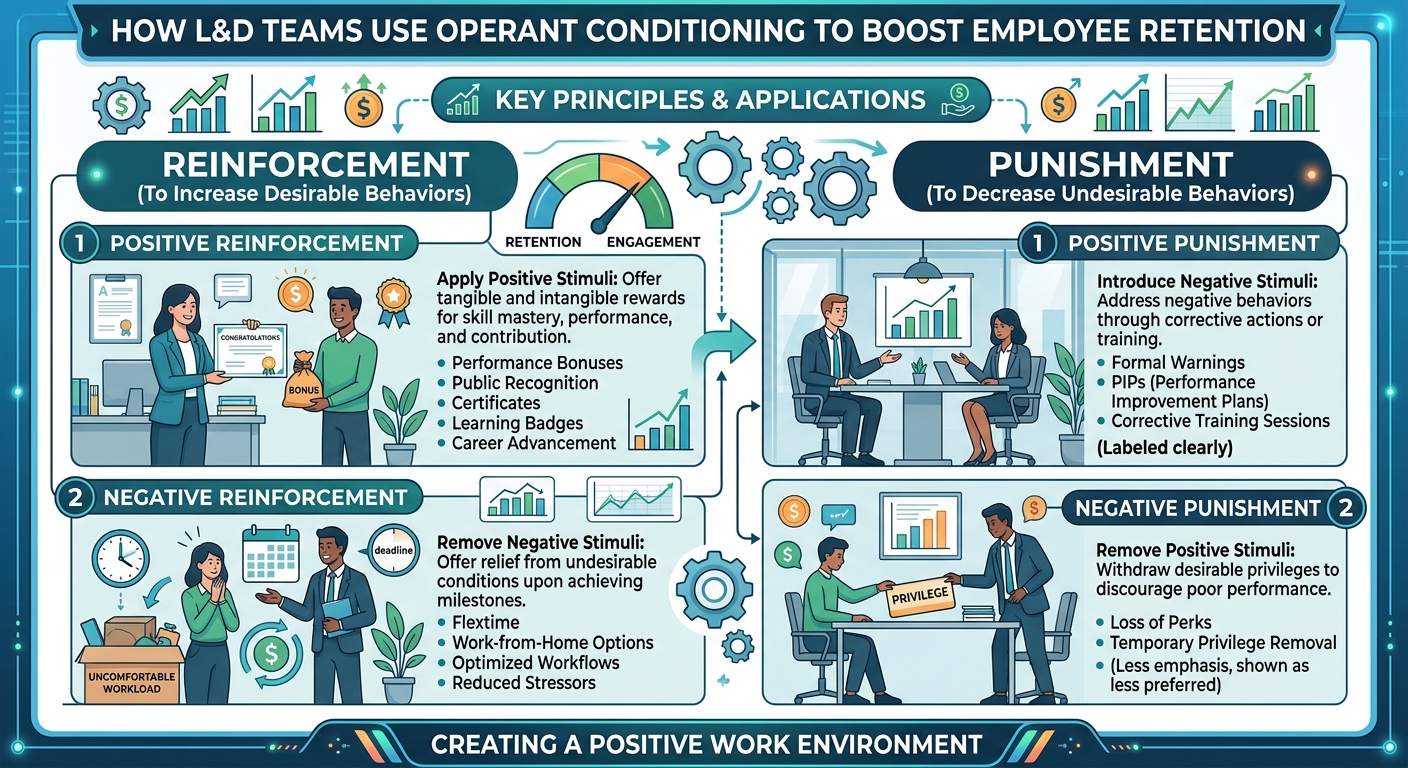
At its core, operant conditioning involves changing voluntary behaviors through consequences. In an L&D context, this means designing training programs and workplace experiences that reinforce positive actions and discourage undesirable ones. The two main components are reinforcement (increasing a behavior) and punishment (decreasing a behavior).
Positive Reinforcement: The Cornerstone of Retention
Positive reinforcement is arguably the most effective tool in the L&D arsenal for retention. It involves adding a desirable stimulus after a desired behavior, making that behavior more likely to occur again. Think beyond monetary rewards; intrinsic motivators often yield more sustainable results. For example:
- Recognition and Praise: Public acknowledgment of employees who complete challenging Gamified LMS modules or achieve certification in online medical billing and coding training.
- Opportunities for Growth: Offering access to advanced courses, mentorship programs, or leadership roles as a reward for consistent performance and engagement in healthcare academy training.
- Skill Application: Providing immediate opportunities for employees to apply newly acquired skills in meaningful projects, demonstrating the value of their learning. This is especially vital in technical fields like training for mining.
- Tangible Rewards (Carefully Used): Small, meaningful incentives for reaching milestones, like badges in a Gamified LMS or a bonus day off for exceptional performance after completing american bankers association training.
By consistently rewarding positive learning behaviors and their application, L&D can create a feedback loop that encourages employees to invest further in their development, fostering a sense of achievement and belonging.
Negative Reinforcement: Encouraging Desired Behaviors
Often misunderstood, negative reinforcement is not punishment. Instead, it involves removing an undesirable stimulus after a desired behavior, increasing the likelihood of that behavior occurring again. In L&D, this could look like:
- Streamlining Processes: If employees complain about cumbersome manual training sign-ups, implementing an intuitive cloud based learning management system removes that frustration, reinforcing the act of registering for training.
- Reducing Tedious Tasks: Automating routine compliance checks for personal training insurance requirements for staff who proactively complete their annual modules, making timely completion a more appealing option.
- Pre-empting Skill Gaps: Proactive Adaptive Learning paths that identify and address skill deficiencies early can remove the stress and pressure of struggling with tasks later on, reinforcing proactive learning.
The goal is to eliminate barriers or unpleasant aspects that hinder desired learning and performance behaviors.
Punishment vs. Extinction: What to Avoid
While operant conditioning also includes punishment (adding an undesirable stimulus or removing a desirable one to decrease a behavior), its use in L&D for retention is generally discouraged. Punishment can lead to resentment, fear, and a decrease in overall morale, counteracting retention efforts. Instead, L&D should focus on extinction – withholding positive reinforcement for undesirable behaviors. For example, if a team member consistently misses optional development workshops, simply stop inviting them to exclusive, reward-based learning opportunities rather than imposing penalties. This allows the undesired behavior (skippin training) to fade without causing negative emotional responses.
Practical Applications Across Industries
Operant conditioning principles can be tailored to various industries to significantly boost retention. An enterprise learning management system or LCMS becomes crucial in delivering these tailored experiences.
- Banking & Finance: For american bankers association training or an investment banking prep course, positive reinforcement could involve early access to advanced market analysis tools for those who consistently excel in compliance and new product training. Negative reinforcement might mean simplifying complex reporting procedures for teams that demonstrate mastery in data security protocols.
- Healthcare: Healthcare academy training and online medical billing and coding training can benefit from rewarding continuous professional development units (CEUs) with opportunities for specialization or peer mentorship roles. Removing administrative hurdles for highly trained staff to focus on patient care acts as negative reinforcement.
- Retail: For training for retail or retail staff training, commission bonuses for those completing advanced sales techniques courses, coupled with recognition for top performers, are powerful positive reinforcers. Streamlining inventory management training for training for retail employees who consistently achieve accuracy targets removes a burden, acting as negative reinforcement.
- Oil & Gas/Mining: Given the high-risk environments, continuous training for oil and gas and training for mining is paramount. Rewarding adherence to safety protocols with additional training opportunities for specialized equipment or career advancement is key. Simplifying safety audit procedures for teams with a flawless record removes administrative stress.
Leveraging Technology: The Role of an Advanced LMS
Modern L&D strategies rely heavily on technology to implement operant conditioning effectively. A robust learning management system (LMS) or learning content management system (LCMS) serves as the backbone for delivering, tracking, and reinforcing learning behaviors.
- Personalized Learning Paths: An Adaptive Learning system, often found within a sophisticated lms learning management system, can dynamically adjust content based on individual progress and performance. Achieving milestones triggers positive reinforcement, while overcoming identified weaknesses removes the frustration of struggling, acting as negative reinforcement.
- Gamification & Badges: A Gamified LMS platform can incorporate points, badges, leaderboards, and virtual rewards for course completion, high scores, and consistent participation. These are classic positive reinforcers that tap into intrinsic motivation.
- Instant Feedback & Recognition: An enterprise learning management system allows for immediate feedback on assessments and direct recognition from managers, reinforcing desired learning behaviors in real-time.
- Automated Incentives: Integration with HR systems allows for automated rewards or career path adjustments based on training achievements, providing consistent positive reinforcement without manual oversight. Solutions like MaxLearn LMS excel in this integration, streamlining the process of delivering learning management software and learning management solutions that drive results.
- AI-Powered Content Creation: An AI Powered Authoring Tool can generate highly relevant and engaging content quickly, ensuring employees always have access to fresh, impactful learning experiences. This itself can be a form of positive reinforcement, as it provides valuable resources tailored to their needs.
Answering Key Questions for L&D Leaders
As L&D professionals consider integrating behavioral science into their retention strategies, certain questions frequently arise:
How can L&D leverage advanced analytics and personalized content to boost employee retention?
By using sophisticated analytics built into modern learning platforms, L&D teams can identify learning patterns, skill gaps, and engagement levels. This data allows for the creation of highly personalized learning paths, often via Adaptive Learning methodologies. When employees receive content that is precisely relevant to their roles and development needs, they feel understood and supported. This targeted, effective learning acts as a powerful positive reinforcement, as they can immediately see the value and progress in their careers, making them more likely to stay.
What global strategies for nurturing employee commitment have proven most effective across diverse organizational cultures?
Globally, the most effective strategies often involve a blend of universal human motivators and cultural sensitivity. Establishing clear pathways for career progression (positive reinforcement), offering flexible learning opportunities that respect work-life balance (negative reinforcement by removing stress), and fostering a culture of continuous feedback and recognition are paramount. Programs that allow for peer-to-peer learning and mentorship also create strong social bonds, intrinsically reinforcing commitment. The key is to design programs that align with local values while upholding universal principles of growth and respect.
What are the primary challenges L&D teams encounter when implementing new retention strategies, and how can they be overcome?
Common challenges include securing leadership buy-in, demonstrating ROI, integrating new technologies, and managing resistance to change among employees. To overcome these, L&D teams should: start with pilot programs to showcase tangible results (positive reinforcement for leadership), clearly articulate the financial and cultural benefits of reduced turnover, invest in user-friendly learning management software like MaxLearn LMS to ease adoption, and communicate the benefits of new strategies directly to employees, emphasizing how it improves their work life rather than adds to it. Celebrating early successes acts as a crucial positive reinforcement for all stakeholders.
Conclusion
The strategic application of operant conditioning offers L&D teams a scientifically backed framework for enhancing employee retention. By thoughtfully applying positive and negative reinforcement through well-designed training programs and an advanced learning management system, organizations can cultivate a learning culture that actively encourages growth, engagement, and loyalty. Focusing on reinforcement over punishment creates a positive and supportive environment where employees not only acquire new skills but also feel valued enough to commit their long-term careers to your organization. Embrace these principles, and watch your retention rates soar.
“`
No responses yet