

Decoding Motivation: Why Microlearning Badges and Leaderboards Excel Through B.F. Skinner’s Lens
For Vice Presidents, Directors, and Managers of Learning & Development, the quest for truly effective training solutions is perpetual. In an era demanding agility, retention, and measurable impact, microlearning has emerged as a powerhouse. But what makes its gamified elements—specifically badges and leaderboards—so remarkably potent? The answer, surprisingly, lies deep in the foundational principles of behavioral psychology, particularly the work of B.F. Skinner.
Skinner’s theory of operant conditioning provides a robust framework for understanding how consequences influence behavior. When applied to modern eLearning, it illuminates why these seemingly simple gamification tools are not just engaging novelties, but powerful drivers of learning, skill acquisition, and sustained performance across industries from Compliance to Pharma, and from Finance to Retail.
The Core of Behavioral Science: B.F. Skinner’s Operant Conditioning
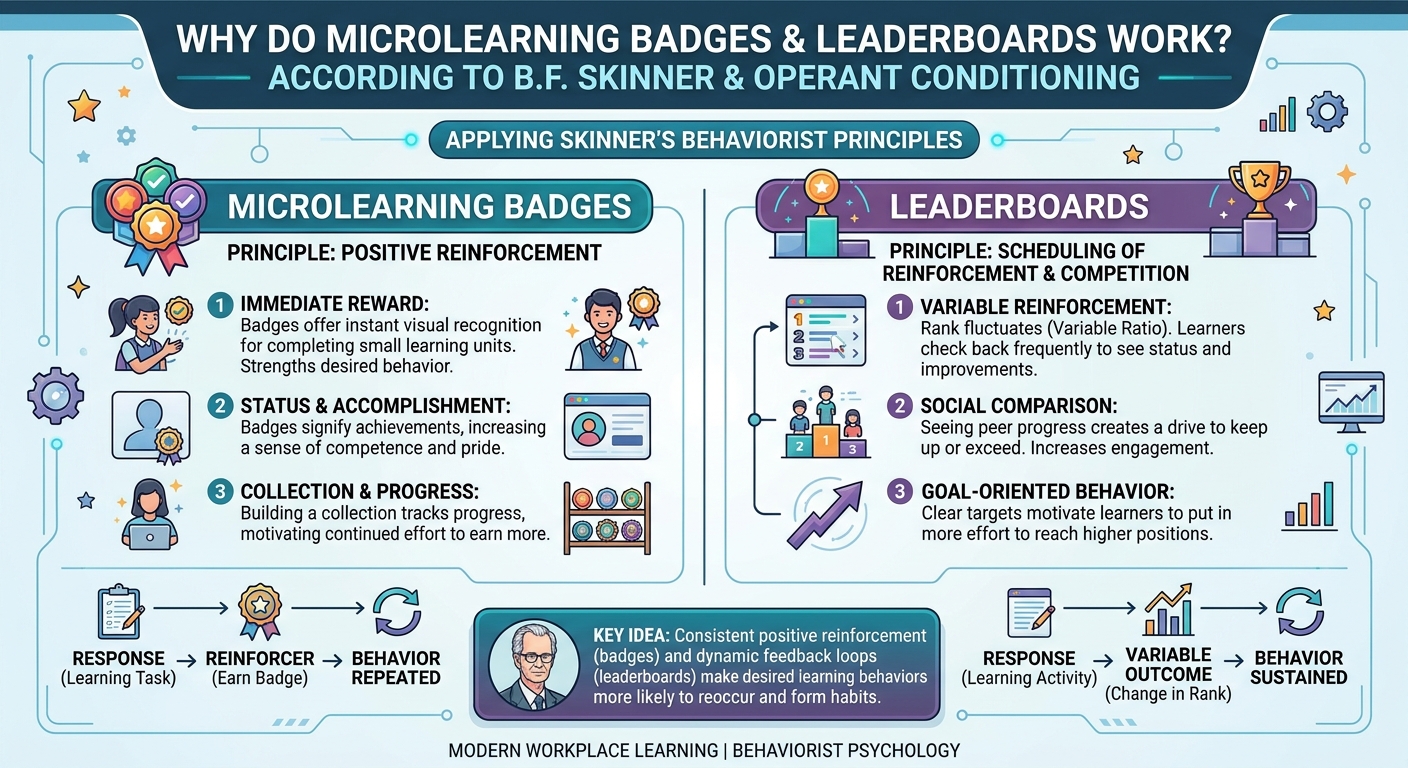
At the heart of Skinner’s work is the concept of operant conditioning, where learning occurs through rewards and punishments for behavior. Learners associate their actions with specific outcomes, which then either increase or decrease the likelihood of those actions being repeated. The most relevant aspect for L&D is positive reinforcement—the addition of a desirable stimulus that increases the frequency of a behavior.
Think about a sales professional completing a module on new product features. If that completion is immediately followed by a positive outcome—a badge, a shout-out on a leaderboard, or even just the satisfying “completion” message—they are more likely to repeat that behavior (i.e., complete future modules, apply the learned knowledge). This immediate feedback loop is crucial for reinforcing desired learning behaviors.
Reinforcement Schedules and Lasting Impact
Skinner also explored different schedules of reinforcement. While continuous reinforcement (rewarding every desired behavior) is great for initial learning, intermittent reinforcement (rewarding some but not all desired behaviors) can lead to more persistent behavior. In microlearning, this translates to strategically awarded badges for certain milestones or fluctuating leaderboard positions, keeping learners engaged and striving for rewards without expecting one every single time.
Microlearning: Precision-Engineered for Reinforcement
Microlearning, by its very nature, is perfectly suited for applying Skinnerian principles. Its bite-sized modules facilitate quick completions and immediate feedback, creating rapid cycles of behavior and reinforcement. Whether it’s Microlearning LMS modules for compliance training or quick refreshers for `pharmaceutical sales training`, the short duration means learners aren’t waiting long for their reward.
This approach is particularly effective in high-stakes environments such as `training for oil and gas` or `training for mining`, where complex procedures are broken down into manageable, reinforced steps. An effective Microlearning LMS enables L&D teams to deliver these focused bursts of information, ensuring that every learning interaction can be an opportunity for positive reinforcement, driving better retention and application of knowledge.
Badges: Tangible Trophies of Progress
Badges in microlearning environments are classic examples of conditioned reinforcers. Initially, a badge may hold little inherent value. However, when consistently paired with the completion of challenging tasks, mastery of new skills, or successful application of knowledge, it acquires reinforcing properties. The badge becomes a symbolic reward, a digital trophy signifying achievement.
Consider the impact on `online medical billing and coding training`. Earning a badge for mastering a specific coding set provides a concrete, visual representation of progress and competence. Similarly, in a `healthcare academy training` program, badges for patient safety protocols or new equipment operation boost learner confidence and validate their effort. These visual cues of accomplishment reinforce the learning behavior itself.
Answering a common query: “How can digital badges effectively motivate diverse workforces across industries like `healthcare academy training` or `training for mining`?” Digital badges offer universal appeal because they tap into the fundamental human desire for recognition and achievement. They transcend cultural and linguistic barriers, providing a clear, unambiguous signal of success that can be easily understood and appreciated by any learner. Furthermore, the ability to collect and display these badges offers a sense of pride and ownership over one’s learning journey.
Leaderboards: Igniting Competitive Drive and Social Recognition
Leaderboards introduce an additional layer of Skinnerian reinforcement: social recognition and competition. While direct positive reinforcement focuses on the individual’s progress, leaderboards leverage social comparison, which acts as a powerful motivator. Seeing one’s name climb the ranks, or even just appear on the board, can be a significant positive reinforcer, especially for intrinsically motivated individuals.
For an `american bankers association training` program or an `investment banking prep course`, leaderboards can foster a healthy competitive spirit, pushing learners to engage more deeply with content and strive for higher scores. The desire to earn a top spot, or maintain a prominent position, provides ongoing motivation. An advanced Gamified LMS effectively integrates these elements, making the competitive aspect both fair and transparent.
Addressing an L&D management question: “What are the critical success factors for implementing engaging leaderboards in remote `training for retail employees` or large-scale `training for oil and gas` operations?” Key factors include clear rules, fair scoring metrics, frequent updates, and recognition beyond just the top spot. Celebrating “most improved” or “fastest to complete” can engage a broader audience. Moreover, ensuring the learning is meaningful and directly applicable to their roles (e.g., `retail staff training` for new product knowledge) enhances the leaderboard’s relevance and impact, fostering true engagement rather than just gaming the system.
The Enabling Platform: Modern Learning Management Solutions
The successful implementation of Skinnerian principles through microlearning badges and leaderboards relies heavily on a robust learning management system (LMS). A modern `lms learning management system`, often a `cloud based learning management system`, provides the technological infrastructure to deliver engaging content, track progress, and automate the awarding of badges and updates to leaderboards.
Beyond basic functionality, an `enterprise learning management` solution or an `LCMS` (Learning Content Management System) with an AI Powered Authoring Tool allows L&D teams to design highly interactive and personalized microlearning experiences. This includes creating dynamic content for `training for retail` or specialized modules like `personal training insurance` education, where every interaction can be instantly reinforced.
To answer a common professional query: “How does an advanced `lms learning management system` streamline the deployment of personalized and Risk-focused Training modules?” An advanced LMS, like the MaxLearn LMS, centralizes content creation and distribution, making it easy to tailor learning paths based on individual needs or roles. AI-driven recommendations can suggest specific modules, and the system automatically tracks completion and performance, providing immediate feedback and awards. This seamless integration ensures that `learning management software` and `learning management solutions` are not just administrative tools, but powerful engines for behavioral change and skill development.
Strategic Imperatives for L&D Leaders
For L&D VPs, Directors, and Managers, understanding the Skinnerian roots of microlearning gamification offers a profound advantage. It moves beyond mere anecdotal evidence to a scientific explanation of why these tools are effective. When designing or evaluating your next training initiative, consider these strategic imperatives:
- **Intentional Reinforcement:** Ensure badges and leaderboard positions are tied to meaningful learning outcomes, not just activity.
- **Immediacy and Clarity:** Provide immediate feedback and clear explanations for earned rewards.
- **Variety in Reinforcers:** Combine individual badges with social recognition through leaderboards to cater to different motivational drivers.
- **Leverage Technology:** Utilize a sophisticated `learning management system` to seamlessly integrate and manage these gamified elements at scale.
Conclusion
The enduring power of microlearning badges and leaderboards isn’t just about novelty; it’s deeply rooted in the proven psychological principles of B.F. Skinner. By providing immediate positive reinforcement and fostering healthy competition, these gamified elements transform passive learning into active engagement, driving significant improvements in knowledge retention and skill application across all industries. For L&D leaders looking to maximize their training ROI and cultivate a truly motivated workforce, embracing these Skinnerian-inspired strategies within a modern, powerful LMS is not just an option—it’s a strategic imperative for continuous organizational growth and success.
No responses yet