

What Is Operant Conditioning and How Does It Shape Workplace Learning Behavior?
In the dynamic world of corporate learning and development, understanding how employees learn and adapt is paramount. As Vice Presidents, Directors, and Managers of L&D, your strategic decisions directly impact productivity, compliance, and overall organizational success. At the heart of effective behavioral change and skill acquisition lies a fundamental psychological principle: Operant Conditioning. This powerful framework, pioneered by B.F. Skinner, offers profound insights into how consequences influence voluntary behavior, making it an indispensable tool for shaping workplace learning.
From Microlearning LMS deployments to comprehensive compliance programs in finance, healthcare, or oil and gas, operant conditioning principles are quietly at play. Grasping these concepts allows you to design more impactful, engaging, and ultimately, more effective training initiatives across all segments, from
pharmaceutical sales training to complex
training for mining safety protocols.
The Fundamentals of Operant Conditioning in the Workplace
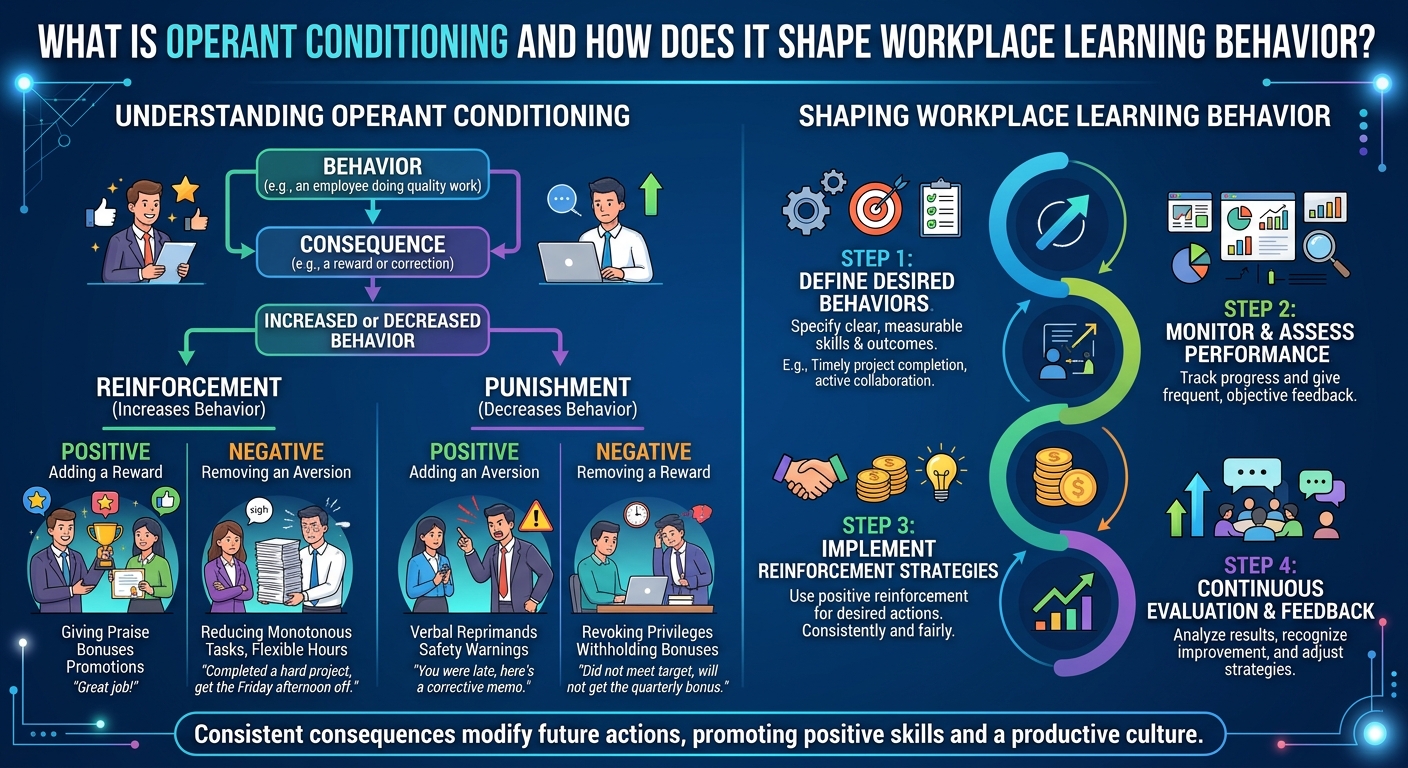
Operant conditioning posits that behaviors are learned through their consequences. Simply put, employees are more likely to repeat actions that lead to positive outcomes and less likely to repeat those that lead to negative ones. This isn’t about rote memorization; it’s about fostering desired behaviors and diminishing undesirable ones through systematic reinforcement and punishment.
Key Concepts: Reinforcement and Punishment
- Positive Reinforcement: Adding something desirable to increase a behavior.
- Example: An employee successfully completes an
online medical billing and coding training module ahead of schedule and receives public recognition or a bonus point on a Gamified LMS leaderboard. This encourages timely completion of future modules.
- Application: Use badges, points, peer recognition, or career advancement opportunities to reinforce desired learning behaviors in
healthcare academy training or
american bankers association training.
- Example: An employee successfully completes an
- Negative Reinforcement: Removing something undesirable to increase a behavior.
- Example: A sales team consistently achieves their targets for
pharmaceutical sales training, leading to the removal of weekly mandatory check-in meetings. The relief from the meetings encourages continued high performance.
- Application: Streamline processes or reduce oversight for teams that consistently demonstrate mastery of complex subjects, like those undergoing an
investment banking prep course.
- Example: A sales team consistently achieves their targets for
- Positive Punishment: Adding something undesirable to decrease a behavior.
- Example: An employee repeatedly fails to follow safety protocols in
training for oil and gas, leading to mandatory re-training sessions during their personal time.
- Application: Immediate, constructive feedback or temporary removal from certain responsibilities for non-compliance in critical areas like
training for mining. This should be used cautiously and ethically.
- Example: An employee repeatedly fails to follow safety protocols in
- Negative Punishment: Removing something desirable to decrease a behavior.
- Example: A
retail staff training participant consistently disrupts sessions, resulting in the loss of privileges, such as early access to new product samples.
- Application: Suspending access to certain professional development opportunities for consistent underperformance or failure to complete essential
training for retail employees.
- Example: A
For L&D professionals, the focus should almost always be on reinforcement, particularly positive reinforcement, as it fosters a more engaged and positive learning environment. Punishment, while sometimes necessary, can lead to resentment and may only suppress behavior rather than truly changing it.
Shaping Learning Behavior with Modern L&D Tools
The principles of operant conditioning are more relevant than ever in the digital age. Modern
learning management software and
learning content management system solutions provide sophisticated platforms to apply these concepts systematically.
Consider a retail company implementing
training for retail to improve customer service. Through a
cloud based learning management system, employees complete short modules on conflict resolution. Successful completion (positive reinforcement) could unlock new product discounts or recognition from managers. Conversely, failing to demonstrate proficiency might trigger an Adaptive Learning path, requiring them to review specific sections until mastery is achieved.
Leveraging AI for Enhanced Behavioral Shaping
Artificial intelligence is revolutionizing how we apply operant conditioning in learning. AI-powered platforms can personalize reinforcement and identify learning gaps with unprecedented precision.
How can intelligent systems optimize learning pathways based on individual performance?
AI can analyze learner data to identify patterns, recommending personalized reinforcement schedules. For instance, if an employee struggles with specific compliance topics, an AI can trigger immediate feedback and remedial modules, acting as a timely positive or negative reinforcement mechanism. An AI Powered Authoring Tool can even suggest content adjustments to better align with observed learning behaviors.
What role can predictive analytics play in anticipating training needs and proactively shaping behavior?
Predictive analytics in an
enterprise learning management system can foresee skill gaps before they impact performance. For a financial institution, this means identifying employees likely to struggle with new regulatory updates and proactively enrolling them in targeted
american bankers association training, offering reinforcement through early success and preventing future compliance issues (a form of negative reinforcement by avoiding sanctions).
How might intelligent automation ensure global consistency while respecting regional nuances in training?
For multinational corporations, an intelligent
Learning content management system can adapt content and reinforcement strategies to local cultural contexts. This ensures that while core behaviors are consistently reinforced, the delivery mechanism (e.g., type of recognition, peer interaction) resonates regionally. For
training for oil and gas or
training for mining, where safety is paramount, consistent reinforcement of critical safety behaviors is non-negotiable, but the specific feedback mechanisms can be localized effectively.
Practical Applications Across Industries
The application of operant conditioning is universal across various industries targeted by L&D leaders:
- Compliance & Finance: In banking and insurance, consistent reinforcement for adherence to regulations and ethical conduct is vital. Regular, short quizzes with immediate feedback and recognition through an
lms learning management system can reinforce correct procedures, preventing costly errors and fines. Think of
personal training insurance modules that ensure advisors are up-to-date with policy changes.
- Sales & Retail:
Pharmaceutical sales training,
training for retail, and
retail staff training benefit immensely. Hitting sales targets leads to bonuses (positive reinforcement), while consistent product knowledge application in customer interactions might reduce supervision (negative reinforcement).
- Healthcare:
Online medical billing and coding training and
healthcare academy training can use operant conditioning to solidify critical skills. Correctly applying complex coding rules can be reinforced with achievement badges, leading to fewer claim rejections and increased efficiency.
- Industrial (Oil & Gas, Mining): Safety training is non-negotiable. Consistent positive reinforcement for following safety protocols (e.g., recognition for zero-incident shifts in
training for oil and gas) and immediate corrective feedback for unsafe practices (positive punishment) are crucial to prevent accidents.
- Hospitality: Excellent customer service can be reinforced with positive feedback from guests, peer recognition, and opportunities for advancement, enhancing the overall guest experience.
The key is to identify the desired behaviors, choose appropriate reinforcers or punishments, and apply them consistently using a robust
learning management solution. An effective
Learning content management system, like
MaxLearn LMS, allows L&D teams to implement these strategies at scale, ensuring every employee, from new hires to seasoned executives, receives tailored learning experiences that truly stick.
Conclusion
Operant conditioning offers a powerful lens through which L&D leaders can design and implement more effective workplace learning programs. By systematically understanding and applying the principles of reinforcement and punishment, you can actively shape employee behavior, driving skill development, enhancing compliance, and fostering a culture of continuous improvement. As technology, particularly AI, continues to advance, the ability to personalize and optimize these conditioning processes within an
enterprise learning management system will only grow, making your training initiatives more impactful than ever before. Embrace these psychological foundations, and empower your workforce to not just learn, but to truly adapt and excel.
No responses yet