

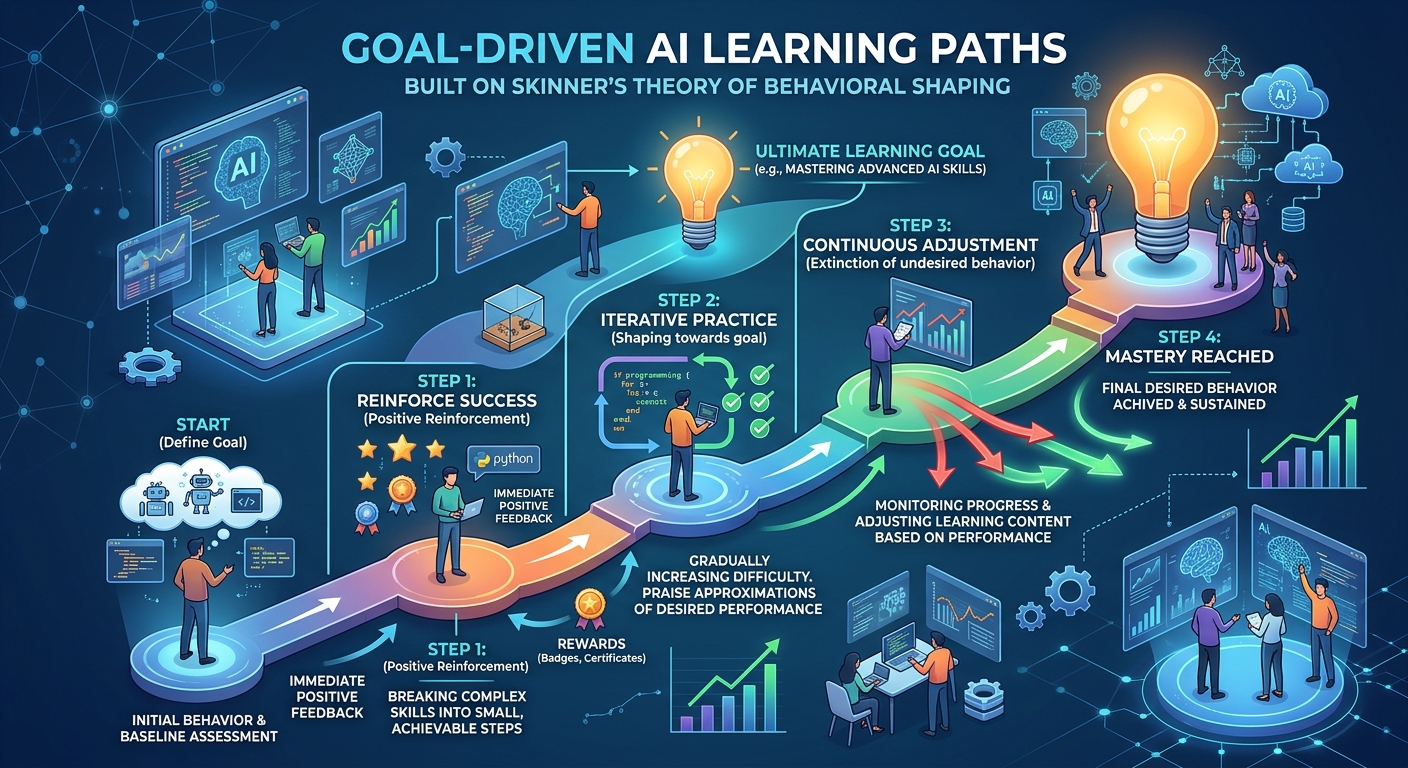
Goal-Driven AI Learning Paths Built on Skinner’s Theory of Behavioral Shaping
In today’s fast-paced corporate world, learning and development (L&D) leaders face a constant challenge: how to create training programs that are not only effective but also engaging, scalable, and measurable. Traditional, one-size-fits-all approaches often fall short, struggling to adapt to diverse learning styles, track nuanced skill development, or provide timely, relevant feedback. The demand for tangible ROI on training investments is higher than ever, pushing L&D departments to seek innovative solutions.
Enter the powerful synergy of artificial intelligence (AI) and a foundational principle of behavioral psychology: B.F. Skinner’s theory of behavioral shaping. By integrating AI into learning paths, L&D professionals can now design sophisticated training ecosystems that precisely guide learners towards desired outcomes, mirroring the meticulous process of shaping behavior through successive approximations and reinforcement. This isn’t just about automation; it’s about intelligent, adaptive instruction that drives measurable skill acquisition.
Reimagining Learning: The Behavioral Science Foundation
B.F. Skinner, a pioneer in behavioral psychology, introduced the concept of operant conditioning – learning through rewards and punishments. Central to this theory is “shaping,” a method used to establish a new behavior by reinforcing successive approximations of that behavior. Instead of waiting for a complex behavior to occur spontaneously, shaping involves rewarding small steps that move the individual closer to the ultimate goal.
Consider teaching a complex skill: you wouldn’t expect mastery overnight. Instead, you’d break it down, reward partial success, then gradually raise the bar, reinforcing increasingly accurate behaviors until the full skill is achieved. This systematic, feedback-driven approach is incredibly effective for developing new competencies, but it’s resource-intensive in traditional human-led training environments. This is precisely where AI revolutionizes the process.
AI as the Modern “Shaper”: Personalized & Adaptive Learning
Artificial intelligence provides the computational power and adaptability needed to implement Skinnerian shaping at scale, transforming how employees learn complex skills. AI-driven learning paths can dynamically respond to each learner’s progress, delivering the right content and challenges at the optimal time, much like a skilled trainer would adjust their approach to an individual.
Dynamic Goal Setting and Feedback
AI-powered platforms excel at tracking learner performance with granular detail, identifying specific strengths and weaknesses. This allows for the dynamic adjustment of learning goals and the immediate delivery of targeted feedback – the digital equivalent of positive reinforcement. If a learner struggles with a particular concept, the AI can provide additional resources or practice exercises. When a learner demonstrates mastery, they are promptly moved to the next level of complexity. This Adaptive Learning capability ensures that training is always relevant and never too easy or too difficult.
Shaping Complex Skills Incrementally
Just as shaping breaks down complex behaviors, AI facilitates this by delivering learning content in manageable, bite-sized units – often referred to as microlearning. An advanced Microlearning LMS can orchestrate these short, focused modules, ensuring that each step builds upon the last. For instance, instead of overwhelming a new sales representative with an entire product catalog, the AI might first reinforce understanding of core features, then pricing models, then objection handling, gradually shaping them into a proficient salesperson through reinforced success at each stage.
The Power of Reinforcement Scheduling
Skinner also explored different schedules of reinforcement, finding that intermittent reinforcement often leads to more persistent behavior. AI can replicate this by varying the challenge and reward structure within learning paths. Through sophisticated algorithms, an Gamified LMS can introduce elements like points, badges, leaderboards, and even adaptive quizzes that challenge learners just enough to keep them engaged without causing frustration. This intelligent scheduling of content and incentives maximizes engagement and long-term retention, preventing skill decay by reinforcing learning at optimal intervals.
Industry Applications: Where AI-Driven Behavioral Shaping Excels
The practical applications of AI-driven, goal-oriented learning are vast and impactful across numerous industries, offering L&D leaders a strategic advantage in developing high-performing teams.
- Healthcare & Pharma: For complex fields like healthcare, this approach ensures precise skill development. From Risk-focused Training in compliance and patient safety to advanced pharmaceutical sales training, and even online medical billing and coding training, AI guides healthcare professionals. It ensures critical adherence to protocols and elevates overall competence for healthcare academy training.
- Financial Services: In the high-stakes world of finance, precision and ethical conduct are paramount. AI-driven paths can be invaluable for american bankers association training, ensuring compliance and best practices. Similarly, an investment banking prep course can be tailored to individual needs, building complex analytical skills incrementally. It can also support continuous professional development, including specialized areas like personal training insurance for advisors.
- Retail & Hospitality: Enhancing customer experience is key. Training for retail, including retail staff training and training for retail employees, can leverage AI to shape customer service skills, sales techniques, and product knowledge, leading to measurable improvements in customer satisfaction and sales figures.
- Heavy Industry (Oil & Gas, Mining): In environments where safety and operational efficiency are critical, such as training for oil and gas and training for mining, AI-driven simulations and step-by-step procedural training can significantly reduce errors and improve safety outcomes. Learners are shaped through virtual practice until critical procedures become second nature.
The Modern LMS: Powering Behavioral Transformation
To effectively implement these AI-driven, goal-oriented learning paths, a robust learning management system (LMS) is not just beneficial; it’s essential. A modern LMS acts as the central nervous system for your training ecosystem, orchestrating content delivery, tracking progress, and enabling the adaptive capabilities of AI.
Solutions like MaxLearn LMS are at the forefront of this revolution, offering comprehensive learning management solutions that include advanced features. As an enterprise learning management solution, it seamlessly integrates the principles of behavioral shaping with cutting-edge AI. Whether you require a cloud based learning management system for global accessibility or a powerful learning content management system (LCMS) to author and manage your adaptive content, a sophisticated learning management software provides the infrastructure. A true lms learning management system should not only deliver courses but actively shape learner behavior towards defined organizational goals.
Unlocking Learning Potential: Your Questions Answered
L&D leaders frequently inquire about the practicalities of advanced AI in learning, seeking clarity on its reach and intelligence. Here’s a closer look at common questions:
How can intelligent systems transform corporate training programs?
By offering hyper-personalized content, real-time feedback, and dynamic progress tracking, intelligence-driven platforms move beyond one-size-fits-all approaches. They adapt to individual learning styles and paces, ensuring maximum engagement and retention. These systems can proactively identify knowledge gaps, suggest remedial modules, and challenge learners with increasing complexity, effectively mimicking a dedicated personal tutor for every employee.
Where do advanced learning technologies deliver the most significant impact globally?
From remote teams in vast enterprises to specialized training needs in diverse industries worldwide, these platforms break geographical barriers. They standardize quality while personalizing delivery, crucial for global compliance and skill development initiatives across various operational footprints. This global reach ensures consistent training quality, regardless of location or cultural context, fostering a unified and highly skilled workforce.
What cutting-edge capabilities do AI-powered learning systems offer L&D leaders?
Beyond basic tracking, these systems provide predictive analytics on learner performance, identify potential skill gaps before they become critical, and even auto-generate adaptive learning paths. This proactive intelligence empowers leaders to make data-driven decisions, optimize resource allocation, and foster a culture of continuous improvement, turning reactive training into strategic talent development.
The Path Forward: Smarter, More Effective Training
The integration of AI with Skinner’s theory of behavioral shaping represents a paradigm shift in corporate training. L&D leaders now have the tools to design learning paths that are not only efficient and scalable but profoundly effective at cultivating specific, desired behaviors and skills. This goal-driven approach leads to measurable improvements in performance, compliance, and overall employee competency, translating directly into a stronger bottom line and a more agile workforce.
By embracing these advanced learning management solutions, L&D professionals can move beyond merely delivering content to actively shaping expertise, ensuring their organizations are equipped with the skills needed to thrive in an ever-evolving market.
No responses yet