

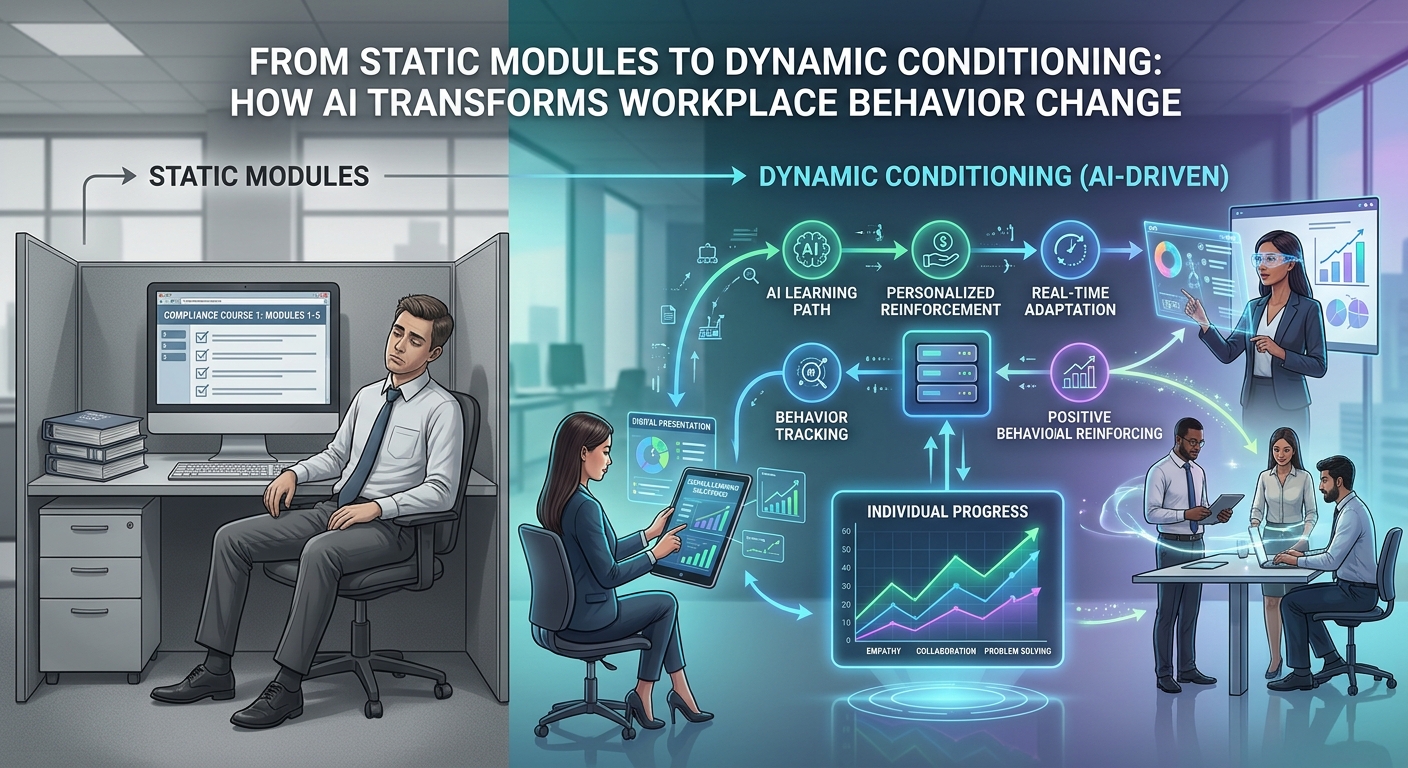
From Static Modules to Dynamic Conditioning: How AI Transforms Workplace Behavior Change
The modern workplace is a dynamic ecosystem, constantly reshaped by technological advancements, market shifts, and evolving employee expectations. For Vice Presidents, Directors, and Senior Managers of Learning & Development, the challenge of fostering consistent, effective behavior change has never been more pressing. Traditional, static training modules, while foundational, often fall short in delivering the agile, personalized conditioning required for today’s high-stakes environments. Enter Artificial Intelligence (AI) – a transformative force poised to redefine how organizations approach workplace learning, moving beyond passive consumption to active, dynamic behavior conditioning.
Imagine a training ecosystem that not only delivers content but also understands individual learning styles, predicts skill gaps, and adapts in real-time to reinforce desired behaviors. This isn’t a futuristic vision; it’s the present reality enabled by AI. From enhancing compliance in banking to optimizing sales techniques in pharmaceuticals, AI is unlocking unprecedented levels of effectiveness in behavior change initiatives across diverse industries.
The Evolution of Workplace Learning
For decades, corporate training has largely relied on standardized courses, often delivered through a Microlearning LMS or a comprehensive LMS. While these systems provided structure and accessibility, their inherent linearity often meant a one-size-fits-all approach that struggled to cater to the nuanced needs of individual learners.
The Limitations of “One-Size-Fits-All”
Static modules, while efficient for broad dissemination, often struggle with engagement and retention. Learners are passive recipients, and the connection between training content and real-world application can be tenuous. This is particularly true in complex fields like pharmaceutical sales training, training for oil and gas, or intricate online medical billing and coding training, where the depth of knowledge and behavioral nuance required is substantial. The result? Disengaged employees, knowledge fade, and ultimately, a limited impact on desired workplace behaviors.
AI: The Catalyst for Dynamic Conditioning
AI’s core strength lies in its ability to process vast amounts of data, identify patterns, and make intelligent decisions or recommendations. In the realm of L&D, this translates into a highly personalized, responsive, and ultimately more effective learning experience. It shifts the paradigm from simply delivering information to actively conditioning behavior.
Personalized Learning Paths
At its heart, AI allows for truly Adaptive Learning. Instead of a linear progression, an AI-powered learning management system can dynamically adjust content, pace, and format based on a learner’s prior knowledge, performance, and even emotional state. This ensures that every employee, whether undergoing training for retail employees or advanced investment banking prep course material, receives the most relevant and impactful instruction.
Real-time Feedback and Intervention
AI’s analytical capabilities extend to real-time performance monitoring. Imagine a system that can detect struggle points in a simulation or identify recurring errors in a training exercise. AI can then trigger immediate, targeted feedback or offer alternative learning modules, preventing bad habits from forming and reinforcing correct behaviors instantly. This is crucial for high-stakes compliance or safety-focused training.
Predictive Analytics for Proactive Training
Beyond reacting, AI can anticipate. By analyzing historical data, performance trends, and external factors, an enterprise learning management system can predict potential skill gaps or areas of behavioral risk before they become problematic. This allows L&D teams to implement proactive training interventions, ensuring a skilled and compliant workforce.
AI-Powered Solutions for Specific Industries
The versatility of AI-driven learning solutions makes them invaluable across a spectrum of industries, each with unique behavioral change requirements.
Financial Services
What’s the most efficient way to ensure global compliance across all banking sectors?
An AI-powered cloud based learning management system can personalize american bankers association training and compliance modules based on an employee’s role, region, and recent regulatory changes. It can simulate real-world scenarios, assess risk comprehension, and provide targeted reinforcement, drastically improving adherence to financial regulations and ethical conduct. For an investment banking prep course, AI can adapt to a candidate’s strengths and weaknesses in complex financial modeling.
Healthcare
How can we rapidly upskill clinical staff on emerging medical procedures or protocols?
For healthcare academy training and hospitals, an AI-driven learning management software can offer highly realistic simulations and virtual patient interactions. It can provide dynamic feedback on diagnostic accuracy, treatment plans, and patient communication skills, crucial for everything from online medical billing and coding training to advanced surgical prep.
Retail & Sales
How do we ensure consistent, high-quality customer service across thousands of retail locations?
AI can transform training for retail and retail staff training. An AI Powered Authoring Tool can generate sales scenarios, practice objection handling, and provide feedback on communication styles. For pharmaceutical sales training, AI can simulate physician interactions, product presentations, and competitive responses, honing sales team effectiveness and adherence to ethical guidelines.
Heavy Industry & Energy
What’s the most effective way to instill critical safety protocols in high-risk environments globally?
In sectors like training for oil and gas and training for mining, safety is paramount. AI-driven virtual reality (VR) and augmented reality (AR) simulations can place employees in realistic hazard scenarios, allowing them to practice emergency procedures and reinforce safe operating behaviors without actual risk. The AI continuously assesses decision-making and provides instant corrective feedback.
Insurance
How can AI personalize professional development for insurance agents handling diverse policy types?
For personal training insurance agents, AI can tailor learning paths based on their product specialties, client demographics, and regional regulations. It can present case studies, compliance modules, and soft skills training relevant to their specific roles, ensuring agents are always up-to-date and customer-focused.
The Mechanics of AI-Driven Behavior Change
The transformation from static content to dynamic conditioning hinges on several key AI capabilities:
- Intelligent Content Curation: AI analyzes vast content libraries to match learning resources with individual needs and learning objectives.
- Behavioral Analytics: AI tracks learner interactions, performance data, and decision-making patterns to understand underlying behaviors.
- Personalized Interventions: Based on analytics, AI delivers highly specific feedback, prompts, or additional resources designed to reinforce positive behaviors or correct undesirable ones.
- Reinforcement Learning: Through repeated, adaptive exposure to scenarios and challenges, AI helps learners internalize desired behaviors, making them second nature.
Microlearning and Gamification for Engagement
AI often works synergistically with modern learning methodologies. A Microlearning LMS combined with AI ensures bite-sized, relevant content is delivered precisely when needed. When integrated with a Gamified LMS, AI can create personalized challenges, leaderboards, and rewards that further motivate employees, making behavior conditioning an engaging and rewarding experience.
Data-Driven Insights for L&D Leaders
Beyond individual learners, AI provides L&D managers with unparalleled insights. A sophisticated learning content management system or LCMS powered by AI can offer comprehensive analytics on training effectiveness, identify organizational skill gaps, and even forecast future training needs. This empowers strategic decision-making and optimizes resource allocation.
Implementing AI in Your L&D Strategy
Choosing the Right Platform
The key to harnessing AI’s power is selecting the right technology partner. Look for a robust MaxLearn LMS or similar learning management solutions that offer AI capabilities for personalization, analytics, and content generation. Ensure it’s scalable, secure, and integrates seamlessly with your existing HR systems.
Overcoming Resistance and Embracing Innovation
Implementing AI requires a strategic shift. Communicate the benefits clearly to all stakeholders, from executives to front-line employees. Emphasize how AI enhances, rather than replaces, human intelligence and expertise. Focus on pilot programs to demonstrate tangible results and build internal champions.
Conclusion
The era of static, generic training modules is rapidly giving way to a new paradigm of dynamic, AI-driven behavior conditioning. For L&D leaders, this represents an unprecedented opportunity to cultivate a truly adaptive, skilled, and compliant workforce. By embracing AI in your learning management system, you’re not just investing in technology; you’re investing in a future where every employee’s potential is fully realized, and every organizational behavior is optimized for success. The journey from static modules to dynamic conditioning is not just an upgrade; it’s a fundamental transformation of workplace learning, driven by the intelligent power of AI.
No responses yet