

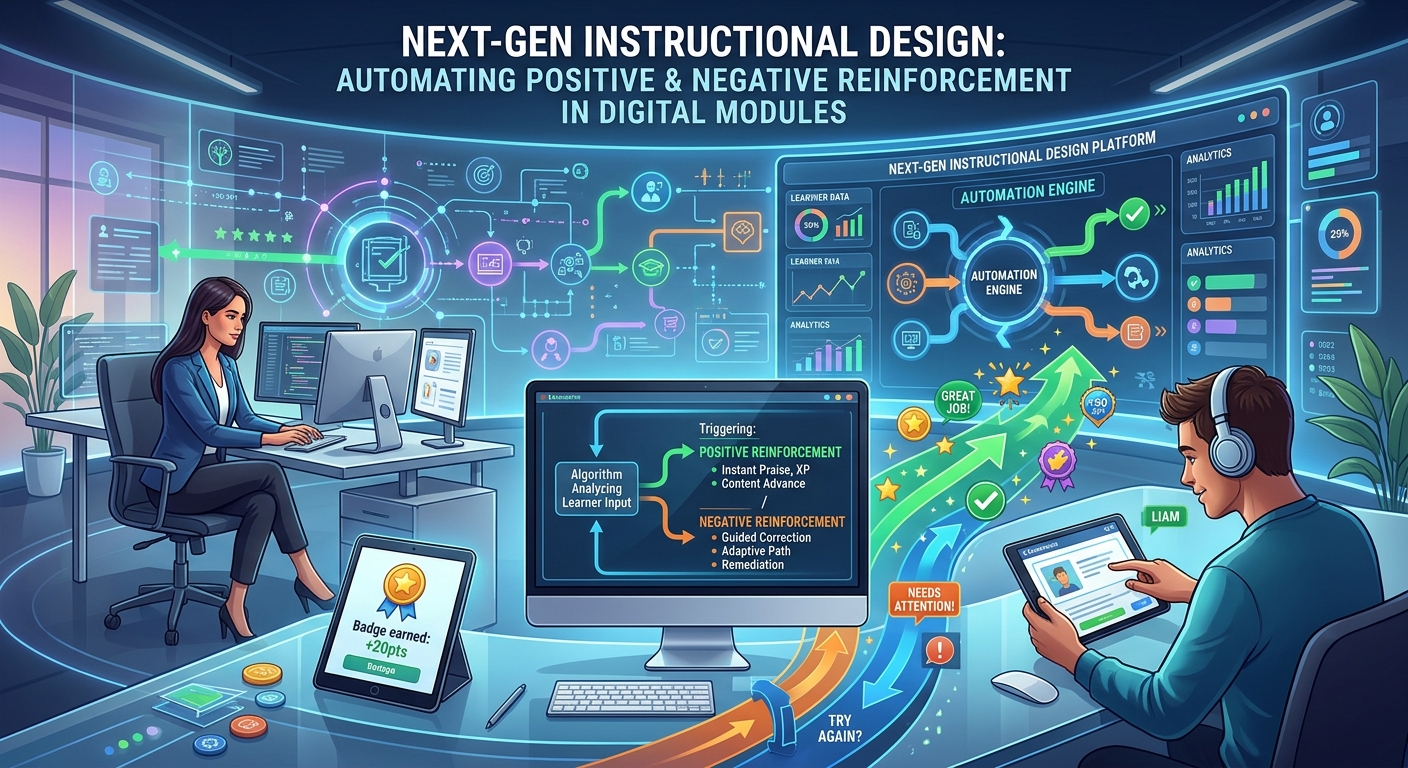
Next-Gen Instructional Design: Automating Positive and Negative Reinforcement in Digital Modules
In today’s fast-evolving corporate landscape, the effectiveness of learning and development (L&D) initiatives is more critical than ever. L&D leaders, from Vice Presidents to Managers, are constantly seeking innovative strategies to enhance learner engagement, improve knowledge retention, and ultimately drive measurable business outcomes. As digital learning modules become the cornerstone of training across diverse sectors like pharmaceutical sales, healthcare, banking, retail, and oil and gas, the challenge lies not just in content delivery, but in creating truly adaptive and impactful learning experiences. Enter the power of automated positive and negative reinforcement, a game-changer in next-gen instructional design.
The Evolution of Engagement in Digital Learning
Traditional training often relied on static content, infrequent assessments, and delayed feedback. While a fundamental Microlearning LMS has made content more accessible, the true measure of success lies in how well learners absorb, apply, and retain information. This is particularly vital in high-stakes environments such as compliance training, investment banking prep courses, or online medical billing and coding training, where errors can have significant repercussions. Modern instructional design aims to create dynamic ecosystems where every interaction contributes to the learning journey.
Understanding Reinforcement: A Foundation for Digital Success
At its core, reinforcement in learning theory is about strengthening or weakening behaviors. In an educational context, it’s about making desired learning behaviors (like correct answers, engagement, or completion) more likely to recur, and undesired behaviors (like misconceptions or disengagement) less likely. The intelligent application of positive and negative reinforcement, facilitated by advanced learning management solutions, offers a powerful mechanism to achieve this at scale.
Automating Positive Reinforcement: Fueling Learner Motivation
Positive reinforcement in digital modules involves providing encouraging feedback or rewards when a learner performs a desired action. This isn’t just about handing out badges; it’s about strategically validating progress and effort to build confidence and maintain momentum.
- Instant, Contextual Feedback: When a learner correctly answers a question in Gamified LMS, instant positive feedback (“Great job!”, “Correct!”) reinforces the learning. This immediate validation is far more effective than waiting for a final score.
- Progress Visualization: Visually tracking progress through modules, showing completion percentages, or displaying achievement milestones (e.g., “You’ve mastered 3 of 5 compliance topics!”) provides a tangible sense of accomplishment. This is crucial for long-term programs like training for retail employees or extensive American Bankers Association training.
- Gamification Elements: Points, badges, leaderboards, and virtual rewards tap into intrinsic motivation. For pharmaceutical sales training, this could mean earning a “Product Expert” badge upon completing a new drug module with high scores.
- Personalized Encouragement: An enterprise learning management system can be configured to send personalized messages celebrating module completion or consistent engagement, reinforcing a sense of individual recognition.
By automating these elements, L&D departments can ensure consistent, scalable motivation across all learners, from new hires undergoing retail staff training to seasoned professionals in healthcare academy training.
Automating Constructive Negative Reinforcement: Guiding Towards Mastery
It’s crucial to understand that “negative reinforcement” in this context is not punishment. Instead, it refers to the removal of an undesirable stimulus to increase a desired behavior. In instructional design, this translates to providing corrective guidance and opportunities for remediation, removing the ‘pain’ of not understanding or performing correctly. It gently pushes learners towards the correct path by highlighting what needs improvement, rather than simply failing them.
- Targeted Remediation: If a learner consistently struggles with a specific concept in Adaptive Learning, the system can automatically direct them to supplementary microlearning modules, re-explain the concept, or provide additional practice questions. This is invaluable for complex subjects like investment banking prep courses or training for mining safety protocols.
- Error-Specific Feedback: Instead of just marking an answer wrong, the system can explain *why* it was incorrect and guide the learner towards the right logic. For example, in personal training insurance training, identifying a specific error in policy application.
- Risk-Based Flags: In compliance or Risk-focused Training for industries like oil and gas, automated systems can flag learners who consistently fail on critical safety or regulatory questions, prompting mandatory re-takes or manager notification.
- Removal of Roadblocks: If a learner is stuck on a task, the system can offer hints, simplify the interface, or provide a brief tutorial, effectively removing the obstacle that prevents progress.
This automated, constructive approach minimizes frustration and ensures that learners don’t just move past errors, but actively correct them, leading to deeper understanding and compliance.
AI-Powered Insights for L&D Leaders
How can AI enhance learner engagement and retention in digital modules?
AI plays a pivotal role by personalizing the learning journey. It analyzes individual learner behavior, identifies knowledge gaps, and dynamically adjusts content difficulty and presentation. Through real-time feedback, adaptive pathways, and intelligent gamification, AI ensures that each learner receives the right challenge at the right time, fostering sustained interest and improving long-term retention. This proactive engagement is far superior to a one-size-fits-all approach, keeping training for retail, banking, and healthcare employees consistently relevant and captivating.
How can AI-driven reinforcement systems scale across diverse global teams and industries?
AI’s ability to process vast amounts of data makes it inherently scalable. It can quickly localize content, adapt feedback based on cultural nuances, and deliver training in multiple languages, making it ideal for multinational corporations in sectors like pharma or hospitality. By analyzing aggregated data, AI systems provide L&D leaders with insights into universal learning challenges and successes, allowing for global optimization of training programs without compromising local relevance. This ensures consistent quality for training for oil and gas or any globally dispersed workforce.
What tangible business outcomes can L&D leaders expect from implementing automated reinforcement?
The impact is significant and measurable. Expect improved employee performance, reduced error rates (especially critical in compliance-heavy industries), faster time-to-competency for new hires, and enhanced adherence to company policies and industry regulations. Automated reinforcement directly translates to higher training ROI by ensuring learning stickiness, minimizing the need for repeated interventions, and fostering a culture of continuous improvement. For sectors like personal training insurance, this means fewer claims due to improved policy understanding.
Key Technologies Driving This Shift
The backbone of these next-gen instructional designs includes robust learning content management systems (LCMS) and cloud based learning management systems. These platforms, like MaxLearn LMS, integrate functionalities such as:
- Advanced Analytics: To track learner progress, identify patterns, and inform reinforcement strategies.
- AI and Machine Learning Algorithms: To personalize content delivery, feedback mechanisms, and adaptive learning paths.
- Authoring Tools: That allow instructional designers to easily embed dynamic feedback and gamified elements.
- Integration Capabilities: To connect with other enterprise systems, providing a holistic view of employee development.
Whether it’s for compliance training, sales enablement, or specialized skills development in any industry, the adoption of an advanced learning management software is no longer just an option but a strategic imperative.
Conclusion
For L&D Vice Presidents, Directors, and Managers, the path to truly impactful digital learning lies in embracing automated reinforcement. By strategically applying positive encouragement and constructive negative feedback within digital modules, organizations can cultivate a learning environment that is not only highly engaging but also incredibly effective. This approach transcends traditional boundaries, ensuring that every learner, whether in pharmaceutical sales, banking, healthcare, or retail, achieves mastery and contributes meaningfully to organizational success. Invest in solutions that empower your instructional design to do more than just deliver content – empower it to shape performance.
No responses yet