

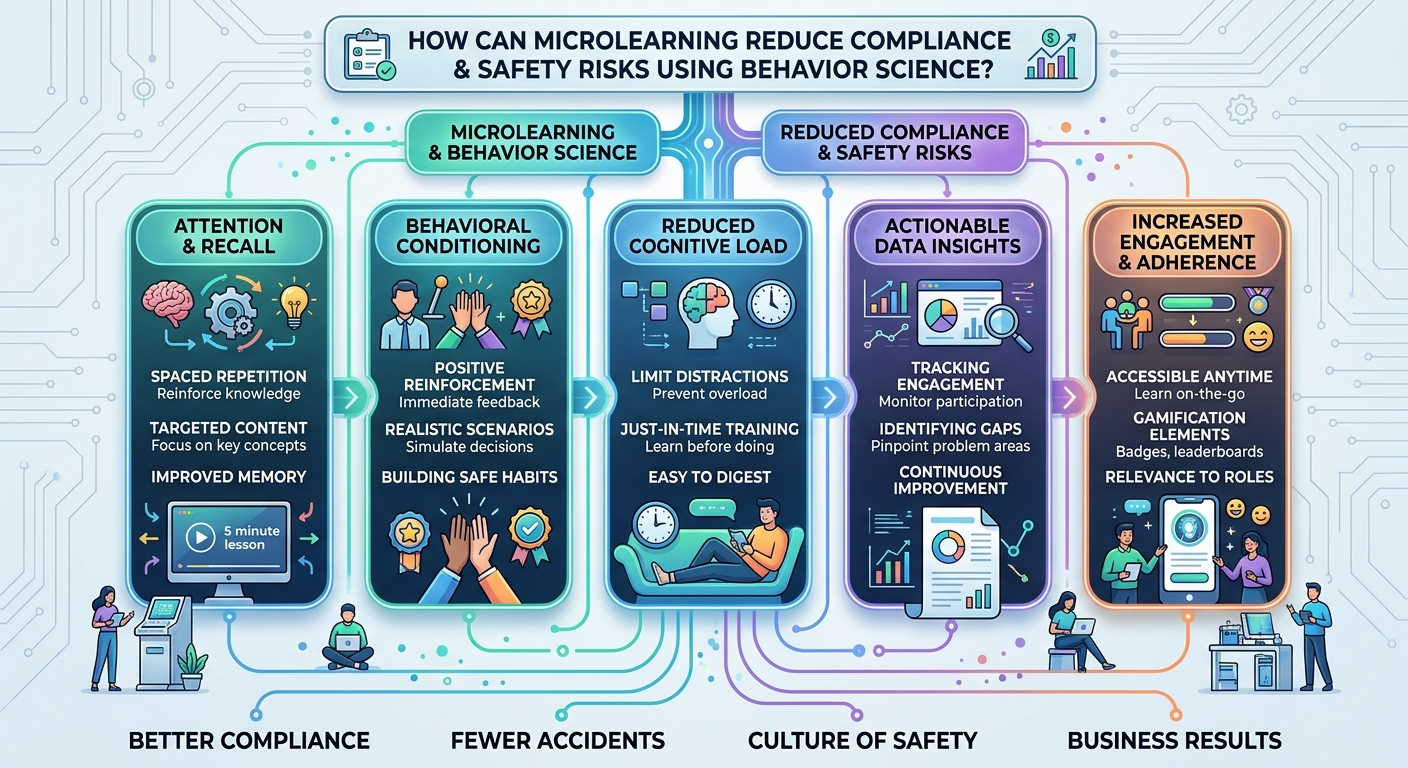
How Microlearning and Behavioral Science Transform Compliance and Safety Training
In today’s complex corporate landscape, compliance and safety are not just checkboxes to tick; they are cornerstones of operational integrity, risk mitigation, and brand reputation. For Vice Presidents, Directors, and Senior Managers in Learning & Development, the challenge lies in moving beyond rote memorization to fostering genuine behavioral change that sticks. This is where microlearning, powerfully amplified by behavior science, emerges as a game-changer.
Traditional, lengthy training sessions often fail to achieve lasting impact, leading to knowledge decay and an increased potential for risks. But what if training could be delivered in a way that aligns with how our brains actually learn and retain information, directly influencing daily actions and decisions? By leveraging the principles of behavior science, microlearning offers a dynamic, efficient, and highly effective pathway to significantly reduce compliance and safety risks across diverse industries, from pharmaceutical sales training to complex operations in oil and gas.
The Evolving Landscape of Risk and Training Imperatives
Organizations face an ever-growing array of risks – regulatory non-compliance, workplace accidents, data breaches, ethical lapses – each carrying hefty financial, legal, and reputational consequences. Whether it’s ensuring adherence to stringent financial regulations for the American Bankers Association training, navigating patient safety protocols in healthcare academy training, or embedding critical safety procedures for training for mining and training for oil and gas operations, effective training is paramount.
The traditional “sheep dip” approach – infrequent, long-form training – often falls short. Employees might complete the modules, but real-world application and retention suffer. This gap directly translates into elevated risk. L&D leaders are actively seeking solutions that deliver measurable results, demonstrating a clear ROI on their training investments by directly impacting employee behavior and reducing incidents.
Microlearning: A Precision Tool for Modern Learning
Microlearning, at its core, is about delivering learning content in short, focused bursts – typically 2-10 minutes in duration. These bite-sized modules can take many forms: short videos, interactive quizzes, infographics, quick simulations, or brief scenario-based challenges. This approach addresses several critical limitations of traditional training:
- Attention Spans: Aligns with diminishing adult attention spans, making learning more digestible and engaging.
- Flexibility: Enables learning “on the go” and “just in time,” fitting seamlessly into busy work schedules.
- Retention: Facilitates better retention through spaced repetition and immediate application.
- Engagement: Higher completion rates and greater learner satisfaction due to its convenient and interactive nature.
An advanced Microlearning LMS provides the ideal platform for deploying and managing this type of content, offering a robust learning management software infrastructure. Features like a Gamified LMS can further boost engagement, turning compliance requirements into achievable challenges.
Behavior Science: The Engine Behind Lasting Change
The true power of microlearning in risk reduction comes alive when it is intentionally designed using principles from behavior science. This field studies why people do what they do, offering insights into how to subtly influence decisions and habits. Key behavioral science principles applicable to training include:
- Nudge Theory: Small, subtle interventions that guide individuals towards desired behaviors without coercion. For example, a quick pop-up reminder before a critical task in online medical billing and coding training.
- Spaced Repetition: Presenting information at increasing intervals to reinforce memory and combat the forgetting curve. An Adaptive Learning system excels at this, tailoring content delivery based on individual performance.
- Immediate Feedback: Providing instant responses to actions or choices, reinforcing correct behaviors and correcting errors in real-time. This is crucial for high-stakes scenarios like personal training insurance claims or investment banking prep course ethics.
- Social Learning & Norms: Highlighting positive behaviors of peers to encourage others. A learning management system with social features can facilitate this.
- Goal Setting & Progress Tracking: Giving learners clear objectives and showing their progress to foster a sense of achievement and motivation.
- Cognitive Load Theory: Designing content to avoid overwhelming the learner, ensuring that each microlearning module focuses on one key concept at a time.
By integrating these principles, microlearning transforms from simple content delivery into a strategic intervention designed to shape safer and more compliant behaviors.
Synergistic Impact: Microlearning + Behavior Science in Action
Reducing Compliance Risks:
- Financial Services (Banking, Investment Banking, Insurance): For American Bankers Association training or investment banking prep course, microlearning can deliver daily refreshers on regulatory updates (e.g., AML, KYC, data privacy). Short, interactive scenarios can test understanding of ethical dilemmas, providing immediate feedback based on behavioral science. This continuous reinforcement helps embed compliance into daily routines, reducing instances of non-adherence and financial penalties.
- Pharmaceutical & Healthcare: Pharmaceutical sales training often involves complex drug information and regulatory guidelines. Microlearning can break down these topics into digestible modules, reinforced by quizzes and case studies. For healthcare academy training and online medical billing and coding training, behaviorally-informed micro-simulations can train staff on proper data handling, patient confidentiality (HIPAA), and billing codes, reducing errors and ensuring compliance.
- Retail: For training for retail employees or retail staff training, microlearning can cover topics like anti-theft procedures, data security for POS systems, and ethical sales practices. Short bursts of content followed by quick quizzes can reinforce correct procedures, minimizing instances of loss or non-compliance.
Enhancing Safety Risks:
- Oil and Gas & Mining: Industries like training for oil and gas and training for mining involve inherently high safety risks. Microlearning can deliver daily or weekly safety tips, equipment checks, and emergency procedure refreshers. Short videos demonstrating correct lockout/tagout procedures or emergency evacuation routes, reinforced by immediate feedback, can significantly reduce accidents and improve response times. Behavior science principles ensure these safety messages are delivered at optimal times for maximum impact and retention. This is an excellent example of Risk-focused Training.
- Healthcare: Patient safety is paramount. Microlearning can train staff on sterile procedures, medication administration, fall prevention, or new equipment protocols. Behaviorally designed modules using immediate feedback and spaced repetition help ensure critical safety steps are consistently followed, reducing medical errors and improving patient outcomes.
- Hospitality: From food safety to emergency preparedness, microlearning can equip hospitality staff with essential safety knowledge. Quick visual guides on proper hygiene, fire extinguisher usage, or handling guest complaints can be reinforced daily, improving overall safety standards.
AI’s Role in Optimizing Behavioral Microlearning
The integration of artificial intelligence further amplifies the effectiveness of behaviorally-informed microlearning, taking personalization and efficiency to new heights.
Question: How can intelligent systems personalize the learning journey for compliance and safety training?
Answer: AI within an enterprise learning management system can analyze a learner’s performance, past behaviors, and job role to create truly adaptive learning paths. For instance, an AI-powered cloud based learning management system can identify areas where an individual in sales training for retail consistently struggles with ethical guidelines and then automatically push targeted microlearning modules and quizzes to reinforce those specific concepts. This ensures each learner receives the most relevant content when they need it most, optimizing their learning curve and enhancing their behavioral change.
Question: Can advanced analytics from learning platforms predict and prevent compliance breaches or safety incidents?
Answer: Yes, learning management solutions equipped with AI can track engagement, completion rates, and performance data across various microlearning modules. By identifying patterns – for example, a recurring error in a specific safety protocol quiz across a particular department, or low engagement with anti-money laundering modules in a finance team – AI can flag potential risk areas. This proactive insight allows L&D leaders to intervene with targeted training or support before a compliance breach or safety incident occurs, effectively turning training data into predictive risk management.
Implementing a Strategic Microlearning LMS
To successfully leverage microlearning and behavior science, a robust LMS or MaxLearn LMS is indispensable. Such a system should offer:
- Content Authoring Tools: For easily creating and updating microlearning modules.
- Analytics and Reporting: To track completion, performance, and identify areas of risk.
- Personalization and Adaptive Pathways: To deliver tailored learning experiences.
- Mobile Accessibility: To ensure “anytime, anywhere” learning.
- Integration Capabilities: With other HR or operational systems.
A comprehensive learning content management system (LCMS) ensures that your microlearning assets are organized, easily deployable, and consistently updated to reflect evolving regulations and best practices.
Conclusion: Empowering a Safer, More Compliant Workforce
For L&D leaders, the integration of microlearning with behavior science offers a powerful strategic advantage. It moves training from a reactive necessity to a proactive, risk-reduction engine. By providing employees with timely, relevant, and engaging learning experiences that are designed to influence behavior, organizations can significantly reduce compliance violations, enhance workplace safety, and foster a culture of continuous improvement.
Embracing this modern approach means not only meeting regulatory requirements but exceeding them, safeguarding your organization’s most valuable assets – its people and its reputation. The time to transform your compliance and safety training is now, by adopting an intelligent, behaviorally-informed microlearning strategy.
No responses yet