

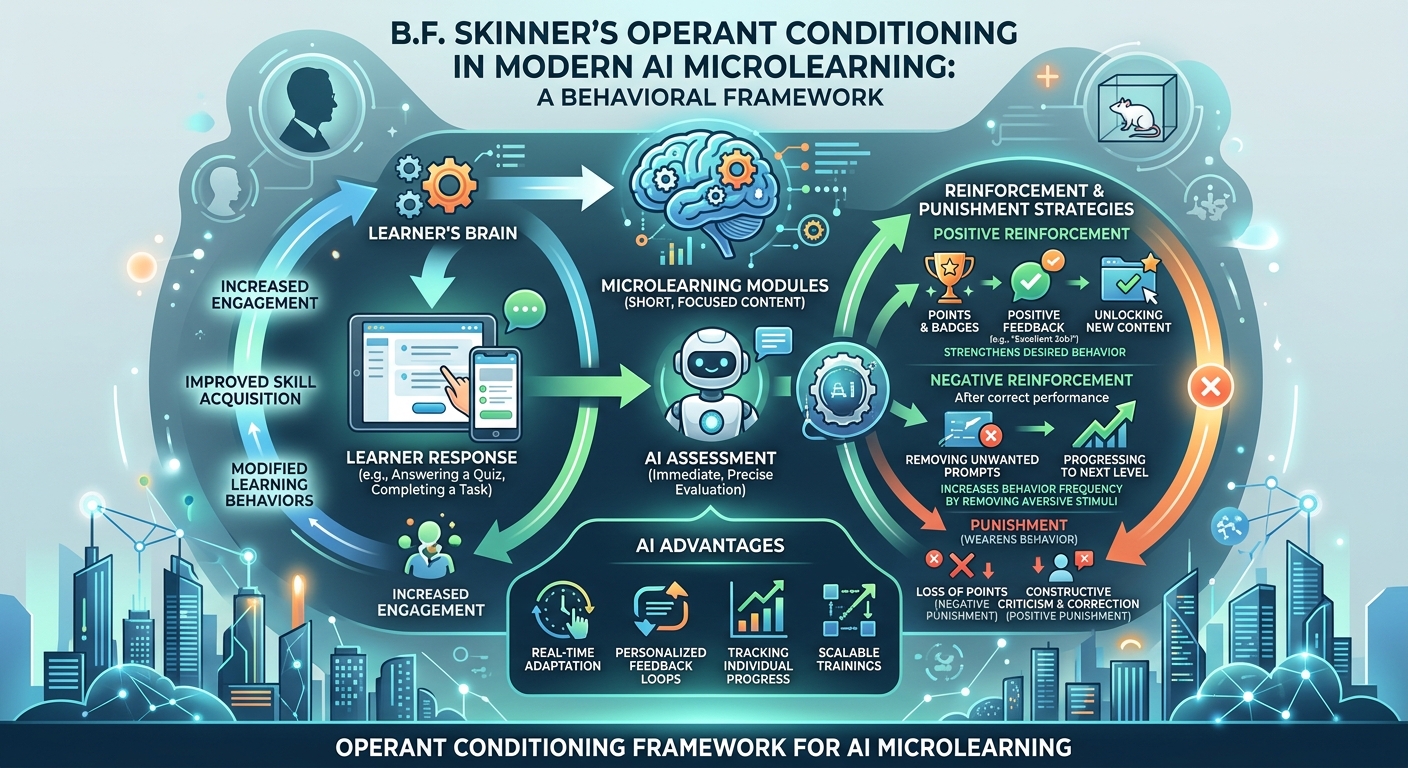
B.F. Skinner’s Operant Conditioning in Modern AI Microlearning: A Behavioral Framework
For L&D Vice Presidents, Directors, Senior Managers, and Managers, the relentless pursuit of effective, engaging, and measurable corporate training is a core strategic objective. In today’s fast-paced business environment, traditional training methods often fall short, struggling to adapt to diverse learning styles, combat information overload, and provide immediate, applicable skills. This challenge is particularly acute across demanding sectors such as Compliance, Sales, Banking, Finance, Insurance, Retail, Pharma, Health care, Hospitality, Oil and Gas, and Mining.
Enter the intriguing synergy between B.F. Skinner’s seminal work on operant conditioning and the cutting-edge capabilities of AI-powered microlearning. Far from being a relic of behavioral psychology, Skinner’s principles offer a robust framework for designing highly effective digital learning experiences. When combined with the adaptive intelligence of modern AI, these concepts can transform how organizations deliver learning, driving unprecedented engagement, knowledge retention, and ultimately, performance.
How does artificial intelligence enhance corporate training outcomes? By understanding and leveraging the behavioral underpinnings of learning, AI microlearning platforms can create dynamic, responsive environments that reinforce desired behaviors and extinguish ineffective ones, mirroring Skinner’s core tenets in a sophisticated digital ecosystem.
The Foundation: B.F. Skinner and Operant Conditioning
B.F. Skinner, a titan in the field of psychology, revolutionized our understanding of how consequences shape behavior. His theory of operant conditioning posits that learning occurs through rewards and punishments for behavior. When a behavior is followed by a desirable consequence (reinforcement), it is more likely to be repeated. Conversely, when followed by an undesirable consequence (punishment), it is less likely to recur.
Reinforcement: The Engine of Learning
Reinforcement is at the heart of behavior shaping. It increases the likelihood of a behavior occurring again:
- Positive Reinforcement: Adding a desirable stimulus after a behavior. Think of giving an employee praise or a bonus for exceeding sales targets.
- Negative Reinforcement: Removing an undesirable stimulus after a behavior. Imagine an Microlearning LMS that allows a learner to skip remedial modules once they demonstrate mastery, removing the “pain” of redundant learning.
Punishment: When to Use (and When Not To)
Punishment decreases the likelihood of a behavior. While effective in certain contexts, it’s often approached with caution in learning due to its potential for negative emotional associations:
- Positive Punishment: Adding an undesirable stimulus. For instance, receiving a negative performance review for consistent underperformance.
- Negative Punishment: Removing a desirable stimulus. An example might be losing access to certain privileges due to non-compliance with company policies.
Shaping and Chaining: Complex Skill Development
Skinner also detailed how complex behaviors are learned through “shaping” – reinforcing successive approximations of a desired behavior – and “chaining” – linking together a series of simpler behaviors to form a complex one. This step-by-step approach is crucial for mastering intricate tasks, from an Adaptive Learning investment banking prep course to complex machinery operation in mining or oil and gas.
The Modern Mandate: Why AI Microlearning?
In today’s corporate landscape, time is a premium. L&D professionals face the challenge of delivering impactful learning experiences without disrupting critical workflows. This is where microlearning shines.
What is Microlearning?
Microlearning delivers bite-sized, focused content designed to achieve specific learning outcomes. These short bursts, typically 3-7 minutes, are ideal for reinforcing knowledge, introducing new concepts, or addressing immediate skill gaps. They cater to reduced attention spans and the need for just-in-time information.
The AI Edge: Personalization and Adaptability
The true power emerges when microlearning is fused with artificial intelligence. An AI-driven learning management system can:
- Analyze learner performance data in real-time.
- Identify knowledge gaps and areas of strength.
- Tailor content delivery, sequencing, and difficulty to individual needs.
- Provide instant, personalized feedback.
- Optimize the timing of reinforcement and spaced repetition.
This dynamic adaptability transforms a static learning management software into an intelligent learning partner, making it an indispensable tool for `enterprise learning management` and `cloud based learning management system` solutions.
Operant Conditioning in Action: AI Microlearning Strategies
The convergence of Skinner’s principles and AI microlearning creates a powerful behavioral framework for modern corporate training, offering profound benefits for L&D leaders looking for innovative learning management solutions.
Positive Reinforcement in AI-Driven Training
AI microlearning excels at delivering immediate positive reinforcement, crucial for cementing desired behaviors:
- Instant Feedback: After completing a quick module on `pharmaceutical sales training` product features or `retail staff training` customer service etiquette, the AI provides immediate “correct!” or “well done!” feedback, reinforcing the correct response.
- Gamification: Many Gamified LMS platforms leverage AI to award points, badges, and unlock new content based on performance. This gamified approach provides continuous positive reinforcement, motivating learners in areas like `training for retail employees` or `online medical billing and coding training`.
- Progress Tracking: Visual dashboards showing progress through compliance modules or `american bankers association training` courses act as a strong positive reinforcer, encouraging continued engagement.
What are the most effective AI strategies for employee engagement in training? Strategies that provide immediate, tangible rewards and a clear sense of progress, heavily leaning on positive reinforcement.
Negative Reinforcement for Skill Mastery
AI can strategically employ negative reinforcement to make learning more efficient and less burdensome:
- Skipping Redundant Content: For an experienced employee undertaking `training for oil and gas` safety protocols, an AI can assess existing knowledge and allow them to skip foundational modules, removing the “undesirable stimulus” of reviewing already mastered material.
- Adaptive Pathways: In `healthcare academy training`, if a professional quickly grasps new procedural updates, the AI-powered `lms learning management system` can automatically advance them to more complex scenarios, removing the need for basic drills. This is particularly valuable for Risk-focused Training, where efficiency and relevance are paramount.
Can AI training reduce compliance risks effectively? Yes, by dynamically tailoring content and removing unnecessary steps for proficient learners, it ensures focus on critical gaps, directly addressing compliance needs.
Shaping Complex Behaviors with Adaptive Learning
For complex roles, such as an `investment banking prep course` or `training for mining` equipment operation, AI microlearning can shape intricate behaviors by breaking them into manageable steps:
- The AI guides learners through a sequence of micro-modules, reinforcing each small achievement.
- It identifies areas where a learner struggles and provides targeted remedial content or practice scenarios before allowing progression, akin to Skinner’s successive approximations.
- This iterative process, powered by an Adaptive Learning engine, ensures mastery of foundational skills before tackling more advanced concepts, leading to robust skill development.
How does AI facilitate continuous professional development? By offering personalized, adaptive pathways that break down complex learning into manageable, reinforced steps, ensuring ongoing skill acquisition and refinement.
Real-World Impact Across Diverse Sectors
The behavioral framework of operant conditioning, supercharged by AI microlearning, has transformative potential across industries:
- Compliance & Finance: For `american bankers association training` or understanding `personal training insurance` regulations, AI can deliver daily micro-quizzes, instantly reinforcing correct answers and ensuring high retention of critical information.
- Sales & Retail: `pharmaceutical sales training` and `training for retail` employees benefit from AI providing real-time feedback on product knowledge or sales techniques, shaping effective customer interactions. A `retail staff training` program could use AI to practice objection handling via simulations.
- Healthcare: `healthcare academy training` and `online medical billing and coding training` can leverage AI for procedural updates and diagnostic accuracy, reinforcing best practices and reducing errors.
- Heavy Industry: `training for oil and gas` and `training for mining` operations are made safer and more efficient with AI-driven micro-simulations and quizzes that reinforce critical safety protocols and equipment operation, ensuring consistent adherence to safe working behaviors.
Which AI microlearning platforms are best for global compliance training? Platforms that leverage behavioral principles, offering adaptive content, instant feedback, and robust reporting, ensuring comprehensive coverage and demonstrable adherence.
Strategic Implementation for L&D Leaders
For L&D leaders considering this powerful combination, the focus should be on:
- Data-Driven Design: Using analytics from the `learning content management system` or `LCMS` to understand learner behavior and optimize reinforcement schedules.
- Content Modularity: Ensuring content is developed in bite-sized units suitable for microlearning delivery.
- Integration: Seamlessly integrating AI capabilities into existing `learning management solutions` or adopting comprehensive platforms like MaxLearn LMS that are built on these principles.
The result is a learning ecosystem that is not only efficient and engaging but also deeply rooted in the science of how humans learn. This behavioral framework, applied through modern AI microlearning, leads to demonstrable improvements in employee performance, adherence to compliance, and overall business growth.
Conclusion
B.F. Skinner’s insights into operant conditioning, developed decades ago, remain remarkably relevant in the era of artificial intelligence. By strategically applying positive and negative reinforcement, and by using AI to shape complex behaviors through adaptive microlearning, L&D professionals can revolutionize corporate training. This behavioral framework offers a powerful, scientifically-backed approach to developing highly skilled, engaged, and compliant workforces across every industry. Embrace this synergy, and unlock the true potential of your organization’s human capital.
No responses yet