

Optimizing L&D: Connecting Operant Conditioning, Spaced Repetition, and Adaptive Learning in an LMS
In today’s dynamic corporate landscape, learning and development (L&D) leaders face the ongoing challenge of creating training programs that are not only comprehensive but also highly effective and engaging. From ensuring compliance across global operations to upskilling sales teams for evolving markets, the demand for measurable learning outcomes is paramount. The good news is that advancements in educational psychology, combined with cutting-edge technology, offer powerful solutions. This article explores how the foundational principles of operant conditioning, the proven efficacy of spaced repetition, and the personalized power of adaptive learning can converge within a sophisticated Microlearning LMS to transform corporate training.
The Foundations of Effective Learning
Operant Conditioning: Reinforcing Desired Behaviors
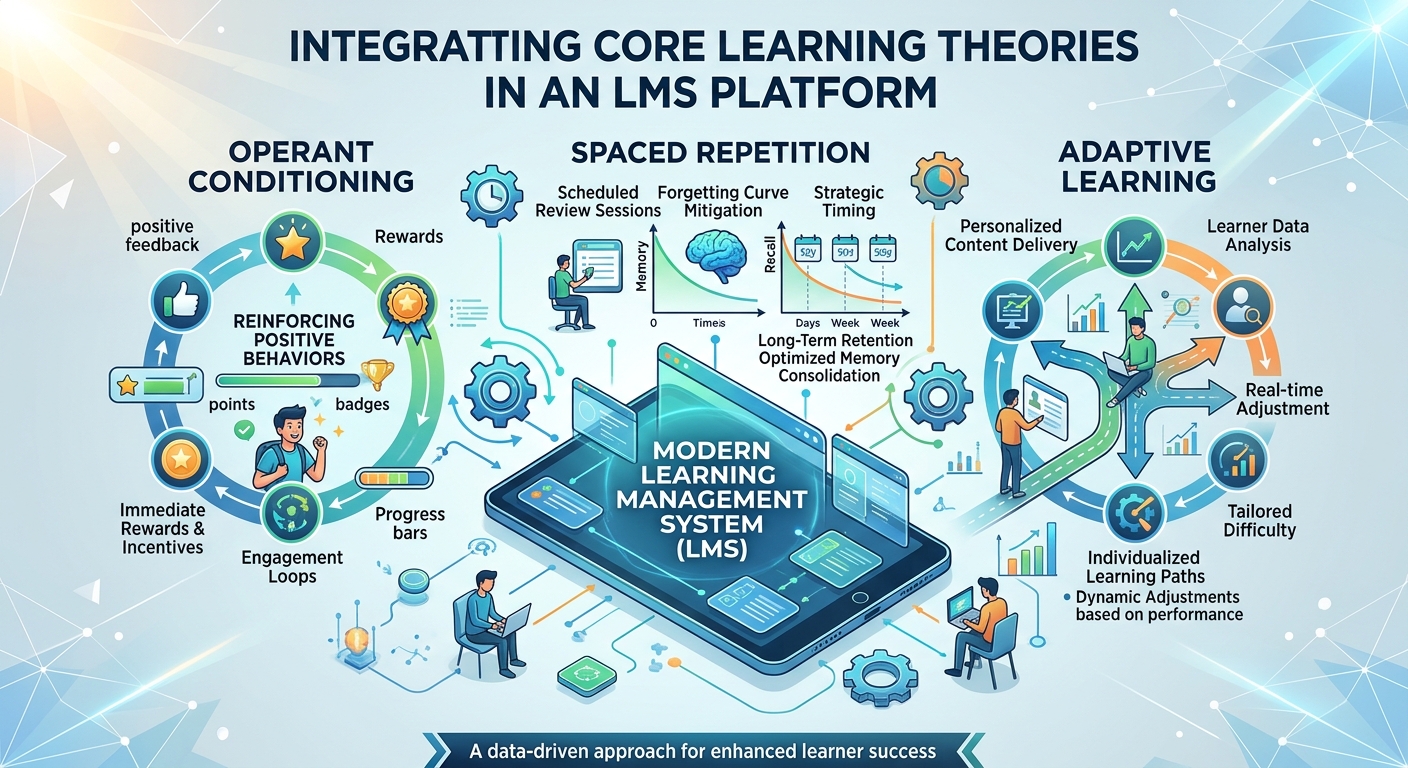
B.F. Skinner’s work on operant conditioning highlights how learning occurs through rewards and punishments for behavior. In the context of corporate training, this translates to designing learning experiences that reinforce correct actions and provide immediate, constructive feedback. For L&D professionals, this means:
- Positive Reinforcement: Celebrating progress, issuing badges or points, and acknowledging successful completion of modules can motivate learners. A Gamified LMS inherently leverages these principles to encourage participation and persistence.
- Immediate Feedback: Providing instant feedback on quizzes or simulations helps learners understand their mistakes and correct them promptly, preventing the reinforcement of incorrect knowledge.
- Shaping Behavior: Breaking complex topics into smaller, manageable chunks allows learners to master foundational concepts before moving to advanced ones, gradually shaping their expertise. This is particularly effective in areas like pharmaceutical sales training or american bankers association training where precision and compliance are critical.
An advanced learning management system (LMS) can integrate these elements by tracking user performance, automating rewards, and providing tailored feedback pathways.
Spaced Repetition: Defeating the Forgetting Curve
Developed from the research of Hermann Ebbinghaus on the “forgetting curve,” spaced repetition is a powerful technique where learners revisit material at increasing intervals. This method significantly enhances long-term retention by challenging the brain just before it forgets information. For L&D, integrating spaced repetition into an LMS means:
- Automated Reminders: The system can prompt learners to review specific content, take short quizzes, or engage in practice scenarios at optimal intervals based on their previous performance.
- Targeted Review: Instead of re-reading entire modules, learners focus only on the information they struggled with, making review sessions efficient and impactful. This is crucial for high-stakes training like training for oil and gas safety protocols or online medical billing and coding training, where information accuracy is paramount.
- Micro-Learning Segments: Spaced repetition works best with digestible content. Combining it with microlearning ensures that review sessions are quick and minimally disruptive to daily work schedules.
Adaptive Learning: The Personalized Path to Mastery
Adaptive learning takes personalization to the next level. Instead of a one-size-fits-all approach, an adaptive system tailors the learning path, content, and pace to each individual’s needs, strengths, and weaknesses. This is where the true power of a modern learning management system shines:
- Dynamic Content Delivery: The LMS assesses a learner’s prior knowledge and performance, then delivers content that is most relevant, skipping what they already know and focusing on areas requiring improvement.
- Personalized Pathways: For roles like training for retail employees or those undertaking an investment banking prep course, adaptive learning can create unique journeys that address specific skill gaps, ensuring everyone reaches proficiency.
- Efficiency and Engagement: Learners stay engaged because the content is always relevant and challenging, never too easy or too difficult. This also makes the learning process more efficient, reducing time-to-competency.
The Synergy: How an LMS Unifies These Principles
A modern cloud based learning management system acts as the central hub, bringing these three powerful concepts together. It allows L&D teams to design, deliver, and manage complex training programs that are inherently more effective:
- Data-Driven Insights: An enterprise learning management solution collects vast amounts of data on learner performance. This data fuels the adaptive engine, informs spaced repetition schedules, and identifies areas for reinforcement.
- Integrated Design: With a robust learning content management system (LCMS), content can be tagged for operant conditioning (e.g., specific feedback points), spaced repetition (e.g., recall questions), and adaptive delivery (e.g., prerequisite modules).
- Seamless Experience: For the learner, these sophisticated mechanisms operate in the background, creating a seemingly effortless and highly personalized learning journey that continuously challenges and supports them.
Leveraging AI for Predictive and Personalized L&D
Artificial Intelligence (AI) elevates the integration of operant conditioning, spaced repetition, and adaptive learning to unprecedented levels. AI capabilities within an LMS can predict learning needs, personalize content delivery, and optimize training effectiveness across diverse industries, from healthcare academy training to training for mining.
How can intelligent learning platforms predict individual mastery and knowledge gaps?
AI algorithms analyze a learner’s interactions, performance on assessments, time spent on topics, and even confidence levels. By cross-referencing this data with historical patterns and course objectives, the system can accurately predict areas where a learner might struggle or excel. This predictive power allows the lms learning management system to proactively offer supplementary materials, suggest different learning paths, or recommend targeted review sessions via spaced repetition. An AI Powered Authoring Tool can further assist in creating content that is highly tailored and responsive to these predicted needs.
What are the most effective strategies for ensuring high retention in compliance and skill-based training?
Beyond traditional methods, AI-driven systems enhance retention by dynamically adjusting the learning experience. For instance, in crucial areas like personal training insurance compliance or retail staff training on new product lines, AI ensures that complex topics are revisited until mastery is achieved. This includes varying the format of review questions, presenting real-world scenarios, and providing “booster” micro-lessons based on forgetting curve predictions. The system also tracks long-term retention, alerting L&D when refreshers are needed, ensuring sustained competence.
How do regional training requirements impact the design and delivery of global learning initiatives?
Global enterprises face the challenge of localizing training for diverse cultures, regulations, and languages. AI in a learning management software can streamline this process. It can identify which content elements need translation or adaptation, suggest culturally appropriate examples, and even analyze regional performance data to highlight disparities. This ensures that a global sales team, for instance, receives relevant training for retail scenarios while adhering to local market nuances. An adaptive system can present region-specific modules, ensuring compliance and engagement without creating an overwhelming amount of content.
Choosing the Right Learning Management System
For L&D leaders looking to implement these sophisticated strategies, selecting the right learning management solutions is critical. Look for a system that offers:
- Robust adaptive learning capabilities.
- Built-in spaced repetition functionality.
- Gamification and strong feedback mechanisms for operant conditioning.
- Powerful analytics for data-driven insights.
- An intuitive user interface for both learners and administrators.
- Scalability as an enterprise learning management platform.
Platforms like MaxLearn LMS exemplify how a comprehensive learning management system can weave together these psychological principles and technological advancements to deliver highly effective corporate training.
Conclusion
The convergence of operant conditioning, spaced repetition, and adaptive learning within an advanced LMS represents the future of corporate L&D. By leveraging these powerful psychological principles, augmented by AI, L&D leaders can move beyond traditional, passive training models to create engaging, personalized, and highly effective learning experiences. This approach not only boosts knowledge retention and skill development across industries but also delivers measurable ROI, transforming your workforce into a continuously learning and evolving asset.
No responses yet