

The Psychology of Badges, Points, and Leaderboards: An Operant Conditioning Framework for L&D
In the dynamic landscape of corporate learning and development, engaging adult learners across diverse industries—from Risk-focused Training in banking to complex pharmaceutical sales training—presents a persistent challenge. Vice Presidents, Directors, and Senior Managers of L&D are constantly seeking innovative strategies to boost participation, retention, and ultimately, performance. Enter gamification: the integration of game-like elements into non-game contexts. While often seen as a modern buzzword, the efficacy of badges, points, and leaderboards is deeply rooted in established psychological principles, primarily operant conditioning. Understanding this framework is key to transforming your learning management system (LMS) into a powerful engine for behavior change and skill acquisition.
The Foundation: Operant Conditioning Explained
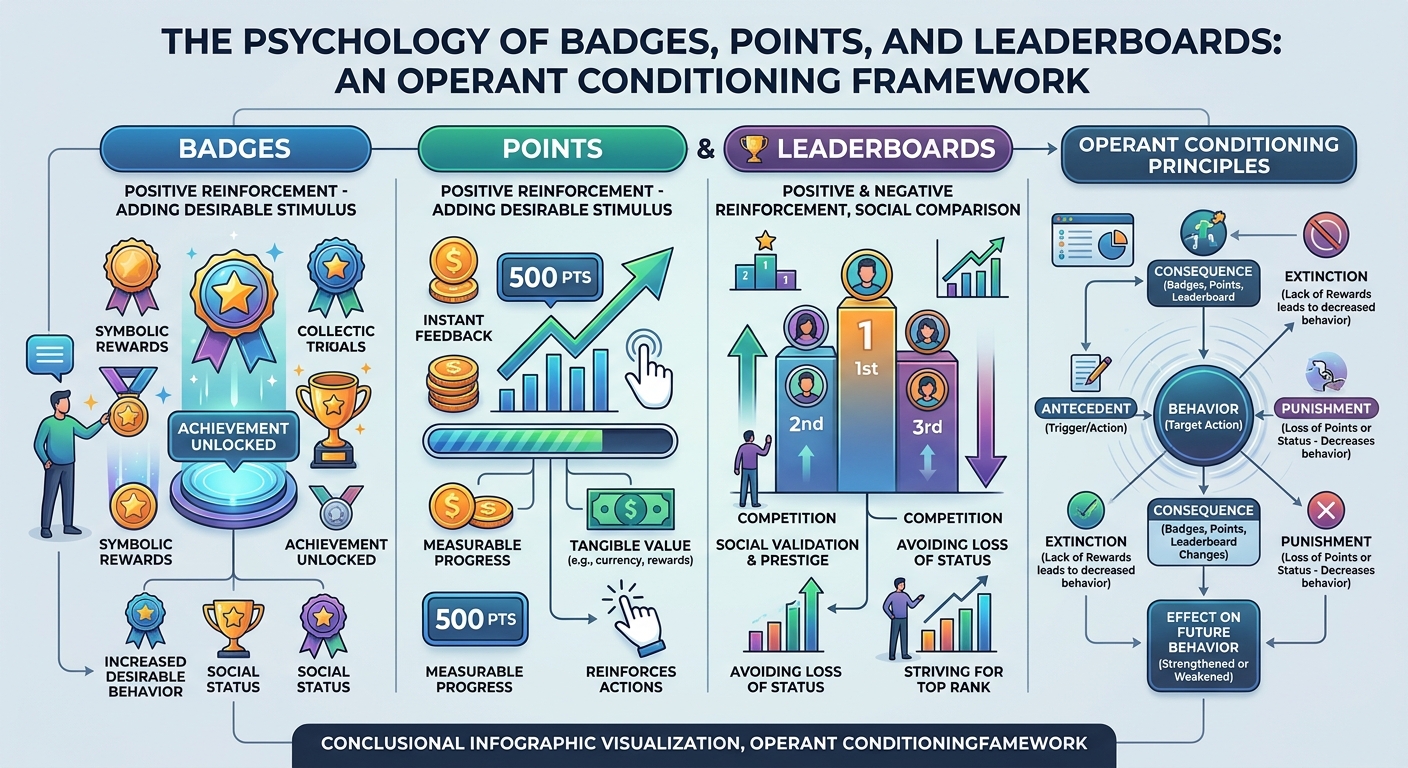
At its core, operant conditioning, a concept championed by B.F. Skinner, suggests that learning occurs through rewards and punishments for behavior. When a desirable behavior is followed by a reward (reinforcement), that behavior is more likely to be repeated. Conversely, behaviors followed by unpleasant consequences (punishment) are less likely to recur. For L&D professionals designing engaging experiences, the focus is overwhelmingly on positive reinforcement.
Consider this: What is the primary psychological principle behind effective corporate training that drives sustained engagement? The answer lies in carefully applied positive reinforcement. This isn’t about mere bribery; it’s about providing meaningful feedback and rewards that acknowledge effort, progress, and mastery. A well-designed learning experience, often facilitated by a sophisticated Microlearning LMS, leverages these psychological triggers to encourage learners to navigate through content, complete modules, and apply new skills.
- Positive Reinforcement: Adding a desirable stimulus to increase a behavior (e.g., earning a badge for completing a module).
- Negative Reinforcement: Removing an aversive stimulus to increase a behavior (e.g., a manager stopping nagging when a report is submitted).
- Positive Punishment: Adding an aversive stimulus to decrease a behavior.
- Negative Punishment: Removing a desirable stimulus to decrease a behavior.
In the context of learning, badges, points, and leaderboards serve as powerful tools for positive reinforcement, shaping learner behavior towards desired outcomes, whether it’s compliance training for banking or intensive Adaptive Learning for healthcare professionals.
Badges: Visualizing Achievement and Status
Badges are digital symbols of achievement, much like physical medals or certificates. Psychologically, they function as powerful secondary reinforcers. They visually represent skill acquisition, module completion, or mastering specific knowledge areas, such as those covered in AI Powered Authoring Tool training. For an employee undertaking Microlearning LMS modules on Risk-focused Training or Adaptive Learning pathways, earning a badge provides immediate, tangible recognition.
How do visual cues like badges motivate learners across different industries? By signaling progress and achievement. They tap into intrinsic motivations like mastery and autonomy, allowing learners to “collect” evidence of their growing expertise. For Microlearning LMS platforms, badges can categorize expertise, from specific pharmaceutical sales training competencies to certifications in Risk-focused Training for financial services. They foster a sense of accomplishment and identity, making the learning journey more engaging and rewarding. Badges also serve as social currency, allowing learners to display their accomplishments to peers and superiors, boosting motivation through social recognition.
Points: Quantifying Progress and Effort
Points are the most basic and ubiquitous gamification element. They serve as immediate, quantifiable feedback, acting as secondary reinforcers for specific actions. Every completed quiz, watched video, or forum post can earn points, transforming learning activities into measurable achievements. For instance, in an Gamified LMS designed for Adaptive Learning in healthcare, points can guide learners through complex online medical billing and coding training, breaking down large learning goals into manageable, rewarding steps.
Points are crucial for motivating sustained effort. They provide a clear metric for progress, allowing learners to track their journey towards a larger goal. In an enterprise learning management system, accumulating points can unlock new content, provide access to exclusive resources, or simply contribute to a learner’s overall score. This continuous feedback loop encourages persistence, especially in lengthy training programs like Risk-focused Training or comprehensive Microlearning LMS curriculum. A robust LMS or learning management software that tracks points effectively can significantly enhance engagement for Adaptive Learning programs.
Leaderboards: Tapping into Social Comparison and Competition
Leaderboards introduce an element of social comparison and competition, leveraging our innate drive to rank ourselves against others. They tap into extrinsic motivation, providing a clear visual representation of individual or team performance relative to peers. Whether for pharmaceutical sales training or training for oil and gas, a leaderboard can ignite a competitive spirit, prompting learners to put in extra effort to climb the ranks.
Where can these gamification elements be best applied universally for compliance training? Universally, but with cultural adaptations. While competition can be highly motivating, it can also be demotivating for those at the bottom. Effective Gamified LMS design mitigates this by:
- Focusing on small, achievable wins: Leaderboards for specific modules or short-term challenges rather than overall, long-term performance.
- Allowing anonymity or group rankings: Reducing individual pressure while retaining competitive drive.
- Highlighting progress over absolute rank: Showing individual improvement.
- Implementing multiple leaderboards: For different criteria or skill sets, fostering diverse areas of excellence.
A cloud based learning management system can seamlessly integrate dynamic leaderboards, showcasing progress in Risk-focused Training, healthcare academy training, or training for mining, providing a potent blend of individual feedback and social motivation.
Strategic Application in L&D: Beyond the Buzzwords
For L&D leaders, understanding the operant conditioning framework means moving beyond simply adding badges and points. It’s about strategically designing Adaptive Learning experiences that align intrinsic and extrinsic motivators with learning objectives. This is particularly vital in high-stakes environments like Risk-focused Training for banking or intricate investment banking prep course content.
What’s the best approach to integrate these psychological principles into an organization’s existing learning infrastructure? The best approach is to start with pilots, using an advanced learning management solution like MaxLearn LMS. This allows for iterative design and refinement. Whether it’s training for retail employees or complex compliance for american bankers association training, the principles remain the same: provide clear goals, offer immediate feedback, and reward desired behaviors. A modern learning management system (LMS) or learning content management system (LCMS) is indispensable here, providing the tools to implement and track these gamified elements effectively.
Best Practices for Implementation
- Clear Learning Objectives: Ensure gamified elements directly support specific behavioral changes or knowledge acquisition, such as in comprehensive retail staff training.
- Meaningful Rewards: Badges and points should have perceived value, whether symbolic or tied to tangible benefits like career advancement or personal training insurance discounts.
- Fair Competition: Design leaderboards that are inclusive and motivating, not demotivating, perhaps by segmenting by department or experience level.
- Continuous Feedback: A robust Gamified LMS provides real-time updates on points, badges earned, and leaderboard standings, reinforcing positive actions immediately.
- Integration with Strategy: Gamification should not be an add-on but an integral part of the overall Adaptive Learning and development strategy, using an enterprise learning management system.
The Role of Technology
Modern learning management solutions are pivotal in leveraging operant conditioning effectively. A sophisticated MaxLearn LMS, for instance, provides the infrastructure to design and deploy complex gamified learning paths. From automating badge awards to dynamically updating leaderboards, these systems make the psychological principles actionable. The shift towards a cloud based learning management system further enhances accessibility and scalability, ensuring that all employees, whether engaged in training for retail or specialized training for mining, can benefit from these psychologically informed interventions.
Conclusion
The strategic implementation of badges, points, and leaderboards, grounded in the principles of operant conditioning, offers L&D leaders a powerful toolkit to enhance engagement and drive learning outcomes. By understanding how positive reinforcement shapes behavior, you can design Adaptive Learning experiences that not only captivate but also effectively develop critical skills across your organization. Leverage the capabilities of a modern Gamified LMS or Microlearning LMS to transform passive learning into an active, rewarding journey. The psychology is clear: reward progress, acknowledge achievement, and foster healthy competition to unlock your learners’ full potential.
No responses yet