

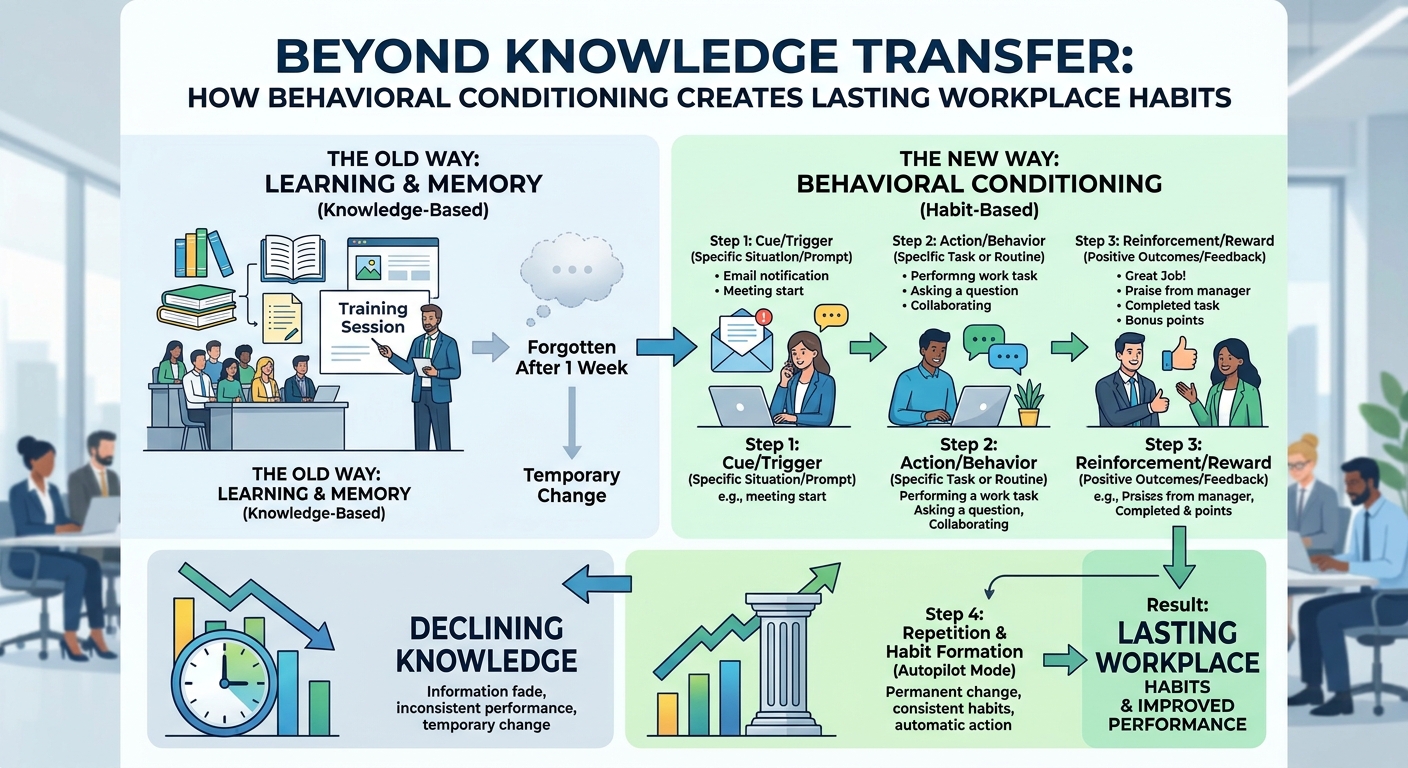
Beyond Knowledge Transfer: How Behavioral Conditioning Creates Lasting Workplace Habits
In the dynamic landscape of modern business, the pursuit of effective employee training is a perpetual challenge for L&D leaders. As Vice Presidents, Directors, and Senior Managers of learning and development, you constantly seek methods that not only impart knowledge but fundamentally alter behavior, ensuring compliance, boosting productivity, and fostering a culture of continuous improvement. The traditional model, often focused solely on information dissemination, frequently falls short. Employees might “know” what to do, but do they consistently “do” it? This gap is where the science of behavioral conditioning offers a powerful, yet often underutilized, solution for creating truly lasting workplace habits.
The Limitations of Traditional Training
For decades, training programs have primarily revolved around the transfer of knowledge. We design comprehensive modules, deliver engaging presentations, and assess comprehension through quizzes. While essential for foundational understanding, this approach often leaves a critical void: the bridge between knowing and doing. Consider a new policy in banking compliance, a safety protocol in oil and gas, or ethical guidelines in pharmaceutical sales training. Employees can recite the rules, but under pressure, do they instinctively follow the prescribed behavior?
Why Knowledge Alone Fails
- The Forgetting Curve: Without reinforcement, new information rapidly fades from memory.
- Lack of Practical Application: Theoretical knowledge, without opportunities for practice and immediate feedback, struggles to translate into real-world action.
- Resistance to Change: Established habits, even inefficient ones, are comfortable. Overcoming them requires more than just new information; it requires a structured approach to habit formation.
- Contextual Disconnect: Learning often happens in a sterile environment, far removed from the actual pressures and distractions of the workplace.
The Science of Habit Formation: Behavioral Conditioning
Behavioral conditioning, rooted in psychological principles, provides a robust framework for cultivating desired actions and mitigating undesirable ones. It’s about more than just understanding; it’s about wiring the brain to perform tasks automatically and consistently. This is particularly crucial in high-stakes environments like healthcare academy training or when ensuring adherence to complex financial regulations, such as those covered by american bankers association training.
Classical vs. Operant Conditioning in the Workplace
While classical conditioning (think Pavlov’s dogs) focuses on involuntary responses linked to stimuli, operant conditioning is the true powerhouse for workplace habit formation. It revolves around voluntary behaviors and their consequences. Through reinforcement (rewards for desired actions) and punishment (negative consequences for undesired actions, though positive reinforcement is generally more effective), we can shape and strengthen habits. This principle is at the heart of effective training for retail employees, where consistent customer service behaviors can significantly impact sales.
Key Principles for Workplace Application
- Repetition and Reinforcement: Consistent practice of a desired behavior, followed by positive feedback or reward, strengthens the neural pathways associated with that action. This is where Adaptive Learning excels, tailoring repetition based on individual mastery.
- Immediate Feedback and Rewards: The closer the consequence is to the action, the stronger the conditioning. An effective Gamified LMS provides instant recognition and rewards, turning learning into an engaging and reinforcing experience.
- Environmental Cues and Prompts: Designing the work environment to trigger desired behaviors (e.g., checklists, visual reminders, software prompts) helps employees initiate the correct actions without conscious effort.
- Chunking and Microlearning: Breaking down complex behaviors into smaller, manageable steps makes them less daunting and easier to practice. This approach, often facilitated by a Microlearning LMS, allows for frequent, targeted reinforcement.
Practical Applications Across Industries
The principles of behavioral conditioning are universally applicable, driving consistent performance and mitigating risk across diverse sectors.
Compliance & Risk Management
In industries like finance and healthcare, where regulations are stringent, behavioral conditioning ensures employees not only understand compliance but instinctively act in accordance with it. This is vital for areas like online medical billing and coding training, where accuracy directly impacts revenue and legal standing. Similarly, training for oil and gas employees around safety protocols, or the complex regulations learned in an investment banking prep course, benefit immensely from habit-forming methodologies that reduce human error and promote adherence.
Sales & Customer Service
For sales teams, particularly in pharmaceutical sales training, consistent adherence to sales methodologies, ethical guidelines, and product knowledge differentiation is paramount. Behavioral conditioning can embed these practices, leading to more successful client interactions. In retail staff training, consistent, polite, and efficient customer service behaviors, alongside effective upselling techniques, are critical drivers of customer loyalty and revenue, making training for retail a prime candidate for habit-focused development.
Specialized Skills
From the intricate procedures taught in healthcare academy training to the precise operations in training for mining, or even the detailed requirements for personal training insurance documentation, behavioral conditioning ensures that complex skills become second nature. This reduces errors, improves efficiency, and builds confidence in employees performing critical tasks.
Leveraging Technology for Habit Formation
Modern learning platforms, particularly an advanced LMS, are indispensable tools for implementing behavioral conditioning strategies at scale. An enterprise learning management system, whether a cloud based learning management system or a proprietary solution, provides the infrastructure to deliver, track, and reinforce learning experiences that build lasting habits. The synergy between a robust learning management software and innovative learning content management system (LCMS) capabilities creates an environment ripe for behavioral change.
AI-Driven Insights for Behavioral Change
Artificial intelligence is revolutionizing how we approach habit formation in the workplace. Its capacity to analyze data and personalize experiences makes it an unparalleled ally in behavioral conditioning.
Question: How can artificial intelligence help design training that sticks?
Answer: AI can analyze learning patterns, predict knowledge gaps, and personalize content delivery. It identifies optimal reinforcement schedules and tailors feedback, turning passive learning into active habit formation. For example, an AI Powered Authoring Tool can dynamically adjust content based on an individual’s performance, ensuring targeted practice where it’s most needed.
Question: Can AI tools adapt training to different regional or industry-specific behavioral norms?
Answer: Absolutely. AI can process vast amounts of data to understand cultural nuances and industry-specific best practices, then adapt scenarios and examples to resonate locally. This fosters context-aware habits, whether for global financial compliance or region-specific retail customer service, making training more relevant and effective.
Question: What if an individual learner struggles with a particular behavioral change – how can AI assist?
Answer: AI provides an individualized learning path, offering targeted remediation, varied practice scenarios, and just-in-time nudges. It helps identify the root cause of difficulty, whether it’s a lack of understanding, insufficient practice, or environmental barriers, and offers diverse strategies to build the desired habit, ensuring no learner is left behind.
The Role of an Advanced LMS
A sophisticated learning management system, or lms learning management system, like MaxLearn LMS, integrates these principles seamlessly. It moves beyond being a mere content repository to become a powerful engine for behavioral change. Features like personalized learning paths, gamification, automated reminders, and performance tracking provide the necessary reinforcement loops that transform knowledge into ingrained habits. Whether you’re managing complex compliance training or enhancing specific skill sets, an advanced learning management solutions platform is your strategic partner in developing a workforce where desired behaviors are the norm, not the exception.
Conclusion
Moving beyond simple knowledge transfer to actively cultivating lasting workplace habits through behavioral conditioning is no longer a luxury but a necessity for progressive organizations. For L&D leaders, embracing this scientific approach—supported by cutting-edge technology like AI-powered platforms and an advanced LMS—means building a workforce that not only understands what to do but instinctively, consistently, and effectively does it. This foundational shift ensures compliance, drives performance, and ultimately, secures a competitive advantage in any industry.
No responses yet