

Unlocking Potential: Individual Learning Differences and Cognitive Conditioning in Adaptive Microlearning
In today’s dynamic corporate landscape, effective employee training isn’t just a best practice—it’s a strategic imperative. For L&D Vice Presidents, Directors, and Managers, the challenge lies in creating learning experiences that genuinely resonate, drive retention, and translate into tangible performance improvements. Traditional, one-size-fits-all training often falls short, struggling to accommodate the inherent individual learning differences within any diverse workforce. This is where the powerful combination of cognitive conditioning and adaptive microlearning emerges as a game-changer, promising a future of personalized, impactful, and efficient skill development across all industries.
The Spectrum of Individual Learning Differences
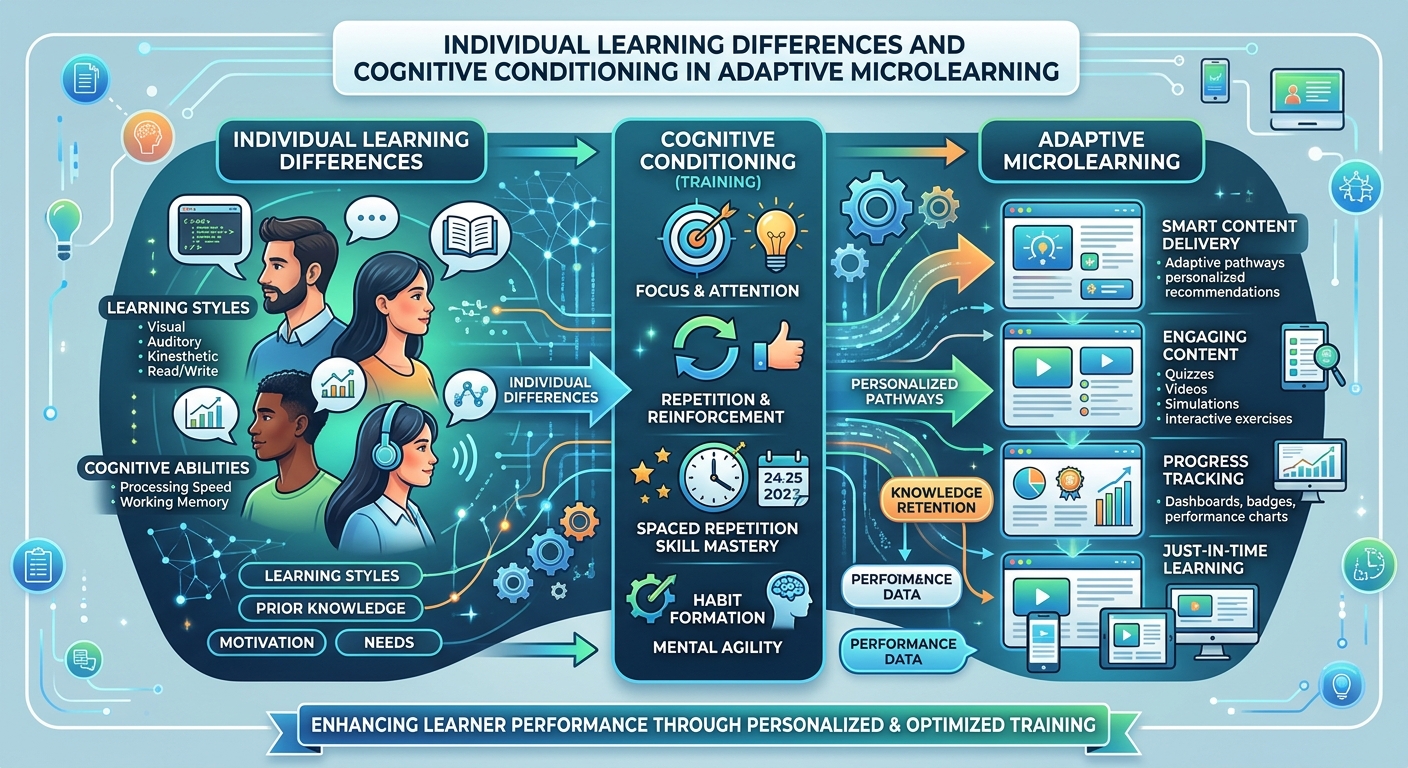
Every learner is unique. They come with distinct prior knowledge, preferred learning styles, varying paces of comprehension, and different motivational drivers. Some absorb information best visually, others auditorily, and many learn by doing. A fast learner might become disengaged if held back, while a slower pace can frustrate others. Recognizing and addressing these individual learning differences is fundamental to designing truly effective training. Ignoring them leads to decreased engagement, poor retention, and ultimately, a wasted investment in learning initiatives.
Consider the varied needs in fields ranging from AI Powered Authoring Tool for pharmaceutical sales representatives mastering complex drug information to new hires in Microlearning LMS for the American Bankers Association training programs. Each individual requires content delivered in a manner that aligns with their cognitive strengths and fills their specific knowledge gaps. This level of personalization is unattainable with static, linear learning modules.
Harnessing the Power of Cognitive Conditioning
Cognitive conditioning, in the realm of learning, refers to the systematic process of reinforcing desired cognitive responses and behaviors through repeated exposure and feedback. It’s about optimizing how the brain acquires, processes, and retains information. Key principles include:
- Spaced Repetition: Presenting information at optimal, increasing intervals to combat the forgetting curve, embedding knowledge into long-term memory.
- Active Recall: Requiring learners to actively retrieve information rather than passively re-reading it, strengthening memory pathways.
- Contextual Learning: Embedding new information within relevant scenarios and practical applications, making it more meaningful and easier to apply.
- Immediate Feedback: Providing instant validation or correction, which is crucial for reinforcing correct understanding and rectifying misconceptions promptly.
When applied effectively, cognitive conditioning transforms training from a passive information dump into an active, brain-friendly experience. This is especially vital for high-stakes environments like Risk-focused Training in the finance and insurance sectors, where accuracy and retention directly impact compliance and business outcomes.
Adaptive Microlearning: The Strategic Synthesis
Adaptive microlearning represents the pinnacle of personalized corporate training. It dynamically adjusts the learning path, content, and pace for each individual based on their performance, preferences, and progress. By combining the efficiency of microlearning with the intelligence of adaptive algorithms, it inherently addresses individual learning differences while leveraging cognitive conditioning principles.
Here’s how this powerful synthesis works:
- Personalized Pathways: An Adaptive Learning system assesses a learner’s current knowledge and skills, then delivers precisely the modules they need, skipping what they already know and reinforcing areas of weakness.
- Just-in-Time & Just-for-Me Content: Microlearning breaks down complex topics into short, digestible bursts. The adaptive engine then delivers these bites of content exactly when and where the learner needs them, whether it’s specific AI Powered Authoring Tool for a new product launch or a quick refresher on compliance regulations.
- Intelligent Reinforcement: Leveraging cognitive conditioning, the system automatically schedules quizzes, scenarios, and practice exercises based on the learner’s forgetting curve, ensuring knowledge is cemented through spaced repetition and active recall.
- Real-time Feedback & Analytics: Advanced learning management software provides immediate feedback to learners and granular data to L&D teams, highlighting individual and team-wide progress, areas of struggle, and overall training efficacy.
For organizations implementing critical training like Risk-focused Training in healthcare or ensuring up-to-date Microlearning LMS, adaptive microlearning ensures every employee achieves mastery.
AI-Powered Learning: Addressing Modern Training Demands
What innovations are shaping personalized training experiences for my workforce?
Modern learning platforms, often powered by sophisticated algorithms, are revolutionizing how organizations approach personalized training. These systems analyze vast amounts of data on learner performance, engagement patterns, and content interactions. This allows them to dynamically adjust content delivery, recommend relevant modules, and even predict potential knowledge gaps before they impact performance. The aim is to create a truly tailored journey for every individual, ensuring that each minute spent in training is optimized for maximum impact and retention.
How can technology ensure consistent learning outcomes across globally distributed teams?
Delivering consistent and effective training to a geographically dispersed workforce, from AI Powered Authoring Tool teams to Risk-focused Training for mining operations, presents a unique challenge. Technology, particularly cloud-based learning management systems (LMS), plays a pivotal role. These platforms provide centralized access to standardized, yet adaptive, content from anywhere in the world. Performance analytics allow L&D leaders to monitor progress in real-time across different regions, identify localized learning needs, and ensure that all employees, regardless of location, achieve the same high standard of competency and compliance.
How can data analytics specifically improve individual employee development trajectories?
Data analytics transforms abstract learning into actionable insights. By tracking metrics such as completion rates, quiz scores, time spent on modules, and common areas of difficulty, advanced learning management solutions can build a detailed profile for each employee. This data identifies specific strengths and weaknesses, allowing the system to recommend targeted remedial content or advanced modules. For L&D managers, these insights enable proactive interventions, personalized coaching opportunities, and the ability to demonstrate a clear return on investment for training programs, fostering continuous individual and organizational growth.
Impact Across Industries: From Compliance to Sales
The adaptability of this approach makes it universally beneficial across the diverse segments and industries our L&D leaders serve:
- Pharmaceutical & Healthcare: For AI Powered Authoring Tool and Microlearning LMS in the medical field, adaptive microlearning ensures compliance with ever-evolving regulations, precise product knowledge, and efficient Microlearning LMS. It’s ideal for Microlearning LMS.
- Banking & Finance: From Microlearning LMS to specialized Microlearning LMS, the need for stringent compliance and up-to-date market knowledge is paramount. Risk-focused Training becomes more effective.
- Retail & Hospitality: Microlearning LMS helps staff quickly master product knowledge, customer service protocols, and seasonal promotions, boosting sales and guest satisfaction. This supports Microlearning LMS.
- Oil & Gas & Mining: Safety protocols, equipment operation, and environmental regulations require rigorous Microlearning LMS. Adaptive systems ensure critical knowledge is retained and applied flawlessly. This includes specialized Microlearning LMS.
Choosing the Right Learning Management Solution
To truly harness the power of adaptive microlearning and cognitive conditioning, a robust learning content management system (LCMS) or enterprise learning management platform is essential. A comprehensive Microlearning LMS provides the infrastructure for delivering personalized content, tracking progress, and generating the analytics needed for continuous improvement. Look for a cloud based learning management system that offers intuitive content authoring, powerful analytics, and, crucially, adaptive capabilities.
Solutions like MaxLearn LMS are engineered to support these advanced methodologies, providing L&D professionals with the tools to build a highly effective, engaging, and personalized learning ecosystem that truly differentiates their organization in a competitive market.
Conclusion
The future of corporate learning lies in its ability to adapt to the individual. By embracing individual learning differences and strategically applying cognitive conditioning through adaptive microlearning, L&D leaders can transcend the limitations of traditional training. This approach not only enhances knowledge retention and skill application but also fosters a culture of continuous learning and development, driving significant improvements in performance, compliance, and overall business growth. Investing in an advanced learning management system that supports these principles is no longer an option but a strategic imperative for any forward-thinking organization.
No responses yet