

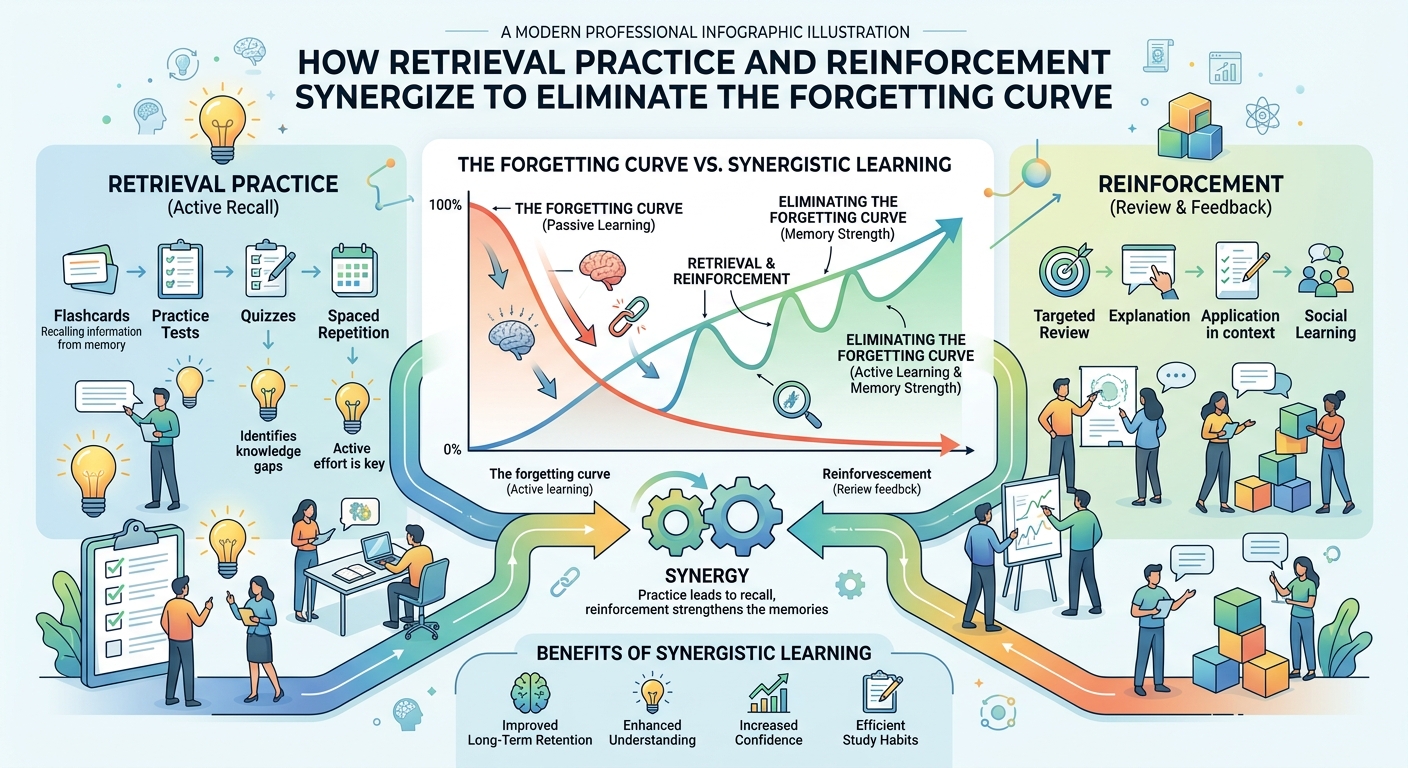
How Retrieval Practice and Reinforcement Synergize to Eliminate the Forgetting Curve
For Learning & Development leaders, the battle against the forgetting curve is perpetual. Training budgets are significant, and the expectation for measurable impact is higher than ever. Yet, studies consistently show that employees forget a substantial portion of what they learn within days or weeks if not actively engaged with the material. This rapid decay of knowledge poses a critical challenge across all industries, from ensuring compliance in finance to enhancing sales performance in retail.
The good news is that cognitive science offers powerful antidotes: retrieval practice and reinforcement. While often discussed individually, their true power emerges when they synergize, creating a robust, long-lasting learning experience that fundamentally alters the forgetting curve’s trajectory. This article delves into how these two pillars of effective learning can transform your organizational training outcomes.
Understanding the Silent Assassin: The Forgetting Curve
In 1885, German psychologist Hermann Ebbinghaus published his groundbreaking work on memory, introducing the concept of the forgetting curve. His research demonstrated that people forget about 50% of newly acquired information within an hour, and 70% within 24 hours, if there is no attempt to retain it. This isn’t a flaw in human memory; it’s a natural and efficient process for discarding irrelevant information.
However, in a professional context, this “discarding” can have serious repercussions. Unretained knowledge leads to wasted training investment, compliance risks, reduced productivity, and slower skill development. For Vice Presidents and Directors of L&D, mitigating this effect is paramount to proving the ROI of their initiatives.
What’s the biggest challenge in making training stick for employees? The answer lies in overcoming the natural human tendency to forget. Without deliberate strategies, even the most well-designed initial training program can fall victim to the rapid decay of information along the forgetting curve, leading to employees quickly losing knowledge and skills they’ve just acquired.
Retrieval Practice: Activating Memory for Deeper Learning
Retrieval practice is a learning strategy where learners actively attempt to recall information from memory. Instead of passively re-reading notes or watching a video, it involves deliberately pulling knowledge out of their minds. This can take many forms: self-quizzing, flashcards, answering open-ended questions, or explaining concepts to others. The act of successful retrieval not only assesses what has been learned but, more importantly, strengthens the memory trace itself, making it easier to recall that information in the future.
Why is this so effective? Every time you retrieve a piece of information, you’re essentially practicing the neural pathway associated with that memory. The more you practice, the stronger and more accessible that pathway becomes. It also highlights gaps in understanding, directing learners to focus on areas where their recall is weak. For organizations utilizing a Microlearning LMS, incorporating short, frequent retrieval quizzes after each module is a simple yet powerful application.
Reinforcement: Sustaining Knowledge Over Time
While retrieval practice builds stronger memory traces, reinforcement ensures those traces endure. Reinforcement strategies are about systematically revisiting and applying learned information over time, preventing it from fading. Key elements of effective reinforcement include:
- Spaced Repetition: Re-exposing learners to content at increasing intervals. This counteracts the forgetting curve by targeting information just as it’s about to be forgotten.
- Varied Practice: Presenting information in different formats or contexts to promote flexible understanding and application.
- Constructive Feedback: Providing immediate and actionable feedback on retrieval attempts, helping learners correct misunderstandings and solidify correct knowledge.
- Application-Based Activities: Encouraging learners to use their knowledge in real-world scenarios, which deepens understanding and relevance.
How can L&D teams ensure knowledge retention beyond initial training? By implementing robust reinforcement strategies, they can consistently re-engage learners with key concepts. This is effectively supported by a Gamified LMS, which can make spaced repetition and varied practice engaging through points, badges, and leaderboards, motivating continuous engagement and knowledge application.
The Synergistic Power: Eliminating the Forgetting Curve
The true magic happens when retrieval practice and reinforcement work hand-in-hand. Retrieval practice acts as the diagnostic tool, identifying specific knowledge gaps and strengthening initial recall. Reinforcement then takes that diagnostic information and strategically schedules future practice, ensuring that the weak areas are targeted, and all learned material is revisited at optimal intervals.
Consider this cycle: An employee completes an initial training module. Shortly after, retrieval practice (e.g., a quick quiz) assesses their understanding. If they struggle with certain concepts, the reinforcement system (often powered by a robust
LMS
or
LCMS
) flags these areas for spaced repetition. Future microlearning modules or scenario-based questions will then prioritize these challenging topics, leveraging spaced repetition to re-present the information just before it would naturally be forgotten.
Can technology help personalize learning paths based on an employee’s performance? Absolutely. Advanced learning platforms integrate data from retrieval practice to dynamically adjust the reinforcement schedule. An Adaptive Learning system, for example, can analyze quiz results to determine which topics an individual needs to revisit and when, tailoring the learning experience to their unique needs and ensuring maximum retention efficiency.
Practical Application Across Diverse Industries
This powerful synergy is transformative for talent development across all sectors:
- Compliance: In banking, finance, and healthcare, Risk-focused Training is paramount. Retrieval practice ensures employees recall critical regulations (e.g.,
american bankers association training
,
personal training insurance
specifics), while reinforcement maintains this recall through regular, low-stakes checks and scenario-based simulations for ongoing adherence.
- Sales: For
pharmaceutical sales training
or
training for retail employees
, mastering product knowledge and objection handling is key. Retrieval practice via an AI Powered Authoring Tool can quickly create quizzes on new products. Reinforcement schedules ensure sales reps routinely practice their pitches and product facts, improving conversion rates and customer satisfaction.
- Healthcare: Whether it’s
online medical billing and coding training
or a
healthcare academy training
for new procedures, retrieval practice ensures accurate recall of complex codes and protocols. Spaced reinforcement ensures this critical knowledge is maintained, reducing errors and improving patient care.
- Industrial: In sectors like
training for oil and gas
or
training for mining
, safety protocols are non-negotiable. Retrieval practice verifies understanding of procedures, and regular reinforcement via safety refreshers and simulations helps embed these critical behaviors, reducing incidents and improving operational efficiency.
- Finance & Investment: For an
investment banking prep course
, the volume of information is immense. Retrieval practice helps solidify concepts, and reinforcement via daily quizzes on market dynamics or regulatory updates ensures long-term mastery.
- Retail & Hospitality:
Training for retail
, including
retail staff training
, benefits immensely. Retrieval practice ensures staff know product features and customer service policies, while reinforcement keeps them sharp on seasonal promotions and loyalty programs.
Choosing the Right Platform: MaxLearn LMS
To effectively implement retrieval practice and reinforcement at scale, L&D leaders need a robust
learning management system
(LMS) or
learning content management system
(LCMS). A comprehensive
lms learning management system
like MaxLearn LMS is designed to facilitate this synergy.
What should L&D leaders look for in an eLearning platform to boost knowledge retention? They should seek features such as integrated quizzing and assessment tools for retrieval practice, spaced repetition algorithms, analytics dashboards to track individual and team performance, and content delivery mechanisms that support microlearning for effective reinforcement. A
cloud based learning management system
or
enterprise learning management
solution that offers these capabilities can streamline content creation, delivery, and tracking, making the implementation of these powerful learning strategies seamless.
MaxLearn LMS empowers organizations to create and deliver engaging, effective training that champions both active recall and systematic reinforcement. By providing tools for dynamic content, powerful analytics, and a user-friendly experience, MaxLearn LMS helps L&D teams move beyond passive learning to active, sustained knowledge acquisition.
Conclusion
The forgetting curve is a formidable adversary to effective corporate training, but it is not insurmountable. By strategically combining retrieval practice and reinforcement, L&D leaders can transform their training programs from one-off events into continuous learning journeys. This synergy not only eliminates the insidious effects of forgetting but also cultivates a culture of deeper understanding, sustained skill development, and improved performance across all organizational functions.
Investing in platforms and methodologies that embrace retrieval practice and reinforcement is no longer a luxury; it’s a strategic imperative for any organization committed to maximizing its human capital and achieving long-term success. It’s time to re-evaluate your current training strategies and embrace the power of this proven synergy to truly make learning stick.
No responses yet