

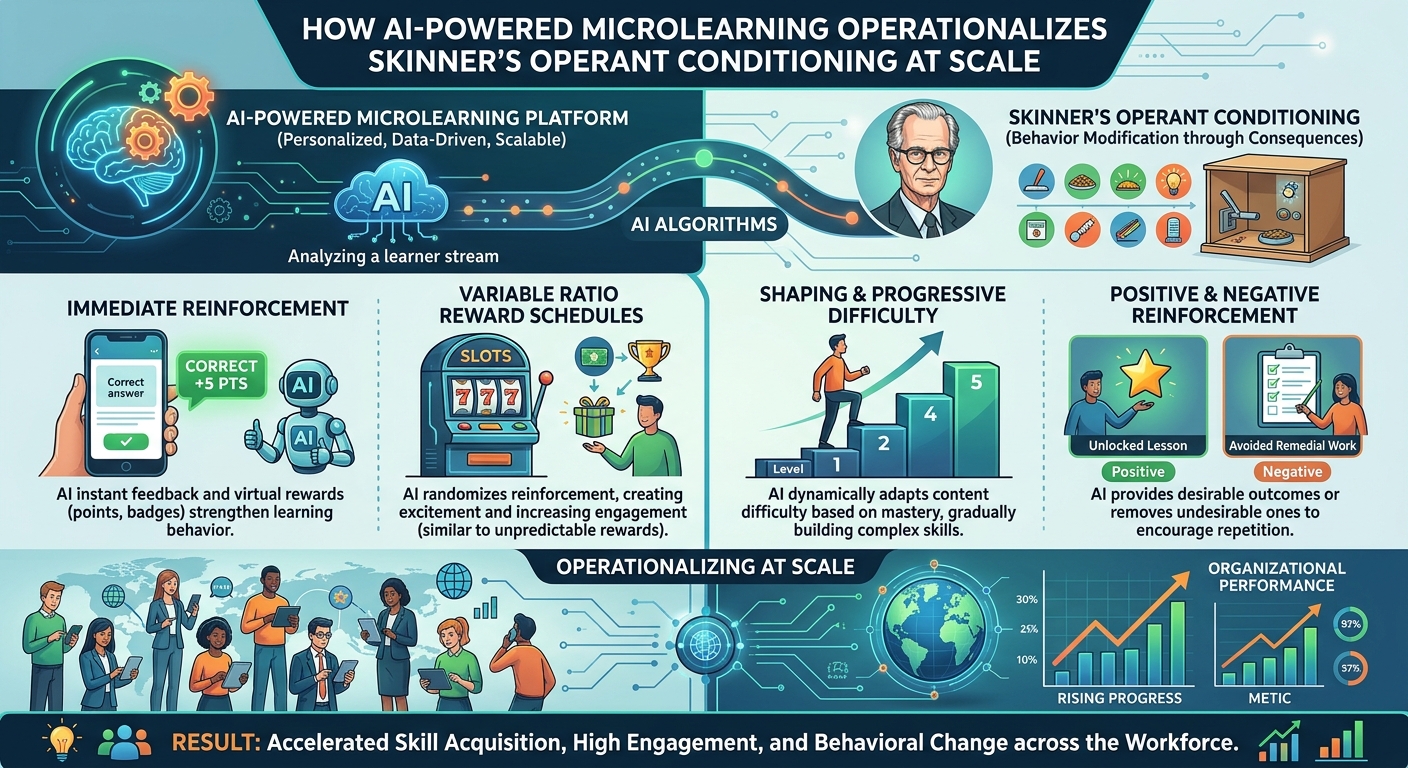
How AI-Powered Microlearning Operationalizes Skinner’s Operant Conditioning at Scale
For L&D leaders, the challenge is constant: how do you foster lasting behavioral change, enhance skill acquisition, and ensure knowledge retention across a diverse and dynamic workforce? Traditional training often falls short, struggling to provide the personalized, timely reinforcement crucial for effective learning. Enter B.F. Skinner’s operant conditioning, a foundational psychological principle that, when combined with cutting-edge AI and microlearning strategies, offers a powerful answer to this perennial L&D dilemma.
This article explores how artificial intelligence, integrated into modern microlearning platforms, allows organizations to operationalize Skinner’s principles of reinforcement at an unprecedented scale, driving measurable improvements in areas from compliance to sales performance.
The Enduring Power of Operant Conditioning in Learning
Skinner’s theory of operant conditioning posits that learning occurs through rewards and punishments for behavior. In the context of corporate training, the focus is overwhelmingly on positive reinforcement – the act of adding a desirable stimulus to increase a desired behavior. When a learner answers correctly, applies a new skill effectively, or demonstrates understanding, immediate and consistent positive feedback significantly strengthens the likelihood of that behavior being repeated.
Consider the process of “shaping” behavior. This involves reinforcing successive approximations to a desired behavior. For instance, to teach a complex sales technique, you might first reward understanding the theory, then practicing a component, then putting it all together in a role-play. This systematic reinforcement guides learners towards mastery. The challenge for L&D has always been how to apply this individualized, consistent reinforcement across thousands of employees in diverse roles, from Microlearning LMS adoption to complex technical skills.
Why Traditional Training Falls Short of Scalable Reinforcement
Conventional training methods, such as lengthy classroom sessions, annual workshops, or exhaustive e-learning modules, inherently struggle with the core tenets of operant conditioning:
- Lack of Immediacy: Feedback often comes days or weeks after a learning event, diminishing its reinforcing power.
- One-Size-Fits-All: These methods rarely account for individual learning paces or existing knowledge, meaning reinforcement isn’t tailored to specific needs.
- Inconsistent Reinforcement: It’s nearly impossible for human trainers to provide consistent, real-time reinforcement to every single learner across an organization.
- Difficulty in Tracking Behavioral Change: Measuring the actual application of learned skills in the workplace is arduous, making it hard to identify where further reinforcement is needed.
These limitations mean that while the principles of operant conditioning are powerful, their practical application at scale has remained elusive, leading to poor retention rates and a significant gap between training completion and actual behavioral change.
Microlearning: The Perfect Foundation for Reinforcement Loops
Microlearning, by its very nature, provides the ideal structural framework for operationalizing operant conditioning. Its short, focused bursts of content are designed for rapid consumption and immediate application. This allows for:
- Spaced Repetition: Delivering small, relevant content pieces over time reinforces learning, much like repeated positive stimuli.
- Immediate Feedback Opportunities: Each micro-module can conclude with a quick assessment, allowing for instant feedback on performance.
- Targeted Practice: Learners can practice specific skills or recall discrete pieces of information, making it easier to reinforce correct responses.
A robust Microlearning LMS is essential here, providing the platform for delivering these bite-sized lessons, tracking progress, and laying the groundwork for more sophisticated, AI-driven reinforcement strategies.
AI: Scaling Operant Conditioning Beyond Human Capacity
This is where artificial intelligence becomes the game-changer, transforming the theoretical elegance of operant conditioning into a practical, scalable reality for L&D. AI supercharges microlearning to deliver personalized, timely, and effective reinforcement:
1. Adaptive Learning Paths: Precision Reinforcement
AI-driven Adaptive Learning systems analyze learner data – performance, preferences, and even emotional responses – to dynamically adjust the learning path. If a learner struggles with a particular concept, the AI delivers additional reinforcing content or practice exercises. If they excel, the system challenges them with more advanced material. This ensures that every learner receives the optimal level of challenge and support, providing precisely timed positive reinforcement for progress and corrective feedback where needed, shaping their learning journey with unparalleled precision.
2. Immediate and Personalized Feedback: Digital Reinforcement
AI can provide instantaneous, contextual feedback on assignments, quizzes, and simulations. Instead of waiting for a trainer, learners receive immediate validation for correct answers or specific guidance for errors. This instant feedback loop is the epitome of positive reinforcement, strengthening desired neural pathways and preventing the formation of incorrect habits. Whether it’s for pharmaceutical sales training scenarios or compliance modules, AI ensures every interaction is a learning opportunity.
3. Gamification for Enhanced Motivation and Engagement
A Gamified LMS leverages AI to personalize game mechanics, rewards, and challenges. AI can identify what motivates individual learners, offering badges, points, leaderboards, or virtual rewards that resonate most with them. This creates powerful positive reinforcement loops, transforming learning into an engaging, habit-forming activity where achieving milestones provides a consistent dopamine hit, driving continued participation and deeper learning.
4. AI-Powered Content Creation and Curation
An AI Powered Authoring Tool can assist L&D teams in rapidly creating, updating, and curating highly relevant microlearning content. AI can analyze vast datasets to identify knowledge gaps, suggest content topics, and even draft initial learning modules tailored to specific roles or skill requirements. This ensures that the reinforcement material itself is always fresh, precise, and aligned with organizational objectives, from training for retail employees to complex technical skills for training for oil and gas sectors.
5. Predictive Analytics for Proactive Intervention
AI can predict which learners are at risk of falling behind or disengaging based on their interaction patterns and performance data. This allows L&D managers to intervene proactively with targeted micro-interventions, additional reinforcement, or personalized support, preventing learning extinction before it occurs. This is critical for risk-focused training, ensuring compliance and safety across industries.
Real-World Impact Across Industries
The operationalization of Skinner’s principles through AI-powered microlearning has profound implications across various sectors:
- Compliance: For american bankers association training or online medical billing and coding training, AI ensures continuous, reinforced learning of complex regulations, significantly reducing organizational risk.
- Sales & Retail: In pharmaceutical sales training or training for retail, AI microlearning reinforces product knowledge, objection handling, and customer service skills through repeated, scenario-based practice.
- Healthcare: Healthcare academy training benefits from adaptive modules for medical procedures, patient interaction, and ethical guidelines, reinforcing best practices.
- Heavy Industry: For training for mining or oil and gas, safety protocols and equipment operation can be reinforced daily through quick, engaging modules, drastically improving safety records.
- Finance & Insurance: An investment banking prep course or personal training insurance compliance can be optimized with continuous, reinforced learning.
Frequently Asked Questions About Intelligent Learning Systems
How does artificial intelligence transform corporate learning and development?
Artificial intelligence revolutionizes corporate L&D by enabling hyper-personalization, automating content delivery, providing immediate feedback, and analyzing learning patterns at scale. This leads to more engaging, effective, and efficient training programs that adapt to individual needs.
What are the benefits of using intelligent learning platforms for employee training?
Intelligent learning platforms offer numerous benefits, including improved knowledge retention, increased learner engagement, faster skill acquisition, consistent application of company standards, reduced training costs, and enhanced data-driven insights into employee performance and learning effectiveness.
Can smart technology personalize professional growth for a global workforce?
Yes, smart technology is exceptionally effective at personalizing professional growth for a global workforce. By leveraging data analytics and adaptive algorithms, intelligent systems can deliver customized content, practice, and feedback tailored to individual roles, skill gaps, and learning preferences, regardless of geographic location or language.
Where can L&D leaders find advanced solutions for digital learning?
L&D leaders can find advanced solutions for digital learning from specialized learning technology providers. These vendors offer sophisticated platforms like a learning content management system (LCMS), cloud-based learning management systems, and enterprise learning management solutions that integrate AI, microlearning, and gamification capabilities.
How do AI-driven training systems improve workforce capability and compliance?
AI-driven training systems improve workforce capability and compliance by consistently reinforcing critical knowledge and behaviors. Through adaptive learning paths, real-time feedback, and engaging gamification, these systems ensure that employees not only learn but also retain and apply essential information and regulatory requirements, thereby mitigating risks and enhancing overall competence.
Conclusion
The marriage of AI and microlearning represents a paradigm shift for L&D. It moves beyond simply delivering content to actively shaping employee behavior and knowledge through scalable, personalized reinforcement. By operationalizing the timeless principles of Skinner’s operant conditioning, organizations can now achieve unprecedented levels of engagement, retention, and performance across their entire workforce. For L&D leaders seeking to future-proof their training strategies and drive tangible business outcomes, embracing AI-powered microlearning is no longer an option – it’s an imperative.
No responses yet