

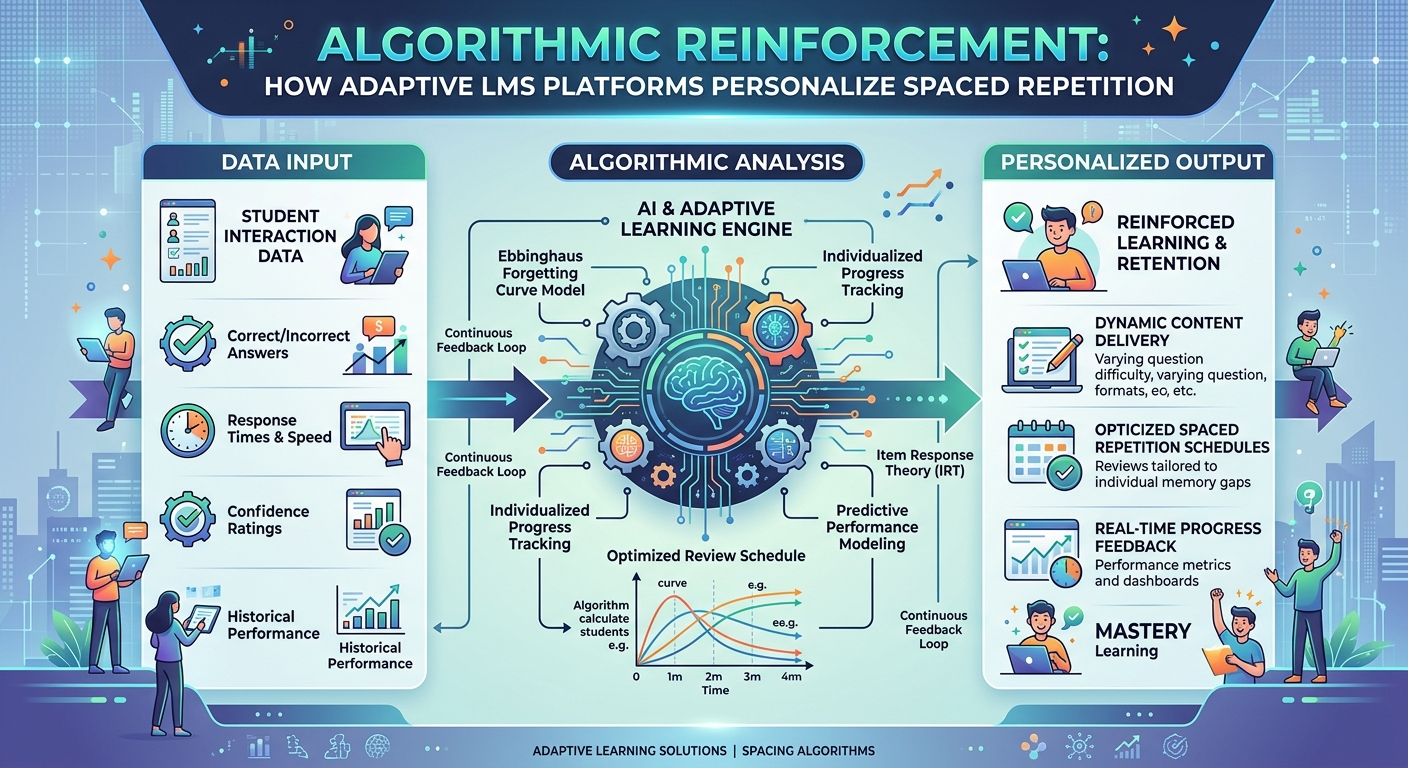
Algorithmic Reinforcement: How Adaptive LMS Platforms Personalize Spaced Repetition
For Vice Presidents, Directors, Senior Managers, and Managers of Learning & Development, the quest for truly effective training isn’t just about delivering content – it’s about ensuring knowledge sticks, skills are mastered, and compliance is consistently met. The traditional “one-size-fits-all” approach to corporate training often falls short, leading to forgotten information and wasted resources. But what if your learning platform could understand each employee’s unique learning pace, pre-existing knowledge, and retention challenges, then adapt the training experience accordingly?
This is the promise of algorithmic reinforcement, powered by adaptive Learning Management Systems (LMS) that leverage the proven science of spaced repetition. It’s a game-changer for organizations across every industry, from AI Powered Authoring Tool for pharmaceutical sales training to complex Risk-focused Training for American Bankers Association training, and even highly specialized training for oil and gas.
The Science of Lasting Knowledge: Spaced Repetition Explained
The concept of spaced repetition isn’t new; its roots trace back to Hermann Ebbinghaus’s late 19th-century studies on the “forgetting curve.” He discovered that humans forget newly learned information rapidly unless it’s reinforced at increasingly longer intervals. Spaced repetition is a learning technique that involves reviewing information at optimal times to maximize retention and counteract this natural forgetting process.
In practice, this means reviewing a topic shortly after learning it, then again a few days later, then a week later, then a month later, and so on. The challenge for L&D has always been scaling this highly individualized process across an entire workforce, especially for diverse groups undergoing online medical billing and coding training or intricate investment banking prep courses.
Adaptive Learning: The Intelligence Behind Personalization
This is where adaptive learning enters the scene. An adaptive learning management system doesn’t just present content; it intelligently responds to learner interactions. It tracks performance, identifies knowledge gaps, and dynamically adjusts the learning path, content difficulty, and most importantly, the timing of review sessions. This intelligent adaptation transforms spaced repetition from a manual, cumbersome process into an automated, highly efficient one.
How do cutting-edge learning platforms ensure that training materials adapt to each individual’s pace and existing knowledge?
The answer lies in sophisticated algorithms. These algorithms analyze a learner’s performance on quizzes, assessments, and interactions with content. If a learner struggles with a particular concept, the system might present remedial content or schedule more frequent reviews for that specific topic. Conversely, if a learner demonstrates mastery, the system extends the review interval, allowing them to progress more quickly or focus on areas where they need more support.
Algorithmic Reinforcement in Action: Beyond Basic Spaced Repetition
An adaptive LMS doesn’t just apply a generic spaced repetition schedule; it customizes it. This is algorithmic reinforcement: the continuous, data-driven refinement of the learning experience.
Personalized Reinforcement Cycles
Imagine a new retail staff training module on product knowledge. One employee might grasp concepts quickly, while another might need more time with certain product lines. An adaptive LMS, through algorithmic reinforcement, will:
- Identify specific areas of weakness based on assessment results.
- Automatically re-present relevant Microlearning LMS content.
- Schedule follow-up questions or scenarios at optimized intervals for each individual, ensuring reviews happen just as the information is about to be forgotten.
- Adjust the difficulty and format of reinforcement activities based on ongoing performance.
Data-Driven Insights for L&D Leaders
The power of these algorithms extends beyond individual learners. For L&D leadership, the data generated by an adaptive learning management system offers invaluable insights. You can identify:
- Common knowledge gaps across entire departments or cohorts.
- Specific training content that may need revision or improvement.
- The overall effectiveness of your training programs in terms of long-term retention.
- Areas where your training for retail employees could be more efficient.
Transforming Training Across Key Industries
The benefits of adaptive LMS platforms personalizing spaced repetition are profoundly impactful across the diverse segments and industries L&D leaders serve:
- Compliance: In finance, healthcare academy training, or any sector requiring stringent adherence to regulations, personalized spaced repetition ensures critical compliance information is not just learned but retained. This is crucial for American Bankers Association training and personal training insurance regulations.
- Sales: For pharmaceutical sales training or general training for retail, product knowledge and sales techniques must be razor-sharp. Adaptive platforms continuously reinforce these skills, making reps more effective.
- Banking & Finance: From investment banking prep course content to anti-money laundering regulations, the sheer volume of information demands efficient retention. Adaptive Adaptive Learning techniques are indispensable.
- Healthcare: Online medical billing and coding training, as well as general healthcare academy training, benefits immensely from personalized reinforcement of complex medical terminology and procedures.
- Retail & Hospitality: For training for retail or specific retail staff training, ensuring consistent customer service standards and product expertise is vital. Algorithmic reinforcement ensures every employee retains essential information.
- Pharma & Oil and Gas: In highly technical fields like pharmaceutical sales training or training for mining, where safety protocols and scientific data are paramount, adaptive learning reduces critical knowledge fade.
Choosing the Right Adaptive Learning Management System
Where can L&D leaders find robust learning management solutions that deliver personalized, data-driven training across diverse global teams?
When evaluating learning management solutions, consider these critical features for an adaptive LMS focused on personalized spaced repetition:
- Intelligent Algorithms: The core capability to dynamically adjust learning paths and review schedules.
- Content Flexibility (LCMS): An integrated learning content management system (LCMS) allows for easy creation, adaptation, and delivery of granular content pieces suitable for spaced repetition.
- Robust Analytics: Detailed reports on individual and group performance, retention rates, and knowledge gaps.
- Scalability: A cloud based learning management system or enterprise learning management solution that can support your entire workforce, regardless of size or geographic distribution.
- User Experience: An intuitive interface for both learners and administrators, making engagement seamless.
- Integration Capabilities: Ability to integrate with existing HRIS or other business systems.
Platforms like MaxLearn LMS are at the forefront of this evolution, offering sophisticated tools that bring algorithmic reinforcement and personalized spaced repetition to life. By combining an advanced lms learning management system with intelligent content delivery, they empower organizations to move beyond mere training completion to genuine, measurable knowledge mastery.
Conclusion
The future of corporate learning isn’t just about delivering information; it’s about optimizing its absorption and retention. Algorithmic reinforcement, delivered through adaptive LMS platforms, provides the most effective strategy for enhancing employee knowledge retention in a large organization. It transforms the challenge of knowledge decay into an opportunity for continuous improvement, ensuring that every training dollar invested yields maximum, long-lasting impact. For L&D leaders seeking to future-proof their workforce and elevate their organizational capabilities, embracing personalized spaced repetition powered by adaptive learning is no longer an option – it’s a strategic imperative.
No responses yet