

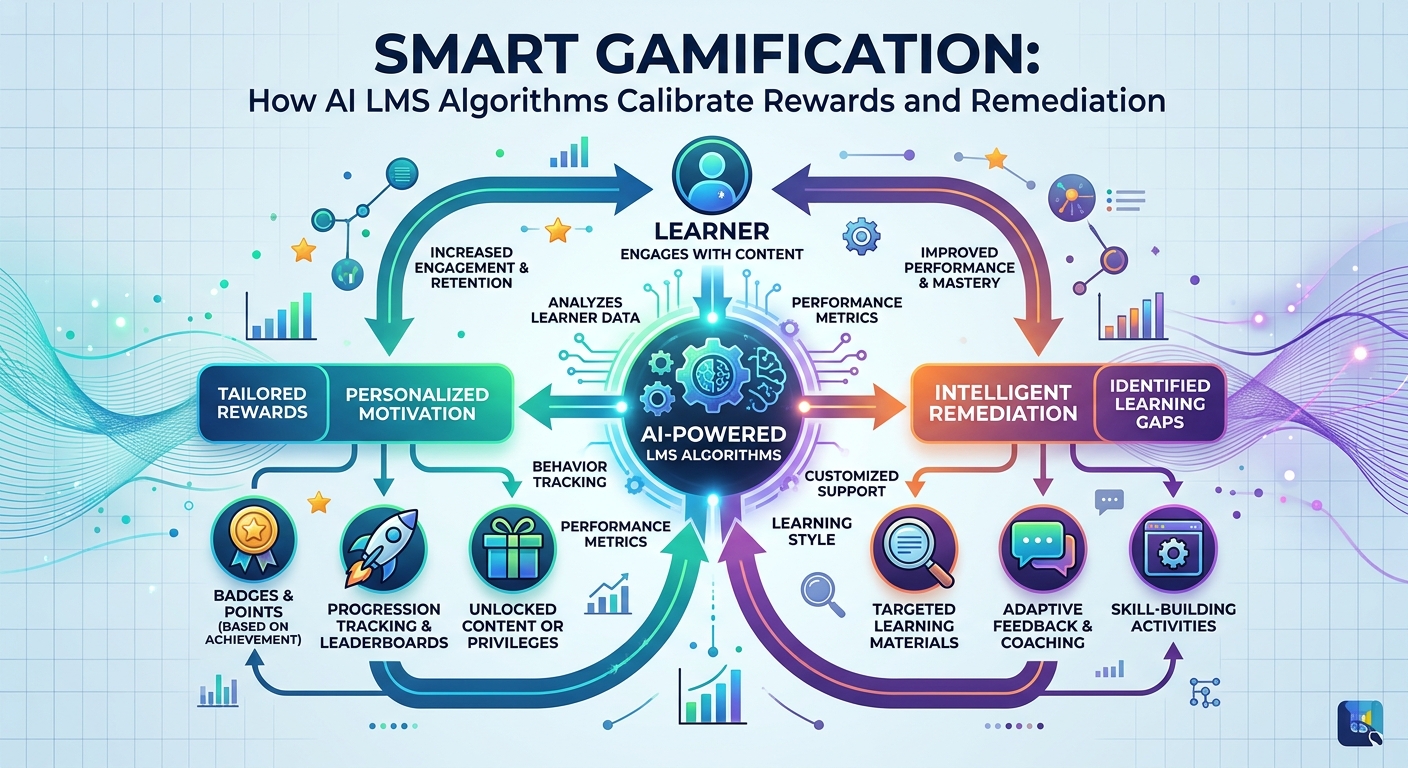
Smart Gamification: How AI LMS Algorithms Calibrate Rewards and Remediation for Peak Performance
In today’s fast-paced corporate landscape, where knowledge is power and continuous learning is paramount, Learning & Development (L&D) leaders face a persistent challenge: how to effectively engage employees, ensure knowledge retention, and swiftly close skill gaps across diverse, global teams. From Risk-focused Training in finance to critical safety protocols in mining, the stakes are higher than ever.
Enter smart gamification, powered by advanced AI learning management system (LMS) algorithms. This isn’t just about badges and leaderboards anymore; it’s about a sophisticated, data-driven approach that personalizes the learning journey, recalibrates motivation, and targets remediation with surgical precision. For Vice Presidents, Directors, and Senior Managers in L&D across industries like Compliance, Sales, Banking, Finance, Insurance, Retail, Pharma, Healthcare, Hospitality, Oil and Gas, and Mining, understanding this evolution is key to unlocking unprecedented training ROI.
The Evolution of Engagement: Beyond Basic Gamification
Traditional gamification in corporate training brought much-needed enthusiasm, transforming mundane modules into interactive experiences. However, it often operated on a one-size-fits-all model. A badge for completing a course might motivate some, but others might find it trivial, or even demotivating if the challenge wasn’t aligned with their skill level.
Smart gamification changes this paradigm. It leverages artificial intelligence to move beyond superficial incentives, delving into the core of learner psychology and performance data. Imagine an enterprise learning management system that doesn’t just present a game, but *learns* from each interaction, adapting the game itself to optimize engagement and learning outcomes for every individual.
The Brain Behind the Brilliance: AI LMS Algorithms
At the heart of smart gamification are powerful AI algorithms embedded within a robust learning content management system. These algorithms are constantly processing vast amounts of data, creating dynamic profiles for each learner and predicting their needs and preferences.
Dynamic Learner Profiling: Understanding Every Employee
How can a cloud based learning management system truly understand the unique learning profile of every employee, from a new hire needing retail staff training to a veteran banker undergoing american bankers association training? AI analyzes an individual’s past performance, learning styles, engagement patterns, job role, and even preferred learning content formats. This comprehensive profile informs every subsequent interaction.
- For a new sales associate, it might identify a preference for video-based training for retail employees and short, scenario-based quizzes on product features.
- For an experienced investment banking prep course participant, it could identify a strength in theoretical concepts but a need for practical application exercises.
Predictive Performance Analysis: Anticipating Learning Gaps
In a complex environment like pharmaceutical sales training, anticipating where knowledge gaps might emerge is crucial. How does an AI-driven platform cut through the noise to deliver precisely the critical information and skills each learner needs to master their role, whether it’s for compliance or new drug launches? AI algorithms predict potential areas of struggle before they become significant issues. By identifying patterns in assessment scores, time spent on modules, and common errors, the system can proactively recommend supplementary microlearning LMS content or practice exercises. This minimizes downtime and ensures that employees are always operating at their peak.
Contextual Recommendation Engines: Delivering the Right Content, Always
For a multinational corporation, how does an enterprise learning management system ensure that training for oil and gas is compliant with local regulations and culturally relevant across different countries and regions? AI-powered recommendation engines go beyond simple content suggestions. They factor in real-time performance, job role, location-specific requirements, and even industry-specific trends to deliver the most relevant learning assets. This means a financial advisor in one region might receive Risk-focused Training on local market volatility, while a healthcare professional gets updates on new regulations for online medical billing and coding training relevant to their state.
Calibrating Rewards for Maximum Impact
The true genius of smart gamification lies in its ability to calibrate rewards dynamically. Instead of generic points, AI determines the most effective motivators for each individual or team, maximizing engagement and driving specific behaviors.
- Personalized Challenges: For a high-performing individual, the AI might present a complex, time-sensitive challenge related to advanced topics, offering a specialized certification as a reward. For a struggling learner, it might offer smaller, achievable goals with immediate recognition, fostering confidence.
- Adaptive Rewards: The system might learn that a particular sales team responds best to collaborative leaderboard challenges, while the healthcare academy training group is more motivated by unlocking access to exclusive expert webinars or advanced modules related to patient care.
- Intrinsic vs. Extrinsic Motivation: AI can discern whether a learner is primarily driven by intrinsic rewards (e.g., mastery, skill development, contributing to a team project) or extrinsic rewards (e.g., virtual currency, public recognition, real-world incentives). Rewards are then tailored to tap into these individual drivers. For example, a learner focused on professional development, perhaps even for personal training insurance certification, might value skill badges that are visible on their professional profile more than game points.
Precision Remediation: Closing Skill Gaps Proactively
Effective remediation is not just about identifying a failure; it’s about providing the right support at the right time. AI-driven Adaptive Learning excels here, preventing knowledge decay and strengthening weak areas before they impact performance.
- Microlearning Interventions: When an AI detects a learner struggling with a specific concept in training for mining safety, it can instantly deliver a bite-sized video, an interactive quiz, or a focused simulation that addresses that precise knowledge gap. This prevents cognitive overload and targets learning efficiently.
- Personalized Learning Paths: Instead of forcing learners to retake an entire module, AI-powered learning management solutions can dynamically adjust the learning path. If an employee consistently misses questions on a particular compliance regulation, the system might loop in additional resources, practice scenarios, or even connect them with a subject matter expert, all orchestrated by the algorithm.
- Spaced Repetition: AI can schedule follow-up questions or mini-quizzes on previously learned material at optimal intervals, leveraging the science of spaced repetition to dramatically improve long-term retention—crucial for high-stakes knowledge in healthcare or banking.
Industry-Specific Applications and Benefits
The power of smart gamification transcends industry boundaries, delivering tangible benefits across various sectors:
- Compliance & Finance: For american bankers association training or navigating complex financial regulations, AI ensures every employee understands nuanced rules, minimizing risk and ensuring adherence. Rewards can be tied to error reduction in simulated scenarios.
- Sales & Retail: In pharmaceutical sales training or training for retail, gamified challenges can simulate customer interactions, product knowledge tests, and objection handling, with AI offering immediate, personalized feedback and recognition for improved conversion rates.
- Healthcare: For healthcare academy training or online medical billing and coding training, AI ensures critical medical knowledge and procedural steps are mastered through personalized practice and remediation, directly impacting patient safety and operational efficiency.
- Oil & Gas / Mining: Training for oil and gas and training for mining often involves high-risk scenarios. AI can create hyper-realistic simulations, rewarding precision and adherence to safety protocols, while providing immediate, targeted remediation for any missteps, reducing accidents and improving operational safety.
Choosing the Right Learning Management Software
Implementing smart gamification requires a robust learning management software that features advanced AI capabilities. Look for a solution with a strong track record in enterprise learning management, a comprehensive LCMS, and a user-friendly interface. An AI Powered Authoring Tool is also invaluable, streamlining the creation of adaptive, gamified content at scale. MaxLearn LMS, for instance, exemplifies these capabilities, offering sophisticated algorithms to drive engagement and performance across diverse industries.
Conclusion
Smart gamification, driven by AI LMS algorithms, represents the next frontier in corporate learning. It transforms the learning experience from a passive obligation into an engaging, personalized, and continuously optimized journey. For L&D leaders, embracing this technology isn’t just about adopting a trend; it’s about investing in a strategic advantage that drives employee engagement, boosts performance, ensures compliance, and ultimately contributes directly to the organization’s bottom line. The future of learning is intelligent, adaptive, and irresistibly engaging.
No responses yet