

Optimizing Memory Retention: AI-Scheduled Reinforcement vs. Manual Training Cadences
In the dynamic landscape of modern business, where knowledge is power and continuous learning is non-negotiable, the challenge of effective memory retention in corporate training stands paramount. For Vice Presidents, Directors, and Senior Managers in Learning & Development (L&D), ensuring that crucial information sticks – whether for compliance in banking, sales strategies in pharma, or safety protocols in mining – directly impacts operational efficiency, risk mitigation, and bottom-line success. The age-old question remains: how do we transition learners from passive recipients to active retainers of vital information? This article delves into the transformative potential of AI-scheduled reinforcement, contrasting it with traditional manual training cadences.
Across industries such as Compliance, Sales, Banking, Finance, Insurance, Retail, Pharma, Healthcare, Hospitality, Oil and Gas, and Mining, the stakes for robust training are incredibly high. From ensuring pharmaceutical sales training resonates with representatives to equipping training for retail employees with product knowledge, the goal is consistent: knowledge must be retained and applied.
The Persistent Problem: The Forgetting Curve
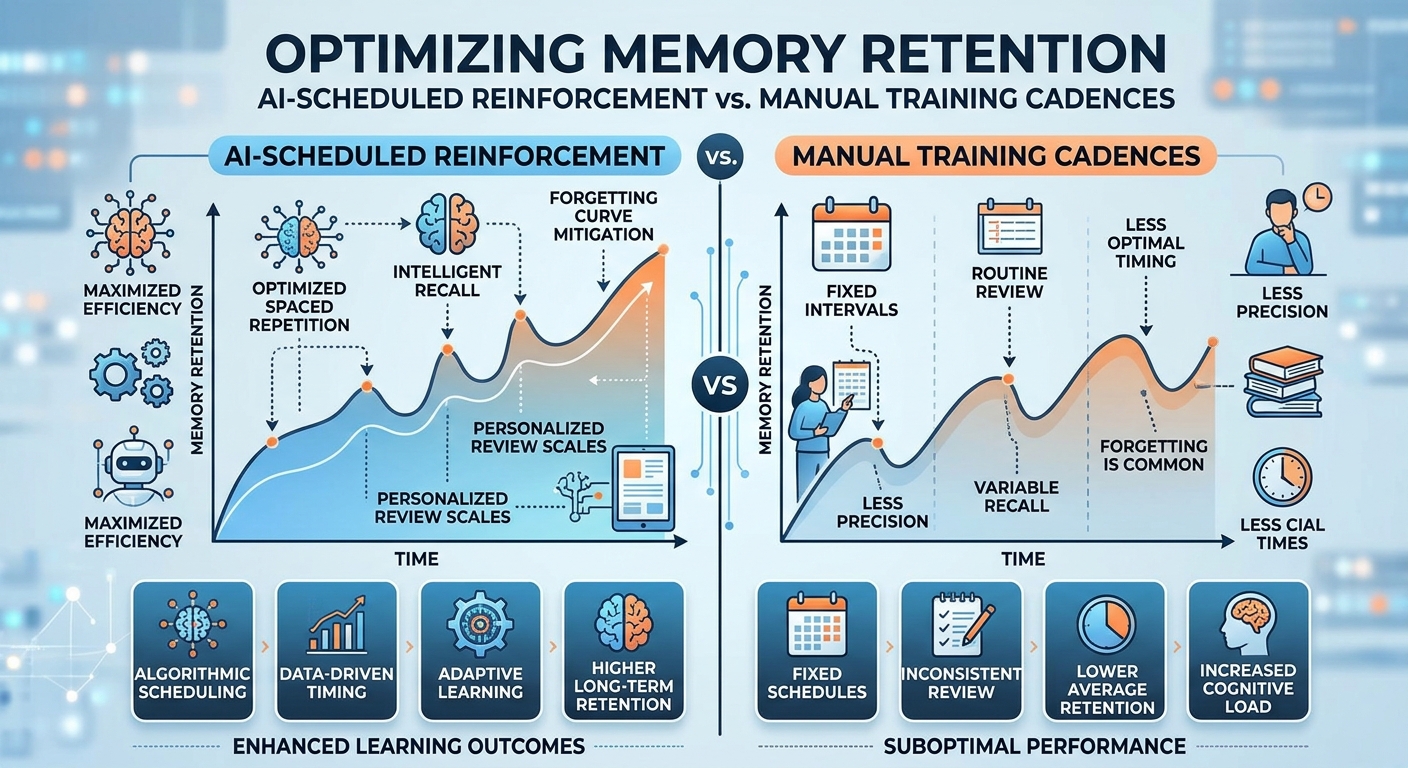
Hermann Ebbinghaus’s “forgetting curve” illustrates a stark reality: without reinforcement, learners rapidly forget newly acquired information. Within days, a significant portion of what was learned is lost. This phenomenon renders much of traditional training ineffective, leading to costly retraining, performance gaps, and potential compliance breaches. For L&D leaders, this translates to wasted resources and unfulfilled learning objectives.
Manual training cadences, often characterized by fixed schedules, annual refreshers, or periodic quizzes, attempt to combat this curve. While well-intentioned, these approaches face inherent limitations in today’s fast-paced, individualized learning environment.
Manual Training Cadences: The Familiar Road
Traditional manual training relies on a human-centric approach to scheduling and delivery. L&D teams meticulously plan training modules, set fixed review dates, and deploy follow-up materials based on generalized assumptions about learning pace and retention needs. This method offers a sense of control and predictability, which can be reassuring for large organizations.
Pros of Manual Cadences:
- Simplicity: Easier to plan for a uniform group.
- Familiarity: Established processes and comfort for learners and trainers.
- Human Touch: Direct instructor involvement and feedback.
Cons of Manual Cadences:
- One-Size-Fits-All: Fails to account for individual learning speeds and knowledge gaps, leading to inefficiencies.
- Inflexibility: Difficult to adapt quickly to evolving business needs, regulatory changes, or individual performance metrics.
- Inefficiency: Over-reinforcement for some, under-reinforcement for others, resulting in suboptimal resource allocation.
- Scalability Challenges: Becomes unwieldy and expensive when managing diverse training needs across vast workforces, such as those requiring Risk-focused Training in finance or extensive training for oil and gas operations.
The core issue with manual methods is their inability to dynamically respond to the unique needs of each learner at the precise moment reinforcement is most effective. This is where Artificial Intelligence steps in as a game-changer.
The Intelligent Edge: AI-Scheduled Reinforcement
AI-scheduled reinforcement represents a paradigm shift, moving beyond generalized training to hyper-personalized learning journeys. An advanced Microlearning LMS leverages AI algorithms to analyze individual learner data – performance on quizzes, engagement with content, time spent on modules, and even historical retention patterns. Based on this rich data, AI intelligently predicts when a learner is most likely to forget specific information and delivers timely, targeted reinforcement.
This approach moves from a reactive, periodic model to a proactive, adaptive one. Imagine a sales professional learning about new financial products for the american bankers association training or an employee undergoing online medical billing and coding training. Instead of a generic reminder, AI can identify precisely which concepts they struggled with, and at what optimal interval to re-present that content to maximize retention.
Key Benefits of AI-Driven Memory Optimization for L&D Leaders
1. Hyper-Personalization and Adaptive Learning
AI crafts unique learning paths for every individual. It recognizes that someone excelling in training for mining safety might need more reinforcement on administrative procedures, while another might need constant refreshers on equipment handling. This level of customization ensures that every moment spent learning is impactful, directly addressing individual knowledge gaps.
2. Enhanced Engagement and Motivation
By delivering relevant content at the opportune moment, AI keeps learners engaged. Coupled with features of a Gamified LMS, AI can turn reinforcement into an interactive, rewarding experience. This dramatically improves learner motivation, particularly in ongoing training scenarios like retail staff training or healthcare academy training.
3. Optimal Efficiency and ROI
AI ensures that training resources are used effectively. By pinpointing exactly what and when to reinforce, it eliminates redundant training, reduces the need for expensive re-training sessions, and accelerates skill mastery. This translates directly into a stronger return on investment for L&D budgets.
4. Scalability for Enterprise-Level Training
For organizations with thousands of employees across diverse roles and geographies, manual scheduling is a logistical nightmare. An AI-powered enterprise learning management system can effortlessly manage individualized reinforcement schedules for an entire workforce, from investment banking prep course participants to those needing personal training insurance knowledge.
5. Intelligent Content Creation and Delivery
Beyond scheduling, AI can also inform content development. An AI Powered Authoring Tool can analyze learning data to highlight areas where content might be unclear or ineffective, guiding L&D teams to create more impactful modules from the outset.
Addressing L&D Leaders’ Strategic Inquiries
“How can AI improve training for our global sales teams, ensuring regional compliance and maximizing performance?”
AI-scheduled reinforcement adapts dynamically to geographic nuances and specific market demands. For a global sales force, AI can personalize compliance updates based on regional regulations, deliver product knowledge in local languages, and reinforce sales tactics tailored to local market conditions. This ensures that every team member, regardless of location, receives timely and relevant reinforcement that directly impacts their performance and adherence to local compliance requirements.
“What’s the immediate impact of AI on learner engagement and retention rates across various departments?”
The immediate impact is a significant uplift in both engagement and retention. By receiving micro-lessons or quizzes at the exact moment they’re needed, learners feel supported and challenged, not overwhelmed. This precision prevents knowledge decay, leading to higher retention rates. Enhanced engagement stems from the relevance and timeliness of the content, making learning feel less like a chore and more like a continuous, supportive growth process.
“Can AI help us develop more relevant content for specific job roles, like pharmaceutical sales training or specialized training for retail staff?”
Absolutely. AI not only schedules reinforcement but also provides invaluable insights into content effectiveness. By tracking which modules or questions are frequently missed or mastered, AI helps L&D teams understand where content improvements are needed. For highly specialized roles, this data can guide the creation of ultra-specific microlearning modules, ensuring that content for online medical billing and coding training or healthcare academy training is always precise and impactful, directly addressing the unique learning needs of those professions.
Implementing AI-Driven Reinforcement in Your Organization
For L&D leaders considering this evolution, the path involves choosing the right technology. A robust learning management system (LMS) or learning content management system (LCMS) with integrated AI capabilities is crucial. Look for solutions that offer a cloud based learning management system for accessibility and scalability. MaxLearn LMS is an example of a platform designed to meet these modern demands.
Considerations for Adoption:
- Data Security: Ensure your chosen platform prioritizes data privacy and compliance.
- Integration: Seamless integration with existing HRIS and other enterprise systems.
- Pilot Programs: Start with a pilot group to demonstrate effectiveness and gather feedback.
- Change Management: Prepare your learners and trainers for this new, adaptive approach to learning.
Conclusion
The choice between AI-scheduled reinforcement and manual training cadences is not merely about technology; it’s about strategic investment in your workforce’s intellectual capital. While manual methods have served their purpose, the complexities and demands of today’s industries necessitate a more intelligent, adaptive, and efficient approach to memory retention. AI-powered platforms offer the precision, personalization, and scalability required to overcome the forgetting curve, transform learning outcomes, and ultimately drive superior business performance. For L&D leaders ready to future-proof their training initiatives, embracing AI is not just an option, but a strategic imperative for cultivating a truly knowledgeable and high-performing organization.
No responses yet