

What Is the Link Between Skinner’s Reinforcement Schedules and Spaced Repetition?
In the dynamic world of corporate learning and development, fostering lasting knowledge retention and driving measurable performance improvements are paramount. L&D leaders are constantly seeking innovative strategies and technologies to optimize training outcomes, whether it’s for Microlearning LMS deployments or comprehensive skill-building initiatives. At the heart of many effective modern learning techniques lies a surprisingly potent connection to foundational psychological principles, particularly B.F. Skinner’s work on reinforcement schedules and the cognitive science behind spaced repetition.
For Vice Presidents, Directors, and Senior Managers overseeing training in sectors like pharmaceutical sales, banking, healthcare, or retail, understanding this link isn’t just academic; it’s a strategic advantage. It illuminates why certain learning approaches succeed where others fail, offering a blueprint for designing more impactful and efficient training programs. Let’s delve into how Skinner’s behavioral insights lay a powerful, often overlooked, foundation for the efficacy of spaced repetition.
Skinner’s Reinforcement Schedules: The Foundation of Learned Behavior
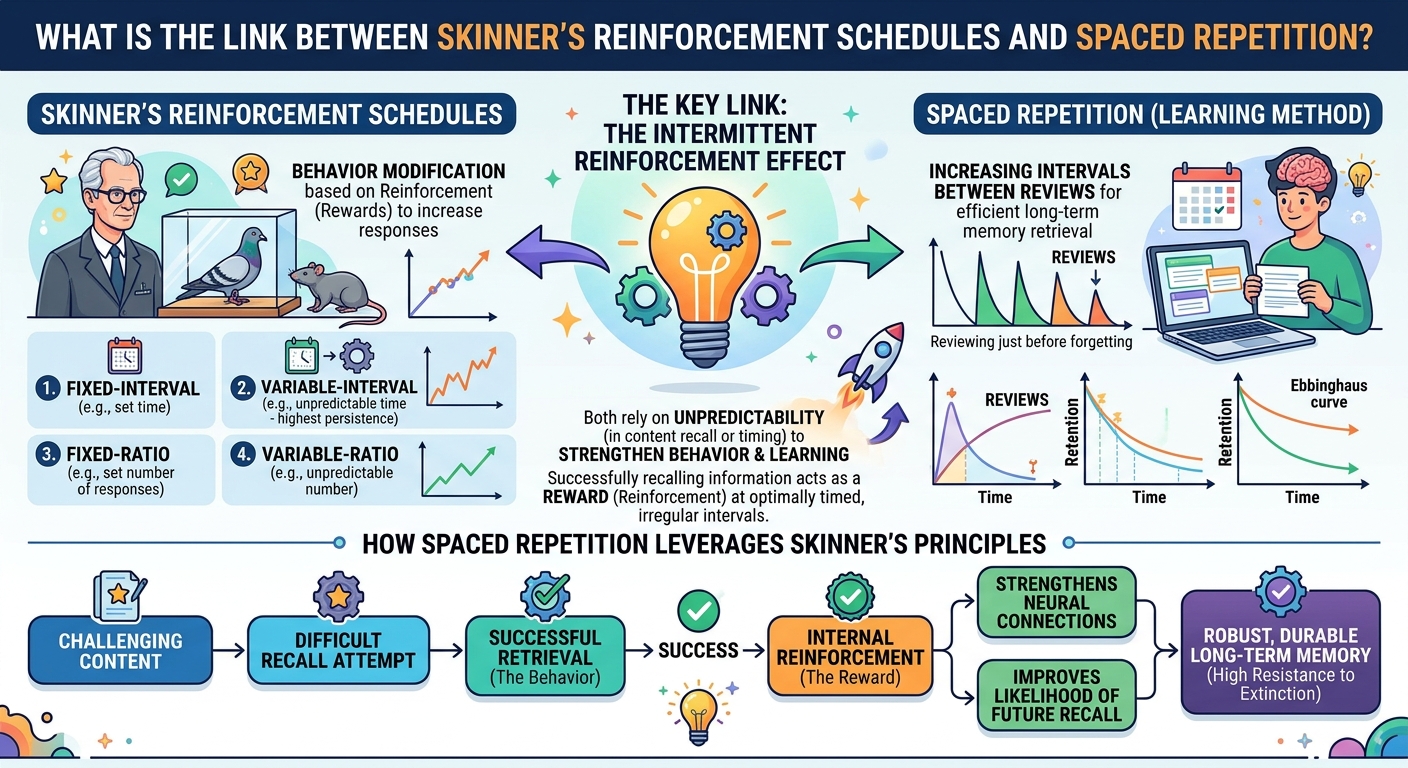
B.F. Skinner, a pioneer in behaviorism, revolutionized our understanding of how consequences shape behavior through his theory of operant conditioning. His research demonstrated that behaviors followed by rewarding consequences are more likely to be repeated, while those followed by punitive consequences are less likely. Central to this theory are reinforcement schedules—the rules that determine how and when a response will be reinforced.
Skinner identified four primary schedules:
- Fixed Ratio (FR): Reinforcement occurs after a fixed number of responses. Think of a salesperson receiving a bonus after every ten sales. This schedule often leads to a high, steady response rate.
- Variable Ratio (VR): Reinforcement occurs after an unpredictable number of responses. This is exemplified by gambling, where payouts are random. VR schedules produce very high and consistent response rates, making the behavior highly resistant to extinction.
- Fixed Interval (FI): Reinforcement occurs for the first response after a fixed amount of time. An employee receiving a weekly paycheck is an example. Response rates tend to increase as the time for reinforcement approaches.
- Variable Interval (VI): Reinforcement occurs for the first response after an unpredictable amount of time. Checking email for a response is a common example. This schedule produces a slow, steady rate of response.
From
pharmaceutical sales training
requiring consistent product knowledge recall to
american bankers association training
for regulatory compliance, these schedules subtly influence how employees engage with and retain information. A well-designed
LMS
or
Learning content management system
can leverage these principles, perhaps unknowingly, to shape learning behaviors.
The Cognitive Science Behind Spaced Repetition
Moving from behavioral psychology to cognitive science, we encounter Hermann Ebbinghaus and his seminal work on the “forgetting curve.” Ebbinghaus’s research in the late 19th century revealed that humans rapidly forget newly learned information unless it is actively recalled. His solution: spaced repetition.
Spaced repetition is an evidence-based learning technique that involves reviewing information at progressively longer intervals. Initially, a new piece of information might be reviewed within minutes, then hours, then days, weeks, and months. The crucial insight is that each successful recall acts as a mini-reinforcement, strengthening the memory trace and pushing the forgetting curve further out. This technique is indispensable for high-stakes learning such as
online medical billing and coding training
,
healthcare academy training
, or complex
investment banking prep course
material.
The Unexpected Link: Reinforcement in Repetition
So, how do Skinner’s reinforcement schedules connect to spaced repetition? The link lies in the very act of successful recall within a spaced repetition system. When a learner successfully retrieves information from memory, that act of retrieval serves as a form of positive reinforcement. The brain “rewards” itself for the correct answer, making it more likely to retain that information in the future.
Consider the variable nature of spaced repetition intervals, especially in adaptive systems. A learner might review a concept, correctly recall it, and then be presented with it again at a longer, unpredictable interval based on their performance. This mirrors a
Variable Ratio (VR)
schedule in a subtle but powerful way: the “reward” (successful recall and progression) comes after a variable ‘effort’ (time spent forgetting and then remembering). This variability, much like in gambling, can be highly engaging and motivating, leading to persistent effort in learning. It’s not just about repetition; it’s about the successful ‘win’ of recall, reinforced on an optimized schedule.
AI-Driven Learning: Modernizing Skinner’s Principles
In today’s corporate landscape, the convergence of Skinner’s principles, spaced repetition, and artificial intelligence offers unprecedented opportunities for L&D leaders.
AI Powered Authoring Tool
within a
cloud based learning management system
or
enterprise learning management
solution can dynamically create and manage these sophisticated reinforcement schedules.
How can AI personalize training schedules for maximum impact?
AI algorithms analyze individual learner performance, identifying knowledge gaps and predicting forgetting curves with remarkable accuracy. This allows the system to deliver timely, targeted reviews—reinforcing correct responses and remediating errors. Imagine
training for oil and gas
employees needing to master complex safety procedures, or
training for mining
personnel requiring precise equipment operation knowledge. An AI-powered platform can ensure critical information is revisited just before it’s forgotten, acting as an optimal variable interval reinforcement mechanism for memory.
Which learning platforms are best suited for driving engagement in specific industries?
Modern
MaxLearn LMS
solutions integrate principles of gamification and adaptive learning to keep learners engaged. For example, a Gamified LMS might award points or badges for correct recalls and consistent engagement, mirroring fixed ratio reinforcement for learning activities. These platforms are proving invaluable for
training for retail
, enhancing skills for
retail staff training
, and ensuring
training for retail employees
master product knowledge and customer service protocols.
Where are intelligent tutoring systems most impactful in optimizing knowledge retention?
The ability of AI to adapt content and schedule repetition makes it profoundly impactful across industries. For sectors like finance, where regulatory changes are constant, Adaptive Learning systems using spaced repetition ensure that bankers remain current with
personal training insurance
requirements or new financial products. This proactive reinforcement prevents skill decay and maintains high levels of compliance and performance. The goal is to provide constant, tailored reinforcement to keep critical knowledge top of mind, preventing the need for costly retraining.
Practical Applications for L&D Leaders
For L&D professionals, the implications are clear: integrating spaced repetition, ideally powered by AI, into your learning strategy is not just a trend; it’s a scientifically validated approach to maximizing retention and skill development. Here’s how:
- Strategic Content Delivery: Design learning modules, especially for high-stakes compliance training, that naturally incorporate spaced review points. A
Learning management software
that supports granular content tagging can facilitate this.
- Leverage Adaptive Technology: Invest in
learning management solutions
that offer adaptive learning paths and intelligent scheduling for spaced repetition. This takes the guesswork out of designing optimal intervals.
- Gamify for Engagement: Incorporate game-like elements where successful recall or completion of review cycles earns points, badges, or progression. This taps into the motivational power of variable ratio reinforcement.
- Measure and Refine: Utilize the robust analytics of a modern
lms learning management system
to track retention rates and learner performance. This data can inform continuous improvement of your training programs, making them more effective at reinforcing desired knowledge and behaviors.
Conclusion
The link between Skinner’s reinforcement schedules and spaced repetition is a powerful testament to the enduring relevance of psychological principles in modern learning. By understanding how successful recall acts as a form of reinforcement, particularly when delivered on a variable schedule, L&D leaders can design more effective training that embeds knowledge deeply and resists forgetting. As technology continues to advance, particularly with AI, the ability to implement these sophisticated, personalized reinforcement schedules at scale will only grow, transforming corporate learning into a truly impactful driver of organizational performance across all industries.
No responses yet