

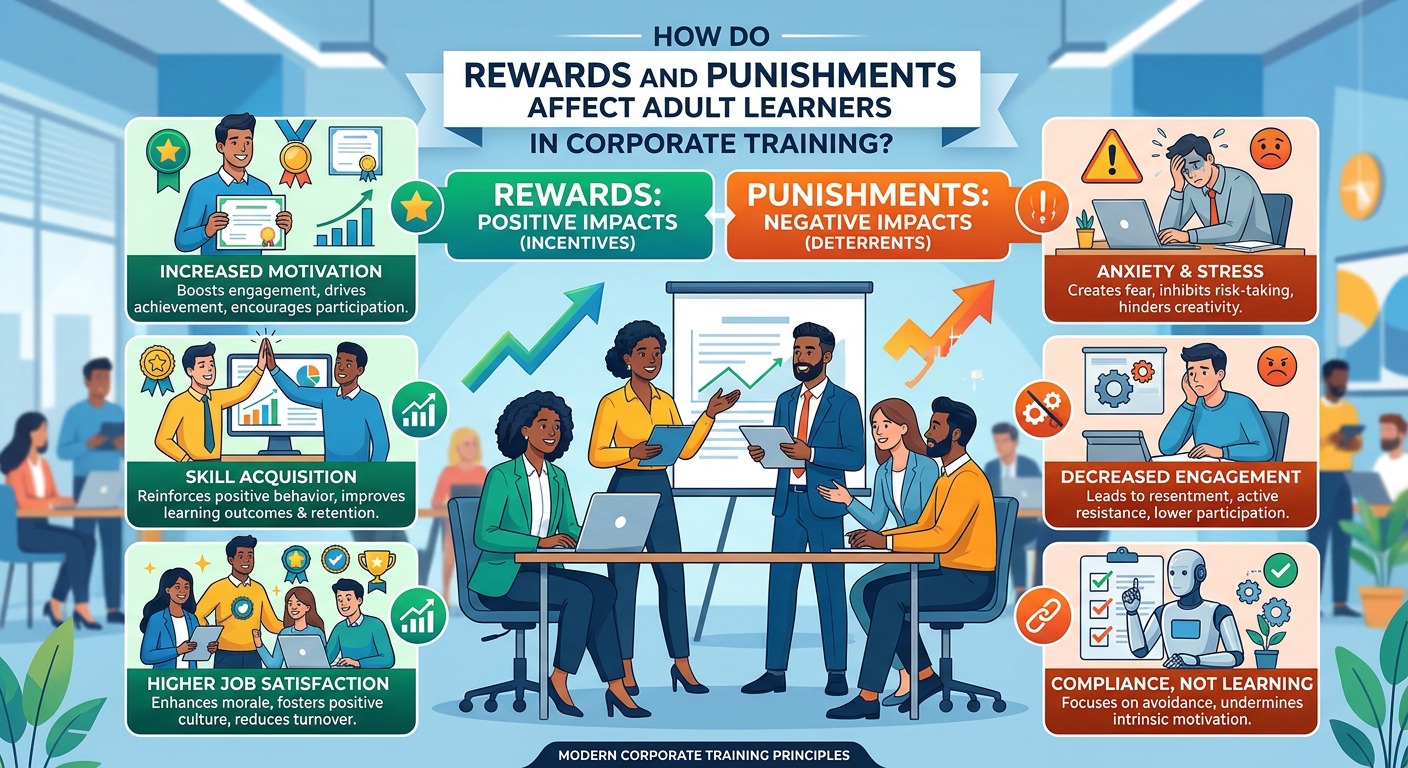
The Art and Science of Motivation: How Rewards and Punishments Affect Adult Learners in Corporate Training
In the dynamic landscape of corporate learning and development, understanding what truly motivates adult learners is paramount. As L&D leaders, VPs, Directors, and Managers across diverse sectors—from Compliance and Sales to Banking, Finance, Insurance, Retail, Pharma, Health care, Hospitality, Oil and Gas, and Mining—you’re constantly seeking strategies to maximize training effectiveness. This often brings to the forefront the age-old debate: what role do rewards and punishments play in shaping learning behaviors and outcomes among seasoned professionals?
Unlike children, adult learners come with a wealth of experience, established work ethics, and often, intrinsic motivations. Their learning isn’t just about absorbing information; it’s about applying knowledge, mastering new skills, and contributing more effectively to organizational goals. Therefore, the application of rewards and punishments in corporate training must be nuanced, strategic, and deeply rooted in adult learning principles.
Understanding the Adult Learner Psyche
Adult learning, or andragogy, posits that mature learners are typically self-directed, pragmatic, and goal-oriented. They learn best when they understand the relevance of the training to their roles and careers. Their motivation is often driven by:
- A desire for self-improvement and career advancement.
- The need to solve real-world problems.
- A drive for competence and mastery.
- Intrinsic satisfaction from learning new things.
Given these characteristics, L&D strategies must move beyond simplistic carrot-and-stick approaches, focusing instead on fostering genuine engagement and long-term behavioral change.
The Power of Rewards in Corporate Training
Rewards, when appropriately designed and implemented, can be powerful motivators for adult learners. They can reinforce desired behaviors, boost engagement, and create a positive learning environment.
Intrinsic Rewards: Fueling the Inner Drive
Intrinsic rewards tap into an individual’s internal satisfaction and sense of accomplishment. These are often the most effective and sustainable motivators for adult learners. They include:
- Mastery and Competence: The satisfaction of truly understanding a complex subject, such as advanced concepts in `investment banking prep course` or intricate `online medical billing and coding training`.
- Purpose and Meaning: Understanding how their learning contributes to larger organizational goals, vital for `pharmaceutical sales training` where product knowledge directly impacts patient well-being, or Risk-focused Training in financial compliance.
- Autonomy: The freedom to choose learning paths or pace, often facilitated by a flexible Microlearning LMS that caters to individual needs.
- Recognition and Peer Validation: Acknowledgment from peers or superiors for effort and achievement, fostering a sense of value.
Extrinsic Rewards: Strategic Enhancements
Extrinsic rewards are tangible or external motivators. While less sustainable than intrinsic rewards, they can be highly effective when used strategically to kickstart engagement or acknowledge significant milestones. Examples include:
- Certifications and Qualifications: Official recognition that enhances professional credibility, crucial for `american bankers association training` or `personal training insurance` certifications.
- Performance Bonuses or Incentives: Directly linking successful completion of critical training (e.g., `training for oil and gas` safety protocols) to tangible rewards.
- Promotional Opportunities: Highlighting how advanced training can open doors to new roles or responsibilities.
- Gamification Elements: Badges, leaderboards, points, and virtual trophies within a Gamified LMS. These turn learning into an engaging, competitive, and fun experience, highly effective for `training for retail employees` or `retail staff training` to boost product knowledge and sales techniques.
The key is to use extrinsic rewards to complement, not replace, intrinsic motivation. They should feel earned and valued, not simply transactional.
The Double-Edged Sword: Punishments in Corporate Training
While the concept of punishment might seem harsh for adult learning, its shadow often looms in the form of negative consequences for non-compliance or poor performance. However, applying direct “punishments” in training is generally counterproductive for adult learners.
Direct Punishments: Rarely Effective
Direct punishments, such as public shaming, punitive measures for failing a module, or exclusion from opportunities, typically elicit negative emotions like resentment, anxiety, and defiance. They can:
- Damage morale and foster a negative perception of learning.
- Lead to minimal compliance rather than genuine understanding or behavioral change.
- Stifle creativity and open communication.
- Reduce engagement and willingness to participate in future training.
In most corporate training contexts, direct punishments are avoided, as they conflict with the principles of adult learning and a positive workplace culture.
Indirect Punishments or Negative Reinforcement: Avoiding Undesirable Outcomes
More often, the “punishment” in corporate training manifests as the avoidance of negative consequences. This is negative reinforcement, where learners engage in training to prevent an undesirable outcome. Examples include:
- Compliance Mandates: Completing mandatory `healthcare academy training` or `training for mining` to avoid legal penalties, regulatory fines, or job termination.
- Performance Deficiencies: Undertaking remedial training to avoid poor performance reviews or missed sales targets.
- Reputational Risks: Ensuring all employees complete essential training to protect the company’s brand and customer trust.
While effective for critical compliance, relying too heavily on fear of negative consequences can still lead to surface-level learning and a tick-box mentality, rather than deep understanding and enthusiastic application.
Balancing the Scales: A Modern, Engaging Approach
For L&D leaders, the optimal strategy lies in emphasizing positive reinforcement, fostering intrinsic motivation, and using technology to create highly engaging and relevant learning experiences. This involves moving beyond basic rewards and punishments towards a holistic approach that respects adult learners’ autonomy and professionalism.
Leveraging AI for Optimal Engagement and Relevance
The strategic integration of artificial intelligence (AI) within a robust learning ecosystem can transform how we manage motivation and learning outcomes. AI helps tailor experiences, making rewards more impactful and minimizing the need for punitive measures by proactive engagement.
For example, how can we predict which training modules will resonate most with a sales team, say, for `pharmaceutical sales training`?
Advanced analytics, powered by AI, can analyze engagement data from past learning modules, learner demographics, and job roles. This allows L&D teams to anticipate successful content, recommend personalized learning paths, and even adapt content delivery to individual preferences. This proactive approach ensures relevance, making the learning itself a reward.
What’s the best way to ensure critical compliance training is not just completed, but truly understood across diverse global teams?
Modern learning management software utilizes AI to identify knowledge gaps dynamically. For instance, in `healthcare academy training` or crucial `training for mining`, if a learner struggles with a specific concept, the system can automatically provide additional resources, interactive scenarios, or supplementary modules. This ensures deep understanding beyond mere completion, which is critical for areas like `american bankers association training` or `online medical billing and coding training`.
How can we make learning personal and relevant for each employee, from `training for retail employees` to an `investment banking prep course`?
AI-driven learning platforms can curate individualized learning journeys based on a learner’s prior knowledge, performance data, and specific job function. This approach ensures that a sales associate undergoing `retail staff training` receives content that is as targeted and effective as modules designed for a professional obtaining `personal training insurance`. Adaptive Learning enhances this personalization, boosting intrinsic motivation and making the learning process inherently rewarding.
The Role of Technology: Modern LMS Solutions
Implementing effective reward systems and minimizing the reliance on punishment hinges on robust learning technology. A comprehensive Learning Content Management System (LCMS) is central to this strategy. A modern learning management system (LMS) or enterprise learning management platform offers the tools necessary to:
- Deliver highly relevant and engaging content: From interactive modules for `training for retail` to complex simulations for `training for oil and gas`.
- Track progress and provide constructive feedback: Allowing managers to identify areas for improvement and celebrate successes.
- Personalize learning paths: Using features to cater to individual needs and pace.
- Provide accessible, cloud-based learning management system solutions: Ensuring training is available anytime, anywhere, for employees in diverse industries like hospitality or health care.
Platforms like MaxLearn LMS exemplify the future of learning management software and learning management solutions, offering the enterprise learning management capabilities needed to implement these sophisticated strategies. The right LMS learning management system becomes the backbone for a positive and productive learning culture.
Conclusion
The impact of rewards and punishments on adult learners in corporate training is complex and multifaceted. While intrinsic rewards and positive reinforcement are overwhelmingly effective in fostering deep learning, engagement, and sustainable behavioral change, extrinsic rewards can play a supportive role. Direct punishments, however, are generally detrimental to the adult learning experience.
L&D leaders must embrace a forward-thinking approach, leveraging insights from adult learning principles and advanced technology, including AI-driven platforms and modern learning management systems. By creating a learning environment that is engaging, relevant, personalized, and intrinsically rewarding, organizations can empower their adult learners to excel, drive innovation, and achieve their strategic objectives across all industries.
No responses yet