

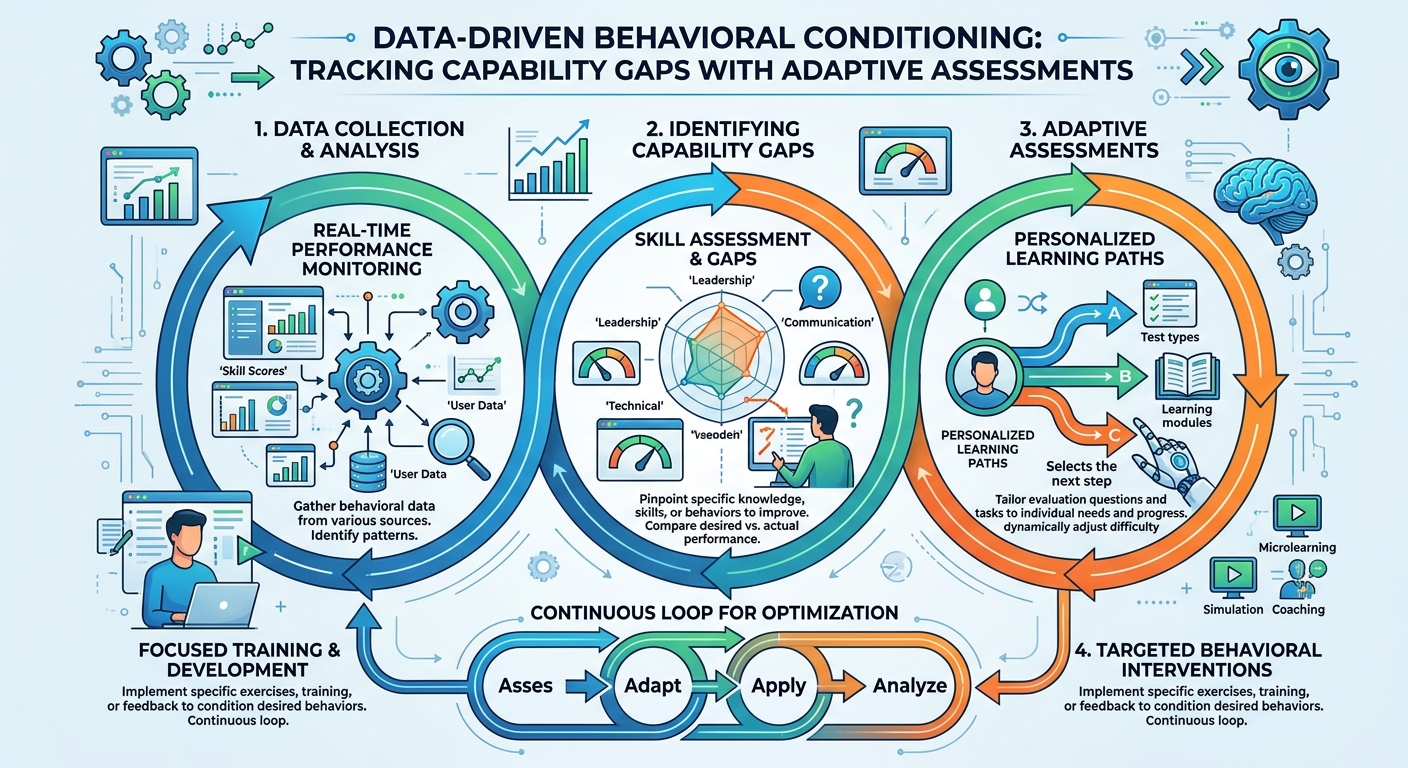
Data-Driven Behavioral Conditioning: Tracking Capability Gaps with Adaptive Assessments
In today’s rapidly evolving corporate landscape, traditional learning and development approaches often fall short. Organizations across sectors—from AI Powered Authoring Tool for pharmaceutical sales training to complex compliance training for banking and healthcare—are grappling with a critical challenge: how to move beyond mere knowledge transfer to actual, measurable behavioral change. The answer lies in data-driven behavioral conditioning, powered by intelligent, adaptive assessments that precisely identify and address capability gaps.
For Vice Presidents, Directors, and Senior Managers of L&D, the imperative is clear: optimize training investments for maximum impact. This means understanding not just what employees know, but what they can *do*, and how their actions align with business objectives. Static, one-size-fits-all assessments are no longer sufficient. We need dynamic tools that adapt to individual learners, pinpointing weaknesses with surgical precision and paving the way for targeted, effective interventions.
The Evolving Landscape of Corporate Learning
The modern workforce demands more than just classroom lectures or generic e-learning modules. Industries like finance, with the intricate demands of Risk-focused Training for investment banking prep course, or the safety-critical environment of training for oil and gas and training for mining, require a learning experience that is immediate, relevant, and impactful. The goal isn’t just to complete a course; it’s to embed new skills and foster desired behaviors that directly contribute to performance and compliance.
Beyond Traditional Training: The Need for Behavioral Conditioning
Behavioral conditioning in a learning context refers to the systematic process of reinforcing desired behaviors and modifying undesirable ones through targeted training and feedback. This is particularly crucial in high-stakes environments such as healthcare academy training, where clinical decisions have direct patient impact, or for personal training insurance agents who need to consistently apply ethical sales practices.
Achieving this requires a deep understanding of individual learner profiles, their existing competencies, and their specific areas for growth. This level of insight is unattainable with outdated methods but becomes entirely feasible with a robust learning management system (LMS) that embraces data analytics and adaptive strategies.
Unveiling Capability Gaps with Adaptive Assessments
Adaptive assessments are a game-changer because they dynamically adjust to the learner’s responses in real-time. Instead of a fixed set of questions, an adaptive assessment selects subsequent questions based on the learner’s performance on previous ones. If a learner performs well, the system might present more challenging questions; if they struggle, it might offer simpler questions or branch to remedial content.
This intelligent approach offers several benefits:
- Precision Diagnosis: Pinpoints exact knowledge deficits or skill gaps, rather than just a general “pass” or “fail.” For instance, in online medical billing and coding training, it can identify precisely which coding standard a learner misunderstands.
- Efficiency: Reduces assessment time by focusing only on relevant areas, preventing over-testing of already mastered topics.
- Personalization: Creates a unique assessment journey for each individual, making the experience more engaging and less frustrating.
- Actionable Data: Generates rich data sets that highlight trends across teams or departments, crucial for enterprise learning management strategy.
Consider the complexity of Microlearning LMS for american bankers association training. An adaptive assessment could quickly identify if a banker needs to brush up on specific regulatory compliance details or customer service protocols, tailoring subsequent training modules precisely to that need.
The Data-Driven Advantage: Powering Personalized Learning Paths
The true power of adaptive assessments comes alive when their data outputs are fed into a sophisticated Adaptive Learning system. This creates a continuous feedback loop:
- Assess: Adaptive assessments identify capability gaps.
- Analyze: The learning management software processes this data.
- Assign: The system automatically recommends or assigns personalized learning content, often delivered as bite-sized microlearning modules.
- Apply: Learners engage with targeted content designed to address their specific gaps.
- Re-assess: The cycle repeats, tracking progress and reinforcing new behaviors.
This dynamic process ensures that training resources are allocated efficiently, focusing on areas where improvement is most needed. A cloud based learning management system, combined with a robust learning content management system (LCMS), facilitates the seamless delivery and tracking of these personalized journeys. Solutions like MaxLearn LMS exemplify how a modern learning management system can support this data-driven paradigm.
AI’s Role in Shaping Adaptive Learning Experiences
Artificial Intelligence (AI) is rapidly transforming how we design and deliver adaptive learning. It’s not just about automating tasks; it’s about making learning intrinsically smarter and more responsive to human needs.
How can technology optimize learning paths for individual employees?
Intelligent algorithms analyze performance data from adaptive assessments, learning styles, and even engagement metrics to dynamically re-sequence or recommend learning modules. This ensures each learner receives content optimally suited to their current understanding and pace, drastically reducing time-to-competency.
Can sophisticated systems predict an employee’s future performance or potential challenges?
Absolutely. By analyzing historical data – including assessment scores, completion rates, and behavioral patterns – advanced analytics can identify early warning signs of skill degradation or predict areas where an employee might struggle with new responsibilities. This proactive insight allows L&D teams to intervene with preventative training, like specialized retail staff training before a new product launch, safeguarding against potential performance dips.
How can learning content be personalized to an unprecedented degree for every individual?
AI-powered authoring tools can automatically generate variations of content, tailor examples to a learner’s specific job role or industry (e.g., specific scenarios for training for retail employees versus oil and gas engineers), and even suggest optimal media formats based on past preferences. This level of customization makes learning incredibly relevant and engaging, leading to more profound behavioral shifts.
Fostering Behavioral Change Through Targeted Interventions
Once capability gaps are identified and personalized learning paths are established, the next step is to ensure that the learning experience itself promotes engagement and retention. This is where modern learning management solutions shine. Incorporating elements of a Gamified LMS can transform compliance training, for example, into an interactive and rewarding experience. Leaderboards, badges, and progress tracking motivate learners to complete modules and apply new skills.
Targeted interventions, informed by continuous data, are crucial for behavioral conditioning. If an assessment reveals a specific compliance weakness across a team, microlearning modules can be deployed instantly to reinforce correct procedures. If data shows a drop in confidence after a particular training, follow-up coaching or peer-to-peer learning opportunities can be facilitated, all tracked and managed through an integrated enterprise learning management platform.
Real-World Impact Across Industries
The application of data-driven behavioral conditioning through adaptive assessments is transformative for a wide array of industries:
- Compliance: Ensures critical knowledge and behaviors are embedded for roles requiring strict adherence, such as American Bankers Association training or personal training insurance regulations.
- Sales: Elevates performance in pharmaceutical sales training and retail staff training by diagnosing specific skill gaps in product knowledge, objection handling, or customer engagement.
- Healthcare: Improves patient outcomes and operational efficiency through precise healthcare academy training and online medical billing and coding training, ensuring practitioners are up-to-date and competent.
- Heavy Industry: Enhances safety and operational excellence in training for oil and gas and training for mining by identifying and rectifying critical procedural knowledge gaps.
- Retail: Boosts customer satisfaction and sales through personalized training for retail employees, ensuring consistent brand experience and product expertise.
- Finance: Develops high-performing professionals in investment banking prep courses by rapidly addressing complex financial concepts and ethical behavior gaps.
By leveraging an advanced learning management system, L&D leaders can shift from reactive training to proactive, predictive learning strategies. This not only optimizes budget and resources but fundamentally transforms employee capabilities and business outcomes.
Embracing data-driven behavioral conditioning with adaptive assessments isn’t just an upgrade; it’s a strategic imperative for any organization aiming for sustained growth, compliance, and excellence in the modern era.
No responses yet