

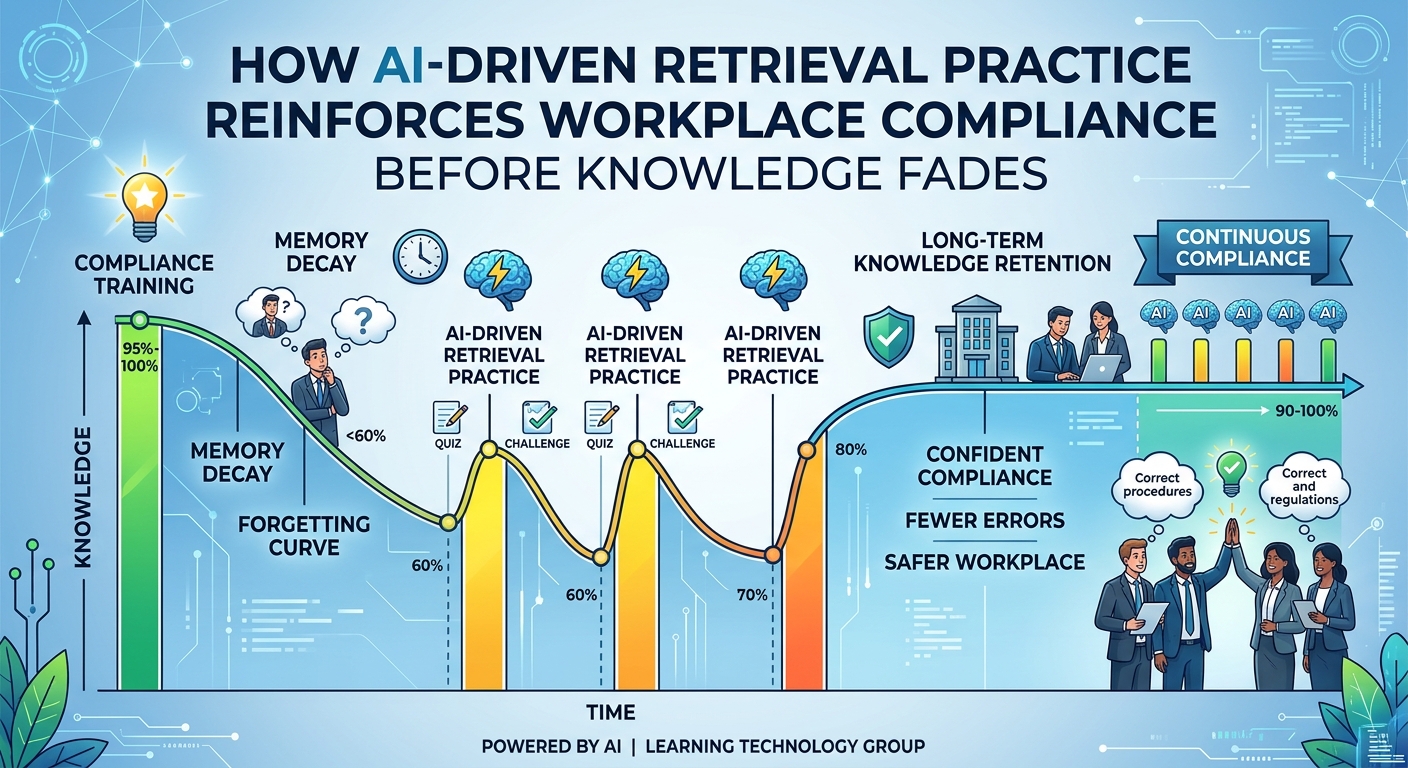
How AI-Driven Retrieval Practice Reinforces Workplace Compliance Before Knowledge Fades
In today’s rapidly evolving business landscape, compliance isn’t just a regulatory obligation; it’s the bedrock of reputation, operational integrity, and sustained growth. Yet, for L&D leaders across industries—from pharmaceutical sales training to training for oil and gas, online medical billing and coding training, and american bankers association training—a persistent challenge remains: ensuring compliance knowledge sticks. Traditional training methods, while necessary, often fall victim to the “forgetting curve,” leading to knowledge decay that leaves organizations vulnerable. Enter AI-driven retrieval practice, a transformative approach poised to revolutionize how we reinforce workplace compliance.
As leaders responsible for organizational learning and development, you understand the high stakes. Non-compliance can lead to hefty fines, legal battles, reputational damage, and even operational shutdowns. The question isn’t just how to deliver compliance training, but how to make it last. Can artificial intelligence enhance compliance training significantly?
The Pervasive Challenge: Knowledge Fading and Compliance Risk
Think about the last comprehensive compliance training your employees underwent. Weeks, perhaps even days, after the session, how much of that critical information do they truly retain? Herman Ebbinghaus’s forgetting curve illustrates that people forget approximately 50% of newly learned information within an hour, and up to 70% within 24 hours, if not actively reinforced. This inherent human characteristic poses a significant threat to compliance, especially in complex sectors like finance (investment banking prep course), healthcare (healthcare academy training), and even training for mining operations.
Traditional compliance training often relies on passive methods: lengthy presentations, dense manuals, and infrequent annual refreshers. While these fulfill a box-ticking exercise, they fail to embed knowledge deeply enough to withstand the forgetting curve. The result? Employees might pass a test today but struggle to apply compliance principles in real-world scenarios tomorrow, unknowingly creating risk-focused training gaps for the organization.
What is Retrieval Practice and Why Does it Work?
Retrieval practice, also known as “the testing effect” or “active recall,” is a powerful learning strategy where learners actively retrieve information from memory. Instead of passively re-reading or listening, they are prompted to recall facts, concepts, or procedures. This act of retrieval strengthens neural pathways, making it easier to access that information in the future. It’s not just about assessing what someone knows; it’s about enhancing what they learn and remember.
When applied to compliance, retrieval practice translates into regular, low-stakes quizzes, scenario-based questions, and interactive drills that challenge employees to recall and apply compliance rules. This proactive approach helps to cement understanding and build long-term retention far more effectively than traditional methods.
How AI Transforms Retrieval Practice for Unwavering Compliance
The true power of retrieval practice is unlocked when integrated with artificial intelligence. AI elevates this proven learning strategy from a simple quiz to a dynamic, personalized, and highly effective reinforcement system. How can AI help employees remember compliance rules longer?
Personalization and Adaptive Learning
One of AI’s greatest strengths is its ability to tailor learning experiences. An Adaptive Learning system powered by AI analyzes an individual’s performance, identifying their specific strengths and weaknesses. Instead of a one-size-fits-all approach, AI customizes the retrieval questions, focusing on areas where an employee struggles. This targeted practice ensures that every learner receives the most relevant and impactful reinforcement, maximizing their time and effort.
Spaced Repetition Optimized by AI
The timing of retrieval practice is crucial. Spaced repetition involves reviewing information at increasing intervals over time. AI algorithms can precisely calculate these optimal intervals for each piece of compliance knowledge and for every individual. Based on how well an employee answered a question previously, the AI schedules the next review for just before that knowledge is likely to fade, effectively disrupting the forgetting curve. This intelligent scheduling is a cornerstone of effective retention.
Identifying and Mitigating Knowledge Gaps
AI’s analytical capabilities extend beyond individual performance. By aggregating data across an entire workforce, AI can identify systemic knowledge gaps within specific departments, roles, or even the organization as a whole. For instance, if a high percentage of retail staff training employees consistently misunderstand a particular anti-fraud policy, AI flags this as a collective weakness. This data-driven insight allows L&D teams to proactively update training content, provide targeted interventions, and implement risk-focused training to address emerging compliance vulnerabilities.
Engaging Retrieval Through Microlearning and Gamification
To keep employees engaged, AI-driven retrieval practice often leverages Microlearning LMS modules and Gamified LMS elements. Short, digestible bursts of questions that can be completed in minutes prevent cognitive overload. Gamification—leaderboards, points, badges, and challenges—transforms compliance reinforcement into an enjoyable competition, motivating employees to participate regularly. This is particularly effective for large workforces undergoing training for retail employees or broad training for retail staff.
Real-World Impact Across Industries
The benefits of AI-driven retrieval practice resonate across diverse sectors:
- Pharmaceutical & Healthcare: Ensuring adherence to stringent regulatory guidelines, drug protocols, and patient data privacy (HIPAA). For pharmaceutical sales training, this means ensuring reps are always up-to-date on compliance surrounding product promotion.
- Banking & Finance: Reinforcing anti-money laundering (AML), Know Your Customer (KYC), and data security protocols. An american bankers association training program could use AI to ensure ongoing compliance with complex financial regulations.
- Retail & Hospitality: Upholding health and safety standards, customer service policies, and data protection for transactions. This is crucial for retail staff training, where staff turnover can be high.
- Oil & Gas & Mining: Reinforcing critical safety procedures, environmental regulations, and operational compliance to prevent catastrophic incidents. Training for oil and gas and training for mining operations are inherently high-risk, making consistent compliance knowledge vital.
- Insurance: Ensuring agents and brokers are compliant with underwriting guidelines, claims processing, and specific product regulations, including those for personal training insurance or other specialized policies.
Implementing AI-Driven Retrieval Practice with an LMS
To effectively deploy AI-driven retrieval practice, a robust LMS (Learning Management System) or LCMS (Learning Content Management System) is essential. An enterprise learning management system acts as the central hub for delivering, tracking, and analyzing all compliance training activities. Key features to look for in a cloud based learning management system include:
- AI-Powered Authoring Tools: For easily creating dynamic, adaptive content and questions.
- Automated Spaced Repetition Scheduling: To manage the delivery of retrieval prompts.
- Comprehensive Analytics: To provide insights into individual and organizational knowledge gaps.
- Integration Capabilities: With HRIS and other business systems for seamless data flow.
- Mobile Accessibility: Allowing employees to engage in retrieval practice anytime, anywhere.
Platforms like MaxLearn LMS offer comprehensive learning management software and learning management solutions designed to meet these needs, including an AI Powered Authoring Tool that streamlines content creation.
Strategic Advantages for L&D Leaders
Adopting AI-driven retrieval practice offers significant strategic advantages for L&D leaders:
- Measurably Higher Compliance: Reduced instances of non-compliance lead to fewer fines and legal issues.
- Reduced Organizational Risk: Proactive identification and mitigation of knowledge gaps prevent costly errors.
- Improved Employee Performance: Confident employees who understand and apply compliance rules operate more efficiently.
- Demonstrable ROI: Quantifiable improvements in compliance rates and reduced incident costs justify investment in intelligent learning management solutions.
- Agility: Rapid adaptation to new regulations and continuous reinforcement keeps the workforce current.
What intelligent tools are available for compliance skill reinforcement? The answer lies in integrated AI and retrieval practice within advanced lms learning management system platforms.
Conclusion
The era of passive compliance training is fading. As L&D leaders, the imperative is clear: move beyond merely delivering information to actively reinforcing it for lasting retention. AI-driven retrieval practice offers a powerful, scalable, and intelligent solution to embed critical compliance knowledge, transforming a potential weakness into a significant strength. By harnessing the power of artificial intelligence, organizations can ensure their workforce remains compliant, competent, and protected, long before vital knowledge has a chance to fade.
No responses yet