

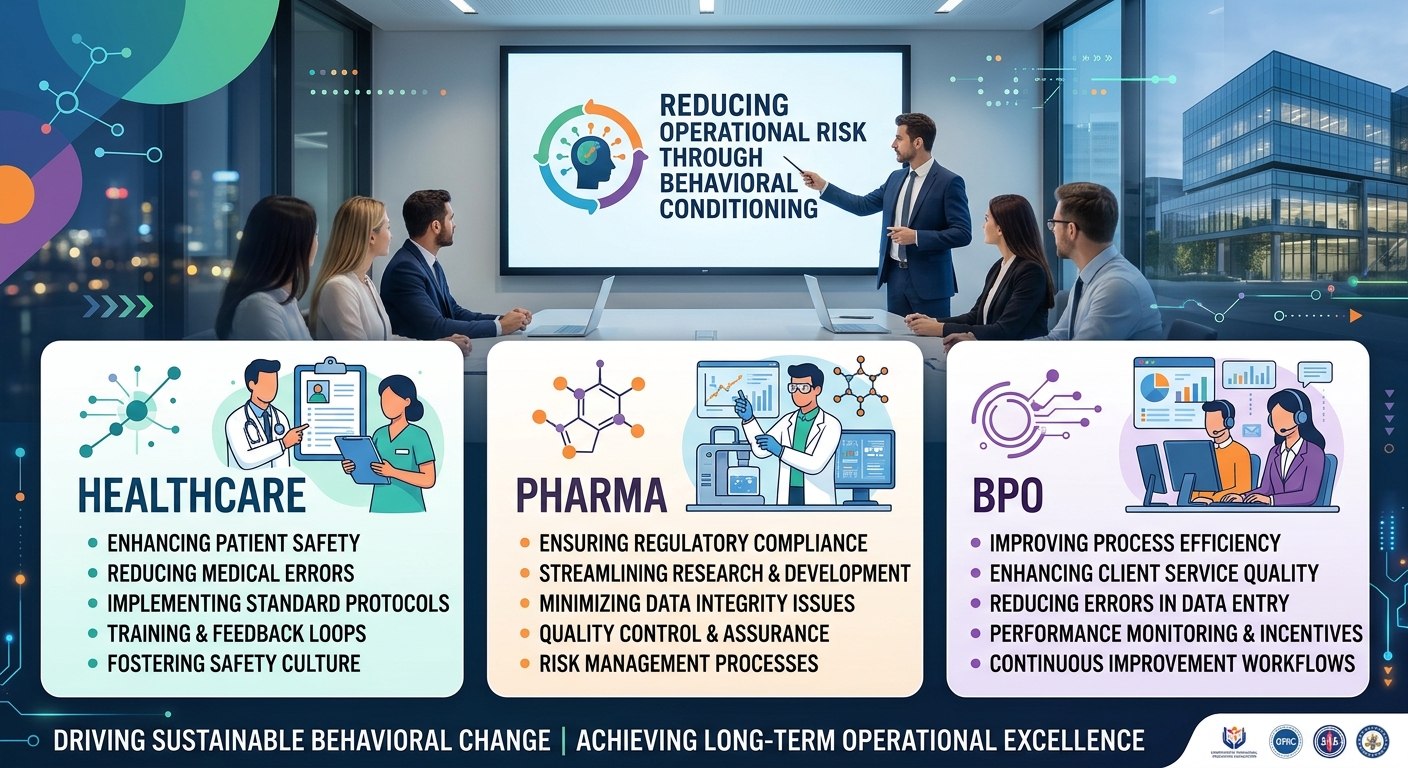
Reducing Operational Risk Through Behavioral Conditioning in Healthcare, Pharma, and BPO
In today’s dynamic business landscape, organizations across healthcare, pharmaceuticals, and Business Process Outsourcing (BPO) face an ever-present challenge: operational risk. From patient safety protocols and regulatory compliance to data integrity and service delivery, the stakes are incredibly high. While robust systems and processes are essential, the human element often remains the most significant variable. This is where behavioral conditioning, strategically applied through modern eLearning, emerges as a powerful tool for Vice Presidents, Directors, Senior Managers, and Managers of Learning & Development (L&D) to build a culture of precision, compliance, and excellence.
Operational risk encompasses a broad spectrum of potential failures stemming from inadequate or failed internal processes, people, and systems, or from external events. Human error, a primary driver of such risks, can lead to costly mistakes, reputational damage, and even severe consequences for lives. L&D leaders are uniquely positioned to address this through targeted interventions that shape and reinforce desired behaviors, ultimately fortifying an organization’s operational resilience.
The Human Element of Risk
Consider the delicate balance in healthcare, where a single lapse in protocol can have dire consequences. Or the pharmaceutical industry, where stringent adherence to Good Manufacturing Practices (GMP) and ethical sales conduct is non-negotiable. Even in the fast-paced world of BPO, errors in data entry, customer interaction, or process execution can erode client trust and profitability. In each scenario, the difference between success and failure often lies in individual employee actions and decisions.
Traditional training often focuses on knowledge transfer. While crucial, knowing what to do doesn’t always translate into doing it consistently, especially under pressure. Behavioral conditioning, when integrated into learning management solutions, shifts this paradigm. It’s about systematically reinforcing desired actions and discouraging undesirable ones, embedding them into the daily routines and subconscious responses of your workforce.
Behavioral Conditioning: A Strategic Imperative for L&D
What is Behavioral Conditioning in an Organizational Context?
At its core, behavioral conditioning in a professional setting involves creating learning environments that encourage and reward specific behaviors, while providing corrective feedback for deviations. This isn’t about rote memorization; it’s about developing muscle memory for correct procedures, ethical decision-making, and critical thinking. It involves techniques like spaced repetition, immediate feedback, scenario-based practice, and positive reinforcement, all designed to make the desired behavior the default action.
The Neuroscience Behind Effective Training
Modern neuroscience informs us that repetition, particularly with varied stimuli and timely feedback, helps to strengthen neural pathways associated with specific actions and responses. When an employee consistently practices a correct procedure through Gamified LMS simulations, or receives instant feedback on a decision, those pathways become more robust. This leads to faster, more accurate, and more automatic execution of tasks, reducing cognitive load and the likelihood of error. An effective learning management system leverages these principles to transform theoretical knowledge into ingrained habits.
Tailoring Behavioral Conditioning for Key Industries
Healthcare: Precision and Patient Safety
In healthcare, the need for precision is paramount. Behavioral conditioning can address critical areas such as medication administration, infection control protocols, and diagnostic accuracy. Through specialized Microlearning LMS modules, healthcare academy training can deliver bite-sized, frequent refreshers on critical procedures, reinforcing correct actions and reducing the likelihood of human error. Think of virtual simulations for emergency response or interactive checklists for surgical preparation, all designed to condition staff to react correctly under pressure. This approach enhances patient safety and ensures compliance with ever-evolving regulations, which is critical for Adaptive Learning platforms that cater to individual learning needs.
Pharmaceutical: Compliance and Innovation
The pharmaceutical industry navigates a complex web of regulations, from research and development to manufacturing and sales. Behavioral conditioning is vital for embedding a culture of compliance. For example, pharmaceutical sales training can use scenario-based training to reinforce ethical sales practices and regulatory guidelines, ensuring representatives automatically adhere to strict promotional rules. Similarly, manufacturing teams can practice GMP adherence through interactive modules that provide immediate feedback on process steps, solidifying correct procedures and minimizing costly deviations. This proactive approach reduces audit risks and supports continuous innovation by ensuring foundational compliance is ingrained.
Business Process Outsourcing (BPO): Efficiency and Quality Assurance
BPO operations thrive on efficiency, accuracy, and consistent service delivery. Behavioral conditioning can significantly reduce errors in data processing, improve customer interaction quality, and enhance overall operational throughput. For agents handling online medical billing and coding training, repeated practice with diverse case studies and instant validation of entries can minimize billing errors and improve claim accuracy. For customer service roles, interactive modules can condition agents to use empathetic language, follow conflict resolution protocols, and upsell effectively, leading to higher customer satisfaction and reduced escalations. A robust cloud based learning management system is essential for scaling such training across distributed teams.
Leveraging Modern Learning Technologies for Behavioral Change
The efficacy of behavioral conditioning in the workplace is dramatically amplified by sophisticated eLearning platforms. An enterprise learning management system provides the infrastructure to design, deploy, and track these targeted interventions at scale. These systems are more than just content repositories; they are dynamic environments for behavioral transformation.
AI-Driven Insights and Personalized Learning
Artificial intelligence is revolutionizing how L&D professionals approach behavioral conditioning. By analyzing learner interactions, performance data, and risk exposure, AI can pinpoint specific areas where behavioral reinforcement is most needed, tailoring the learning journey to each individual.
Question: How can learning technology help reduce human errors in complex operations?
Answer: Modern learning management system platforms employ AI to identify common error patterns and knowledge gaps. Through personalized learning paths, they deliver targeted, iterative training modules that focus on these weak points. Features like Adaptive Learning automatically adjust the difficulty and content based on learner performance, ensuring that individuals receive the precise reinforcement needed to overcome habitual errors and embed correct behaviors. This proactive approach, delivered via a cloud based learning management system, significantly enhances operational safety and efficiency.
Question: What kind of training is most effective for employees needing to adhere to strict compliance rules?
Answer: For strict compliance, Risk-focused Training combined with scenario-based learning and frequent reinforcement is most effective. An advanced LMS, functioning as a learning content management system, can host interactive simulations where employees practice compliance decisions in realistic contexts, receiving immediate feedback. Regular, short refresher courses ensure that complex rules remain top-of-mind, turning compliance from a burdensome task into an ingrained behavioral norm. This is particularly relevant for sectors like American Bankers Association training or investment banking prep course where regulatory adherence is paramount.
Question: Are there specific learning platforms designed for large organizations to manage compliance training across multiple sites?
Answer: Absolutely. Enterprise learning management solutions like MaxLearn LMS are specifically built for large organizations with distributed workforces. These robust platforms offer centralized content management, scalable deployment capabilities, detailed reporting, and granular user management across multiple sites and geographies. They allow L&D teams to implement consistent behavioral conditioning programs globally, track progress, ensure audit readiness, and adapt training based on regional nuances, making them indispensable learning management software for global operations. This also applies to training for retail employees, retail staff training, or training for oil and gas, and training for mining, where consistent procedures across vast operations are critical.
The L&D Leader’s Blueprint for Success
For L&D professionals, embracing behavioral conditioning as a cornerstone of operational risk mitigation requires a strategic approach:
- Identify Critical Risk Behaviors: Collaborate with operational leaders to pinpoint specific human behaviors that contribute most to operational risk. What are the common errors? Where are the compliance gaps?
- Design Targeted Interventions: Develop learning content using a learning content management system that directly addresses these behaviors through scenarios, simulations, and interactive exercises, leveraging principles of repetition and immediate feedback.
- Leverage Advanced LMS Features: Utilize the full capabilities of your enterprise learning management system – microlearning for reinforcement, gamification for engagement, and AI for personalized pathways and predictive analytics. MaxLearn LMS is built for this.
- Measure and Iterate: Continuously track the impact of your behavioral conditioning programs on operational metrics (e.g., error rates, compliance scores, safety incidents). Use this data to refine and improve your training over time.
Conclusion
Reducing operational risk through behavioral conditioning is not just a reactive measure; it’s a proactive strategy for organizational resilience and competitive advantage. By focusing on the human element and strategically shaping employee behaviors, L&D leaders in healthcare, pharma, and BPO can transform their workforces into a powerful line of defense against operational failures. Through the intelligent application of modern eLearning solutions and a deep understanding of behavioral science, L&D can drive a culture of continuous improvement, ensuring higher standards of safety, quality, and compliance across the enterprise.
No responses yet