

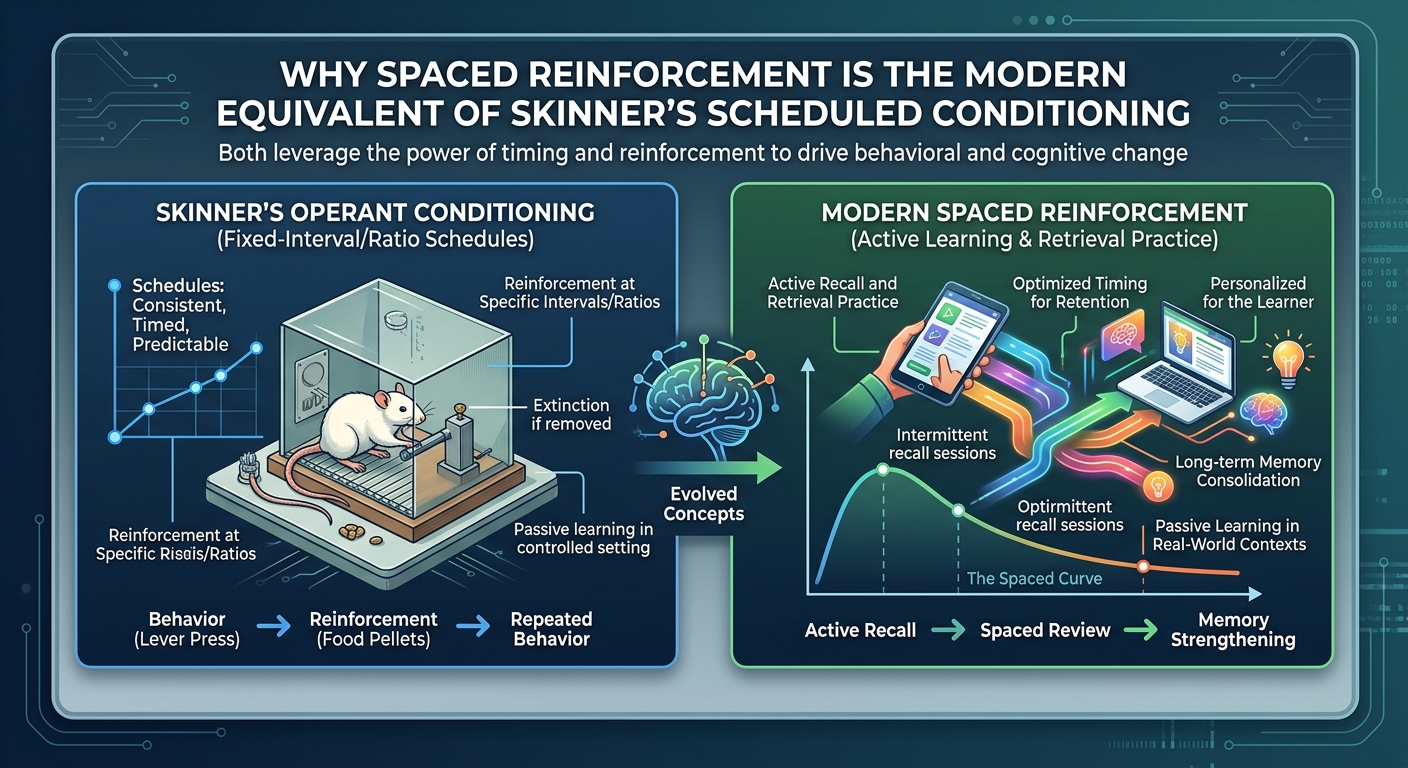
Why Spaced Reinforcement Is the Modern Equivalent of Skinner’s Scheduled Conditioning
In the dynamic landscape of corporate learning and development, the quest for truly effective training methodologies remains paramount. L&D Vice Presidents, Directors, and Managers are constantly seeking strategies that not only impart knowledge but ensure its enduring retention and practical application. While modern eLearning environments seem worlds away from the controlled experiments of B.F. Skinner, the fundamental principles of behavioral psychology he explored are surprisingly relevant. Today, what was once a rigid “scheduled conditioning” in the realm of pigeons and levers has evolved into the sophisticated, data-driven approach we call spaced reinforcement – a powerful, modern equivalent designed for the human mind and the digital age.
The Echo of Behaviorism: From Skinner Boxes to Learning Platforms
B.F. Skinner’s work on operant conditioning revolutionized our understanding of behavior. His concept of “scheduled reinforcement” demonstrated that the timing and frequency of rewards (or reinforcement) significantly impact learning and habit formation. While controversial in some aspects, the core insight—that strategic reinforcement schedules can shape behavior and embed learning—is undeniable. In traditional corporate training, this often manifested as one-off workshops, annual refreshers, or dense manuals, offering a form of scheduled conditioning, albeit often inefficiently applied. The challenge with such approaches, however, became clear: without optimal spacing and relevance, retention plummets, and the desired behavioral changes remain elusive.
For industries as diverse as Compliance, Sales, Banking, Finance, Insurance, Retail, Pharma, Healthcare, Hospitality, Oil and Gas, and Mining, the stakes are too high for ineffective training. Losing critical information can mean regulatory breaches, missed sales targets, increased safety incidents, or compromised patient care. This pressing need for knowledge retention across vast and complex curricula necessitates a more intelligent, adaptive approach than traditional methods can offer.
Spaced Reinforcement: The Intelligent Evolution
Spaced reinforcement isn’t merely a reboot of Skinner’s ideas; it’s an intelligent evolution, grounded in cognitive science and supercharged by technology. At its heart, it leverages the “spacing effect,” a well-documented phenomenon where learning is more effective when study sessions are spaced out over time, rather than crammed into a single session. This principle directly counters the forgetting curve, Ebbinghaus’s observation that memory retention declines rapidly over time without reinforcement.
Imagine a sales team undergoing AI Powered Authoring Tool for a new product line, or a healthcare professional learning complex `online medical billing and coding training`. A single, intensive training session might provide initial understanding, but without timely follow-up, much of that knowledge will be lost. Spaced reinforcement systematically reintroduces key information at progressively longer intervals, ensuring that the knowledge is retrieved from memory just as it’s about to be forgotten, thereby strengthening neural connections and enhancing long-term recall. This is not just about rote memorization; it’s about embedding understanding and making learned behaviors automatic.
How AI Supercharges Spaced Reinforcement for L&D Leaders
Today’s Microlearning LMS platforms are transforming spaced reinforcement from a theoretical concept into a practical, scalable, and highly effective training strategy. AI plays a pivotal role, turning what was once a manual, imprecise process into a precise, personalized learning journey.
L&D leaders often grapple with fundamental questions: How can modern learning platforms ensure employees retain critical information over time, especially in high-stakes fields like `online medical billing and coding training` or complex `investment banking prep course`? The answer lies in the sophisticated application of AI to spaced reinforcement. Advanced `learning management software` now leverages predictive analytics to track individual learner progress, identifying specific knowledge gaps and dynamically adjusting the repetition schedule. This ensures that crucial concepts are revisited just before they would be forgotten, transforming passive learning into enduring knowledge for fields from `pharmaceutical sales training` to `training for mining`.
Another pressing concern for global organizations is: What role does technology play in delivering tailored learning experiences across diverse industries and geographies? For companies with teams distributed globally, such as in `training for oil and gas` or multi-national `healthcare academy training`, a `cloud based learning management system` powered by AI can customize content delivery based on regional nuances, regulatory requirements, and individual learning paces. This `Adaptive Learning` approach ensures that a sales professional in one market gets relevant contextual reinforcement, while a compliance officer in another receives timely updates on `american bankers association training` regulations, all seamlessly managed by an `enterprise learning management` solution.
Furthermore, a common challenge is: How can we efficiently create and update vast amounts of training content to support continuous learning and quickly respond to evolving industry standards? The rapid pace of change in sectors like Pharma and Finance demands agility. AI-powered content generation and curation tools within a robust `LCMS` (Learning Content Management System) enable L&D teams to rapidly develop and deploy fresh, relevant materials. This means that whether it’s new `personal training insurance` policies or updated `retail staff training` protocols, the content is always current and easily integrated into the spaced reinforcement schedule.
Finally, L&D managers often ponder: Beyond simple recall, how can L&D foster deeper engagement and practical application of learned skills, turning knowledge into competence? Spaced reinforcement, when combined with engaging delivery methods, dramatically improves skill transfer. A `Gamified LMS` can embed spaced repetition into interactive scenarios, quizzes, and simulations, making the reinforcement process enjoyable and directly relevant to job roles. For `training for retail employees`, this could mean short, scenario-based refreshers on customer service, while for compliance, it might involve micro-simulations on handling sensitive data.
Industry-Specific Impact: Where Spaced Reinforcement Shines
The versatility of spaced reinforcement makes it an invaluable asset across virtually every industry:
- Compliance: For highly regulated fields like Banking and Insurance, ensuring employees remember complex rules and regulations (e.g., `american bankers association training`, `personal training insurance`) is non-negotiable. Spaced repetition solidifies this critical knowledge, reducing risk and fostering a culture of adherence.
- Sales: In competitive environments, `pharmaceutical sales training` and `training for retail employees` must be razor-sharp. Spaced reinforcement keeps product knowledge, objection handling, and sales methodologies fresh, leading to improved performance.
- Healthcare: From `online medical billing and coding training` to specialized `healthcare academy training`, constant learning is essential. Spaced reinforcement ensures medical professionals retain vital protocols, diagnoses, and procedural steps.
- Heavy Industry: `Training for oil and gas` and `training for mining` often involves complex safety procedures and equipment operation. Spaced reinforcement is critical for embedding safety protocols, minimizing accidents, and enhancing operational efficiency.
- Retail: Effective `training for retail` and `retail staff training` relies on consistent customer service standards and product knowledge. Spaced reinforcement provides regular, digestible refreshers that empower employees to deliver excellent customer experiences.
Implementing Spaced Reinforcement with a Modern Learning Platform
To effectively deploy spaced reinforcement, a sophisticated `learning management system` is indispensable. Modern `LMS` solutions are no longer just repositories for content; they are intelligent engines designed to optimize learning outcomes. Platforms like MaxLearn LMS embody this evolution, offering features specifically tailored to harness the power of spaced repetition, Adaptive Learning, and personalized pathways.
When evaluating `learning management solutions`, L&D leaders should look for systems that offer:
- AI-driven scheduling of content delivery.
- Robust analytics to track knowledge retention and identify gaps.
- Support for microlearning, allowing for digestible, focused reinforcement.
- `Gamified LMS` elements to boost engagement.
- An integrated `LCMS` for dynamic content creation and updates.
Conclusion
Skinner’s scheduled conditioning, once a groundbreaking insight into behavior, has found its contemporary and far more nuanced expression in spaced reinforcement. For L&D leaders striving to elevate organizational knowledge, performance, and compliance, embracing this modern methodology is not just an option—it’s a strategic imperative. By leveraging intelligent `learning management system` technology, organizations across all segments can ensure that critical learning isn’t just delivered, but truly sticks, driving sustained growth and success in an ever-evolving corporate landscape.
No responses yet