

Shaping Performance: A Complete Guide to Positive Reinforcement, Negative Reinforcement, and Deterrents for L&D Leaders
In the dynamic landscape of corporate learning and development, influencing employee behavior is paramount. As L&D leaders, you’re not just disseminating knowledge; you’re sculpting capabilities, fostering compliance, and driving performance. Understanding the psychological underpinnings of behavior modification – specifically positive reinforcement, negative reinforcement, and deterrents – is crucial for crafting impactful training programs. This guide delves into these core concepts, offering strategic insights for L&D professionals across diverse sectors, from AI Powered Authoring Tool applications in Microlearning LMS environments to specialized training in high-stakes industries.
Understanding the Core Principles of Behavioral Psychology in L&D
The principles of operant conditioning, pioneered by B.F. Skinner, provide a robust framework for understanding how consequences shape voluntary behavior. Applied thoughtfully, these principles can dramatically enhance learning outcomes and workplace performance.
Positive Reinforcement: Encouraging Desired Behaviors
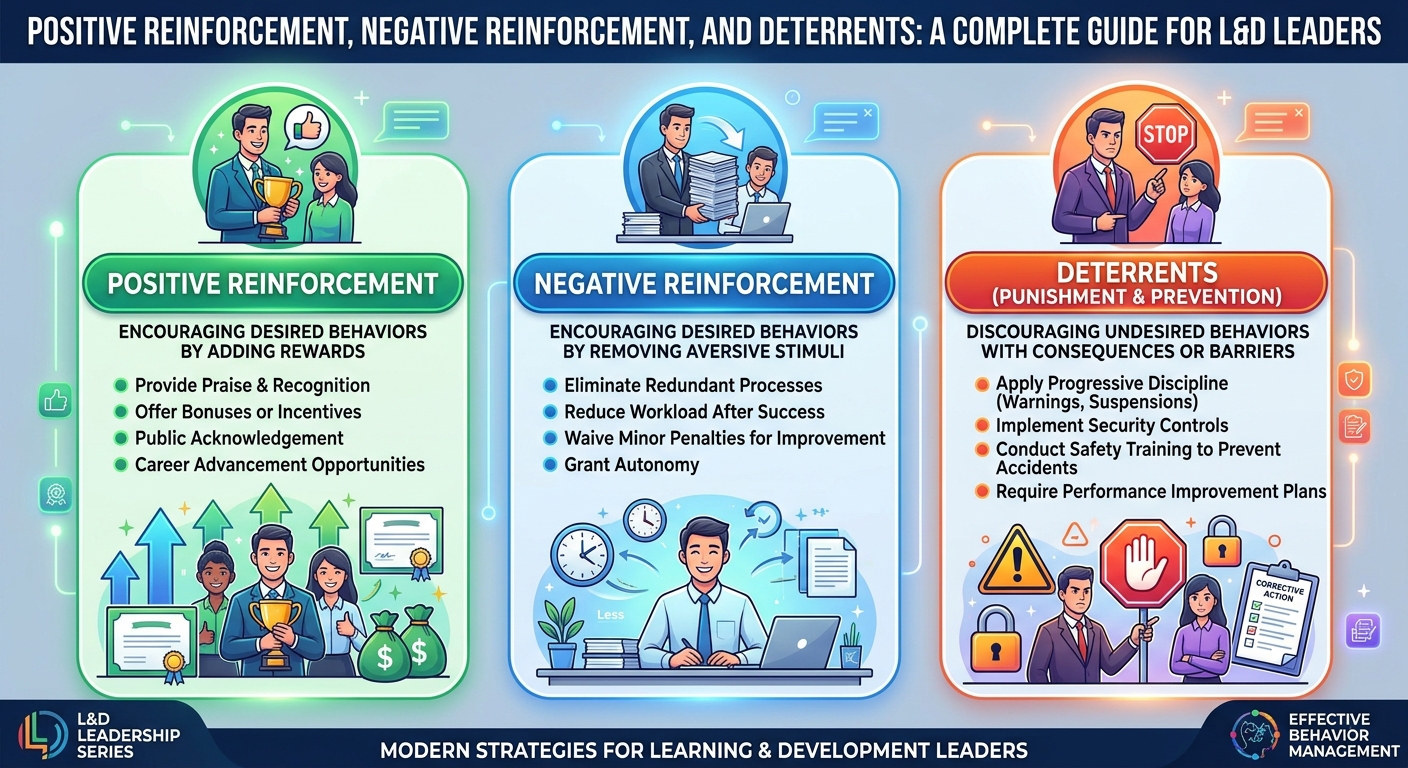
Positive reinforcement involves adding a desirable stimulus after a desired behavior occurs. The goal is to increase the likelihood of that behavior happening again. In L&D, this is your most powerful tool for fostering a culture of continuous learning and high performance.
- Definition: Presenting a reward or positive outcome immediately after an employee exhibits a desired action or masters a new skill.
- L&D Application:
- Recognition & Rewards: Acknowledging employees who complete challenging modules, achieve high scores, or apply new skills effectively. This could be public praise, badges, certificates, or even small monetary bonuses. For example, in Gamified LMS environments, leaderboards and virtual rewards serve as powerful motivators.
- Skill Application Success: Providing positive feedback when an employee successfully implements a new sales technique learned in a pharmaceutical sales training program, or correctly processes a complex transaction following an Adaptive Learning module for investment banking prep course participants.
- Career Advancement Opportunities: Linking successful completion of advanced training (e.g., for american bankers association training or online medical billing and coding training) to promotion pathways or new responsibilities.
- Impact: Boosts morale, increases engagement, accelerates skill acquisition, and cultivates a proactive learning mindset.
Negative Reinforcement: Removing Undesirable Conditions to Encourage Behavior
Often misunderstood as punishment, negative reinforcement is actually about removing an unpleasant stimulus when a desired behavior is performed. Its aim is also to increase the likelihood of a behavior, but by eliminating something undesirable.
- Definition: Taking away an aversive stimulus to strengthen a desired behavior.
- L&D Application:
- Removing Obstacles: Streamlining a cumbersome compliance process (e.g., for healthcare academy training or personal training insurance requirements) after employees demonstrate mastery of new, efficient procedures. The “aversive stimulus” here is the lengthy, confusing old process.
- Avoiding Negative Outcomes: Employees complete mandatory training for oil and gas safety protocols to avoid the risk of accidents or regulatory penalties. The negative reinforcement is the avoidance of these undesirable events. Similarly, training for mining ensures workers avoid dangerous situations through correct procedures.
- Reducing Cognitive Load: By providing clear, concise, and accessible learning management software modules on complex topics, L&D removes the frustration and stress of trying to learn from disorganized or overwhelming materials.
- Impact: Reduces anxiety, improves adherence to protocols, and encourages proactive problem-solving to avoid undesirable situations.
Deterrents (Punishment): Decreasing Undesired Behaviors
Deterrents, or punishment, involve adding an undesirable stimulus or removing a desirable one to decrease the likelihood of an undesired behavior occurring again. While effective in the short term, its long-term application in L&D requires extreme caution.
- Definition: Applying an adverse consequence or removing a positive one to reduce an unwanted behavior.
- L&D Application (with caution):
- Compliance Penalties: Failure to complete mandatory compliance training (e.g., for banking regulations or healthcare privacy) might result in loss of privileges, inability to perform certain job functions, or formal disciplinary action.
- Performance Consequences: Failing a critical certification exam for a specialized role (e.g., in pharmaceutical sales training) might prevent an employee from working in that capacity until they pass.
- Retail Theft Prevention: For training for retail employees, clear communication of consequences for policy violations helps deter unwanted actions.
- Impact: Can quickly suppress unwanted behaviors, but risks demotivation, resentment, and a focus on avoiding punishment rather than embracing learning or ethical conduct. Best used sparingly and in conjunction with strong positive reinforcement.
Strategic Application Across Industries with Modern L&D Tools
Leveraging these principles effectively requires sophisticated learning management system (LMS) and learning content management system (LCMS) platforms. An enterprise learning management system like MaxLearn LMS, especially a cloud based learning management system, provides the infrastructure to implement these strategies at scale.
How can AI help tailor training for diverse employee needs and roles?
AI can analyze individual learning patterns, job roles, and performance data to deliver highly personalized positive reinforcement. For instance, an AI-powered Adaptive Learning platform can automatically suggest the next relevant module or a specific microlearning asset after an employee masters a concept, acting as a form of personalized positive reinforcement. This is critical for varied roles like retail staff training versus complex training for retail management.
Can AI adapt content based on regional regulations and cultural nuances?
Absolutely. AI can process vast amounts of data, including regulatory updates for specific geographical regions or cultural contexts. For global organizations in industries like Pharma, Finance, or Oil & Gas, AI can ensure that compliance training is not only up-to-date but also culturally sensitive. For example, training for oil and gas teams operating in different countries can receive region-specific safety protocols, removing the “aversive stimulus” of irrelevant or incorrect information.
What role does AI play in predicting training effectiveness and identifying skill gaps?
AI algorithms can analyze learner performance, engagement rates, and even job role changes to predict which training interventions will be most effective. It can identify early signs of skill gaps (an “aversive stimulus” that needs to be removed) before they impact performance, allowing L&D to proactively deploy targeted learning management solutions. This predictive capability optimizes the application of positive reinforcement by ensuring resources are directed where they will yield the greatest behavioral change.
Building a Balanced L&D Strategy
The most effective L&D programs judiciously combine these three elements, leaning heavily on positive reinforcement, strategically employing negative reinforcement, and using deterrents only when absolutely necessary for critical compliance or safety issues.
- Prioritize Positive Reinforcement: This should be the cornerstone of your strategy. Foster an environment where learning and performance are celebrated. Implement Gamified LMS features to make learning fun and rewarding.
- Leverage Negative Reinforcement for Clarity: Use it to highlight the advantages of following correct procedures and avoiding known pitfalls. Make it clear how training helps employees circumvent uncomfortable or detrimental situations.
- Apply Deterrents Judiciously: Reserve punishment for serious infractions or non-negotiable compliance failures. Ensure that the consequences are clearly communicated, fair, and consistently applied to maintain trust and credibility.
Conclusion
As L&D leaders, your ability to influence behavior through thoughtful instructional design and strategic implementation is key to organizational success. By mastering the nuances of positive reinforcement, negative reinforcement, and deterrents, you can create a learning ecosystem that not only educates but truly transforms performance. Modern LMS platforms, especially those with AI Powered Authoring Tool capabilities, empower you to apply these psychological principles at scale, ensuring your training initiatives are not just informative, but inherently effective in shaping the desired behaviors that drive business outcomes. Embrace these powerful tools to build a workforce that is skilled, compliant, and continuously motivated.
No responses yet