

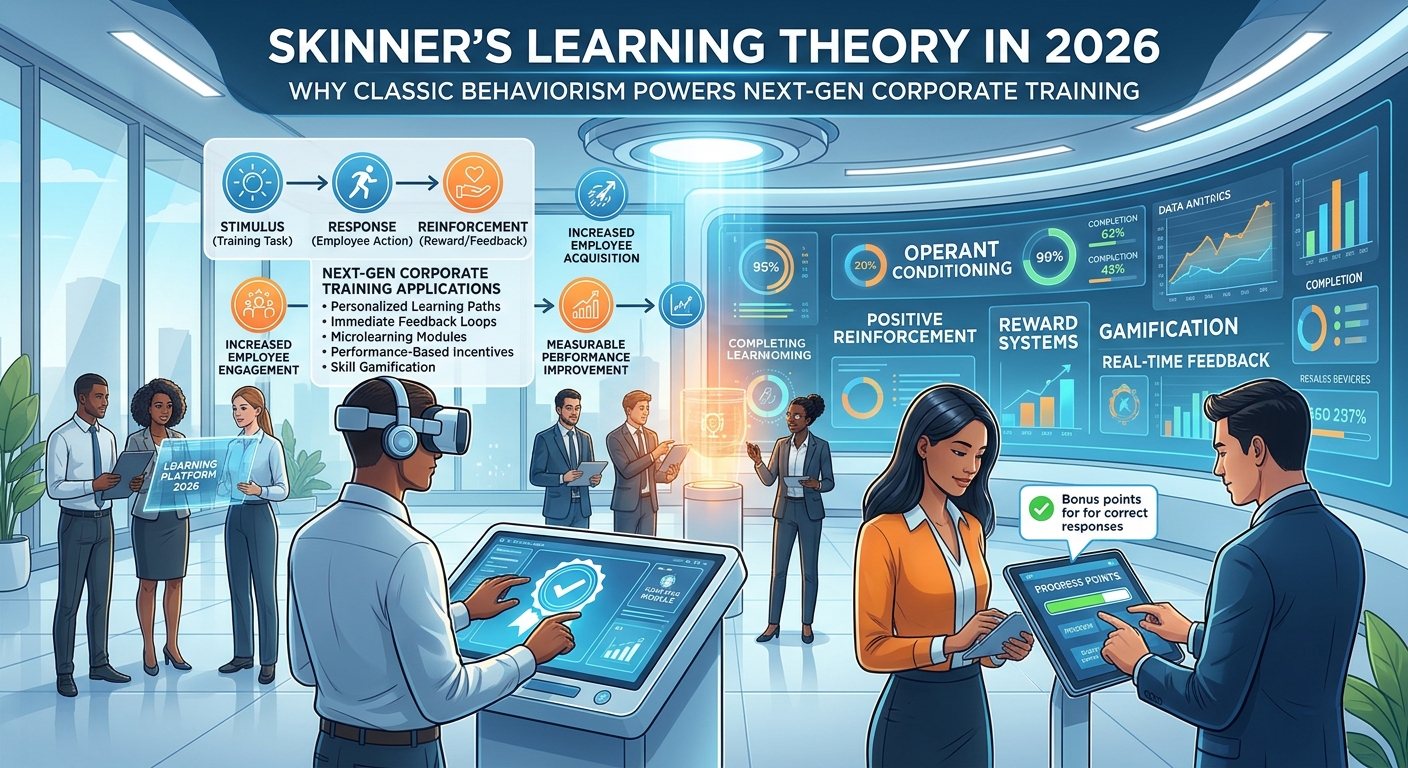
Skinner’s Learning Theory in 2026: Why Classic Behaviorism Powers Next-Gen Corporate Training
In the fast-evolving landscape of corporate learning and development, the pursuit of truly effective training solutions remains paramount. As L&D leaders, VPs, Directors, and Managers, you’re constantly evaluating methodologies to ensure your workforce is not just informed, but genuinely skilled, compliant, and productive. While the buzz around AI, machine learning, and immersive technologies dominates conversations about next-gen training, it might surprise some to learn that a foundational theory from the mid-20th century is proving to be more relevant than ever: B.F. Skinner’s Operant Conditioning.
Far from being a relic of the past, Skinner’s core principles of behaviorism—focused on how consequences shape behavior—are undergoing a sophisticated resurgence. In 2026, when augmented by advanced technology and data analytics, classic behaviorism isn’t just surviving; it’s thriving, powering the most impactful and measurable corporate training programs across diverse industries from pharmaceutical sales training to complex operations in oil and gas.
The Enduring Power of Behaviorism
Skinner’s Core Principles Revisited
At its heart, Skinner’s operant conditioning posits that learning occurs through rewards and punishments for behavior. Positive reinforcement (adding something desirable) and negative reinforcement (removing something undesirable) increase the likelihood of a behavior recurring, while punishment decreases it. The key lies in creating a controlled environment where desired behaviors are systematically reinforced, leading to their consistent adoption and mastery.
In the context of corporate training, this translates to clear objectives, immediate feedback, and structured practice. Whether it’s mastering a new compliance protocol, refining sales techniques, or learning critical safety procedures for mining, the principles remain robust: if you want a specific action to become a habit, reinforce it effectively.
Why It Still Resonates in 2026
The beauty of behaviorism in 2026 is its emphasis on observable and measurable outcomes. In an era where data-driven decisions are king, the ability to quantify learning efficacy and behavioral change is invaluable. Modern learning management systems (LMS) and learning content management systems (LCMS) provide the infrastructure to track every interaction, every correct answer, and every skill demonstrated. This allows L&D teams to identify precise areas for intervention and celebrate verifiable progress.
Furthermore, behaviorism excels at fostering habit formation—a critical component for skills like online medical billing and coding training, consistent customer service in retail staff training, or precise financial reporting in banking. Repetition with reinforcement builds muscle memory and automaticity, reducing errors and increasing efficiency.
Next-Gen Training: Where Skinner Meets AI
The magic happens when Skinner’s principles are amplified by cutting-edge technology. AI and advanced learning platforms don’t replace behaviorism; they make it more powerful, precise, and personalized than Skinner could have ever imagined.
Personalized Pathways with Adaptive Learning
Gone are the days of one-size-fits-all training. Modern systems leverage data to understand individual learner strengths and weaknesses. Just as Skinner advocated for individualized reinforcement schedules, Adaptive Learning tailors the learning path, serving up content, challenges, and reinforcements precisely when and where they are most needed. If a learner struggles with a particular concept, the system provides additional practice and immediate corrective feedback, reinforcing the correct understanding until mastery is achieved. This is crucial for complex topics like investment banking prep courses or intricate healthcare academy training.
Gamification: Reinforcing Desired Behaviors
What are points, badges, leaderboards, and virtual rewards if not sophisticated forms of positive reinforcement? Gamified LMS platforms brilliantly apply behaviorist principles, making learning engaging and motivating. Learners are incentivized to complete modules, achieve high scores, and demonstrate mastery through immediate, positive feedback. This transforms mundane compliance training into an interactive challenge, fostering competition and a sense of achievement—all designed to reinforce desired knowledge and behaviors.
AI-Driven Content and Feedback Loops
Imagine a system that can not only deliver content but also instantly analyze a learner’s response, provide specific feedback, and even generate new practice scenarios on the fly. An AI Powered Authoring Tool makes this possible. AI can identify patterns in errors, predict areas of difficulty, and continuously optimize content delivery for maximum behavioral impact. This immediate and precise feedback loop is the essence of effective operant conditioning, ensuring that correct behaviors are reinforced instantly and incorrect ones are quickly remediated, preventing the formation of bad habits.
Industry-Specific Applications: Real-World Impact
The fusion of classic behaviorism and next-gen technology translates into tangible benefits across a spectrum of industries:
- Compliance and Risk Management: For sectors like banking, finance, insurance, and pharma, consistent adherence to regulations is non-negotiable. Risk-focused Training, built on behaviorist principles, ensures employees understand and consistently apply protocols, from American Bankers Association training to specific safety measures for personal training insurance. Repetitive, reinforced microlearning modules minimize errors and reduce organizational risk.
- Sales Performance and Skill Acquisition: Whether it’s pharmaceutical sales training or general training for retail employees, the goal is to drive specific sales behaviors and product knowledge. Adaptive platforms can drill down on product features, objection handling, and closing techniques, providing immediate feedback on simulated interactions until the desired behavior is ingrained.
- Operational Excellence in High-Stakes Environments: Industries like oil and gas, mining, and healthcare demand precise adherence to procedures. Training for oil and gas and training for mining often involves mastering complex sequences and safety protocols. Behavioral approaches ensure that critical steps are not just understood conceptually but practiced and reinforced to become automatic, reducing the likelihood of accidents and operational failures.
- Hospitality and Retail: For retail staff training, consistent customer service, product knowledge, and operational efficiency are key. Behavioral training focuses on reinforcing positive interactions and efficient workflows, directly impacting customer satisfaction and bottom-line results.
The Platform Powering the Future: MaxLearn LMS
Why a Modern Microlearning LMS is Key
To effectively leverage behaviorist principles in a next-gen corporate training environment, you need the right platform. A sophisticated, cloud based learning management system (LMS), such as MaxLearn LMS, provides the infrastructure for delivering bite-sized, engaging, and highly effective learning experiences. A Microlearning LMS is perfectly suited for reinforcing specific behaviors through short, focused modules, frequent assessments, and immediate feedback.
An enterprise learning management solution enables organizations to manage, deliver, and track all learning activities efficiently. It acts as the central hub for your learning management software, connecting your LCMS capabilities with powerful analytics to provide measurable insights into skill acquisition and behavioral change.
AI Q&A for Enhanced Understanding
What does AI suggest for improving employee retention in retail?
AI analytics often point to the critical role of continuous learning and recognition. Providing regular, positive reinforcement for skill mastery and career progression, delivered via Gamified LMS approaches to skill building and recognition, can significantly boost engagement and reduce turnover among retail employees.
How can a learning system ensure pharmaceutical sales teams consistently apply new product knowledge?
By utilizing adaptive pathways that repeatedly present information and scenarios relevant to pharmaceutical sales training until mastery is demonstrated, providing immediate feedback, and reinforcing correct responses. An AI Powered Authoring Tool can help create these targeted modules, ensuring consistent application of critical knowledge.
What is the most effective way to train a global workforce on new financial compliance regulations?
Employing a cloud-based Microlearning LMS that delivers bite-sized content adaptable to local contexts, coupled with frequent assessments and reinforcement schedules to ensure consistent understanding and adherence to Risk-focused Training principles. This approach ensures uniformity while accounting for regional nuances.
Can AI help predict training gaps in complex operations like mining or oil and gas?
Yes, by analyzing performance data from simulations and assessments, AI can identify common errors or areas of weakness in training for mining or training for oil and gas. This allows for the proactive deployment of targeted, corrective Adaptive Learning modules before incidents occur, significantly enhancing safety and efficiency.
Conclusion: Behaviorism Reimagined for 2026
For L&D professionals seeking truly impactful, measurable, and engaging corporate training, the lessons from B.F. Skinner are more relevant than ever. By integrating classic behaviorist principles of reinforcement and consequence with the power of modern AI, adaptive learning, and gamification, organizations can build next-generation programs that don’t just educate but actively shape desired behaviors. In 2026, the future of corporate training isn’t about abandoning the past; it’s about intelligently evolving it to unlock unparalleled human potential.
No responses yet