

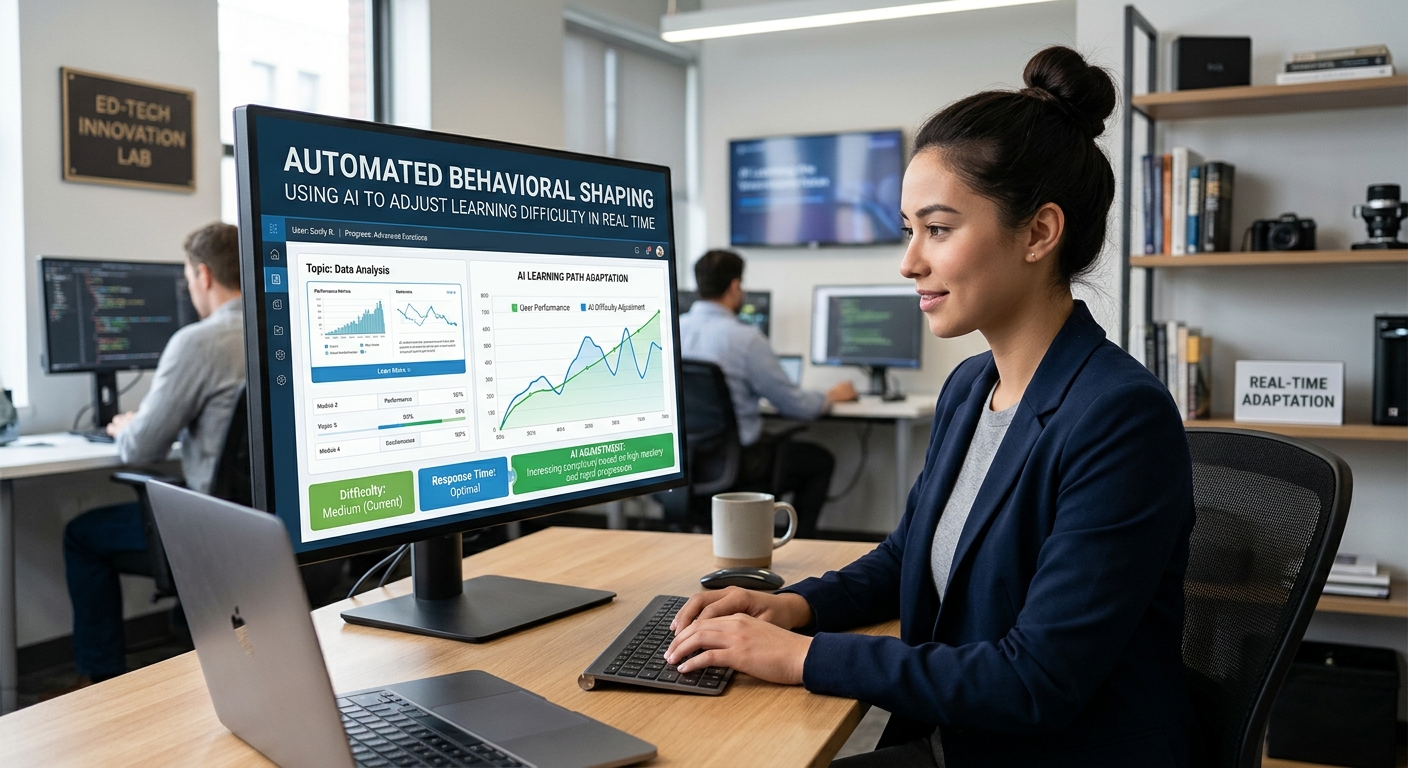
Automated Behavioral Shaping: Using AI to Adjust Learning Difficulty in Real Time
In today’s fast-evolving corporate landscape, the demand for effective and efficient employee training has never been higher. Learning and Development (L&D) leaders, from VPs and Directors to Senior Managers, constantly seek innovative solutions to enhance knowledge retention, improve performance, and drive business growth across diverse industries such as Banking, Finance, Insurance, Retail, Pharma, Healthcare, Hospitality, Oil and Gas, and Mining. The traditional “one-size-fits-all” approach to training is rapidly becoming obsolete, replaced by a yearning for personalized experiences that truly resonate with individual learners.
Enter Automated Behavioral Shaping (ABS) – a groundbreaking application of artificial intelligence that promises to revolutionize how we approach corporate education. By leveraging advanced algorithms, AI can analyze a learner’s performance in real-time, dynamically adjusting the difficulty of training content to create a uniquely challenging yet achievable learning path. This isn’t just about making content easier or harder; it’s about intelligently guiding behavior towards mastery, transforming how employees learn, adapt, and excel.
What is Automated Behavioral Shaping in L&D?
At its core, Automated Behavioral Shaping utilizes AI to observe, interpret, and respond to learner interactions within a training environment. Imagine a system that understands when a learner is struggling with a concept, not by them telling you, but by their nuanced responses, hesitation times, or patterns of incorrect answers. Conversely, it identifies when a learner has mastered a topic and is ready for a greater challenge, preventing boredom and disengagement.
This intelligent adaptation goes beyond simple branching scenarios. It’s about an AI-powered content delivery system acting as a highly perceptive, infinitely patient tutor, continuously adjusting the level of complexity, the type of examples presented, or the sequence of modules. The goal is to “shape” desired behaviors and competencies by providing optimal support and challenge at every step, ensuring deep understanding and practical application. For industries requiring Risk-focused Training, this precise adjustment is critical for mitigating costly errors and ensuring compliance.
How Does AI Personalize Learning Experiences?
The magic behind real-time difficulty adjustment lies in sophisticated machine learning algorithms. An advanced Microlearning LMS or Adaptive Learning platform continuously collects data on learner interactions. This includes quiz scores, time spent on topics, types of errors made, success rates in simulations, and even engagement levels. The AI processes this vast amount of data to build a unique profile for each employee, identifying their strengths, weaknesses, preferred learning styles, and cognitive load capacity.
Based on this profile, the AI makes instant decisions:
- If a learner struggles: It might present simpler examples, offer additional resources, break down complex topics into smaller Microlearning LMS modules, or provide remedial content. For example, in pharmaceutical sales training, if an employee consistently misidentifies a drug’s mechanism of action, the AI could reintroduce foundational biology concepts.
- If a learner excels: The system automatically introduces more complex scenarios, advanced modules, or challenging simulations to push their understanding further. For an experienced financial advisor taking investment banking prep course content, the AI might skip introductory material and present intricate case studies.
This dynamic feedback loop ensures that every minute spent in training is productive, relevant, and engaging, moving away from generic content that can bore advanced learners and overwhelm novices.
The Business Impact of Real-Time Difficulty Adjustment
For L&D professionals, the benefits of implementing Automated Behavioral Shaping are profound, translating directly into improved business outcomes and a stronger workforce.
What Impact Does Real-Time Difficulty Adjustment Have on Employee Performance?
- Increased Engagement and Motivation: When content is neither too easy nor too hard, learners remain engaged. The personalized challenge fosters a sense of achievement and self-efficacy, making training feel less like a chore and more like a growth opportunity. This is particularly crucial for maintaining interest in ongoing american bankers association training or compliance updates.
- Faster Skill Acquisition and Retention: By targeting specific learning gaps and reinforcing concepts precisely when needed, AI-driven adaptive learning accelerates the acquisition of new skills. The active process of problem-solving at an optimal challenge level leads to better long-term retention compared to passive consumption of static content.
- Enhanced Performance and Productivity: Well-trained employees are more confident and competent in their roles. Whether it’s a retail associate handling a complex customer query, a healthcare professional mastering online medical billing and coding training, or an engineer understanding new safety protocols in training for oil and gas, improved training directly translates to higher productivity and fewer errors.
- Optimized Training ROI: By personalizing learning paths, organizations can significantly reduce the overall time employees spend in training while maximizing its effectiveness. This leads to substantial cost savings and a better return on investment for L&D budgets.
Industry Applications and Examples
Automated Behavioral Shaping with AI has transformative potential across a wide array of industries:
Where Can AI-Driven Training Be Most Effectively Deployed?
- Healthcare: From healthcare academy training on new medical procedures to complex diagnostic pathways, AI can tailor simulations and case studies, ensuring nurses and doctors are always operating at peak proficiency. This is vital for patient safety and efficient care delivery.
- Banking & Finance: Navigating complex financial regulations, product knowledge for american bankers association training, and risk assessment are areas where AI can provide dynamic, scenario-based training, crucial for compliance and sound decision-making.
- Retail: For retail staff training, AI can adapt modules on product knowledge, sales techniques, or customer service based on individual employee performance and store-specific challenges. This makes training for retail employees highly effective and relevant.
- Manufacturing & Heavy Industry (Oil & Gas, Mining): Safety training in high-risk environments like training for oil and gas or training for mining can be dramatically improved. AI can adjust the difficulty of simulations for operating heavy machinery or handling emergency protocols, ensuring mastery before real-world application.
- Insurance: Training for new products, regulatory changes, or claims processing can be tedious. AI can personalize learning paths, speeding up onboarding and ensuring ongoing compliance for complex fields like personal training insurance policies.
The Role of a Modern Learning Platform
Implementing Automated Behavioral Shaping requires a robust technological backbone. An advanced Microlearning LMS or Adaptive Learning solution, often incorporating a powerful learning content management system (LCMS), is essential. These platforms, such as MaxLearn LMS, provide the infrastructure for content delivery, learner tracking, and, most importantly, the integration of AI-powered adaptive engines.
A cutting-edge learning management software allows L&D teams to leverage an AI Powered Authoring Tool to create dynamic content that can respond to learner needs. These enterprise learning management systems offer cloud based learning management system flexibility, making sophisticated adaptive training accessible to organizations of all sizes. The evolution of learning management solutions means that true behavioral shaping is no longer a distant dream but an achievable reality for forward-thinking L&D departments.
Conclusion
Automated Behavioral Shaping, driven by AI, represents a paradigm shift in corporate learning. It moves beyond passive consumption to active, personalized mastery, ensuring that every employee receives the precise level of challenge and support they need, exactly when they need it. For L&D leaders striving to build a highly skilled, adaptable, and engaged workforce, embracing this technology is not merely an advantage—it’s a necessity.
Why is AI Crucial for Modern Corporate Training?
In an era of rapid change, AI-driven adaptive learning systems provide the agility and precision required to keep employees ahead of the curve. They transform compliance training from a static requirement into an engaging growth opportunity and elevate skill development across all roles, from entry-level training for retail to complex leadership development. By focusing on behavioral shaping through real-time difficulty adjustment, organizations can unlock unprecedented levels of employee potential and achieve sustainable business excellence.
No responses yet