

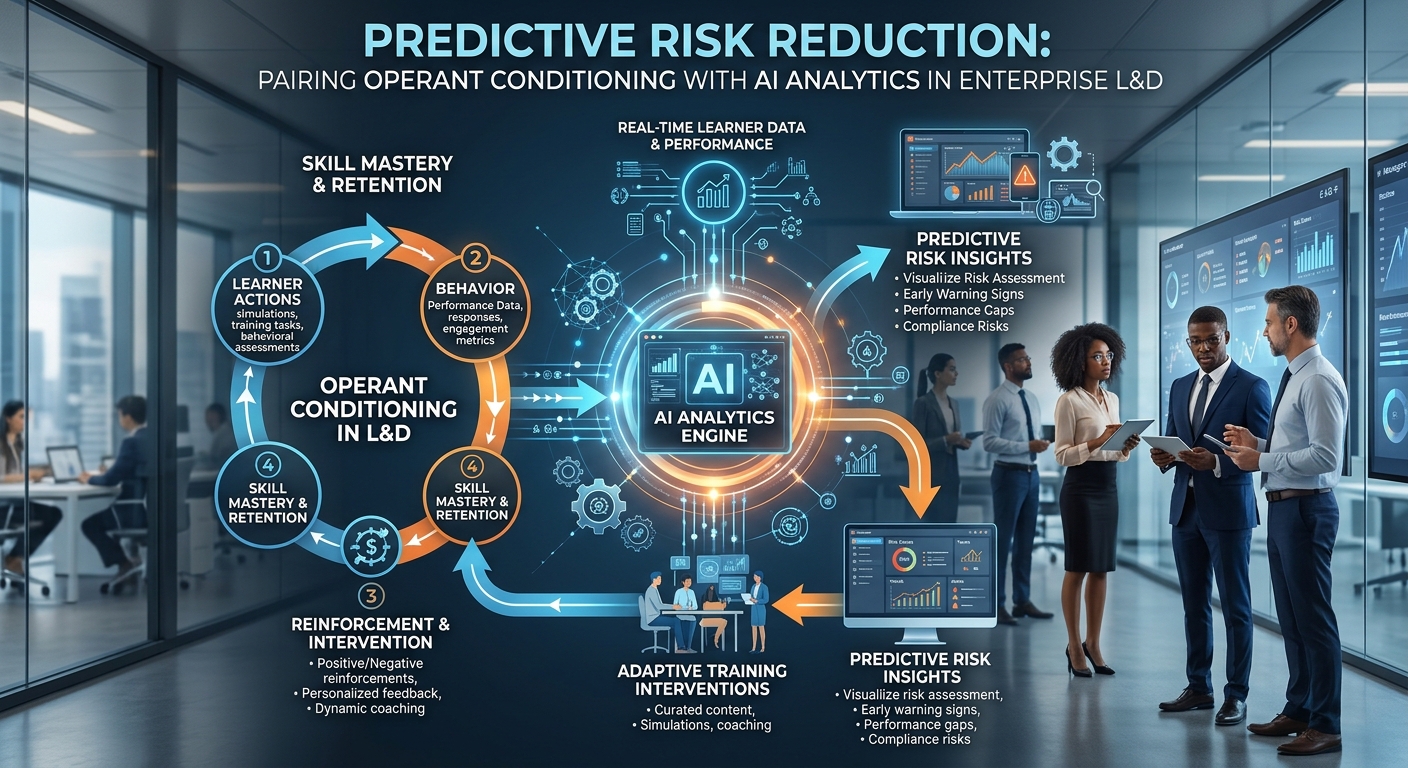
Predictive Risk Reduction: Pairing Operant Conditioning with AI Analytics in Enterprise L&D
In the dynamic landscape of enterprise operations, risk is an ever-present challenge. From ensuring regulatory compliance in highly scrutinized sectors to preventing costly errors in high-stakes environments, L&D leaders like you are constantly seeking more effective ways to safeguard your organizations. Traditional training methods, while foundational, often fall short of proactively mitigating risks before they materialize. The future of Risk-focused Training lies not just in imparting knowledge, but in shaping behavior with predictive precision. This article explores a revolutionary approach: seamlessly integrating the proven principles of operant conditioning with the cutting-edge capabilities of AI analytics to achieve predictive risk reduction in enterprise learning and development.
The Evolving Landscape of Enterprise Risk and L&D’s Mandate
Every industry faces its unique set of risks. In finance, organizations require robust Risk-focused Training, be it for american bankers association training or an investment banking prep course, to navigate complex regulations and market volatility. Healthcare demands impeccable online medical billing and coding training and comprehensive healthcare academy training to ensure patient safety and data privacy. Pharmaceutical companies rely on meticulous pharmaceutical sales training to adhere to ethical guidelines and product knowledge. Meanwhile, sectors like training for oil and gas and training for mining prioritize safety and operational efficiency above all else. Even training for retail, encompassing training for retail employees and retail staff training, carries risks related to customer service, fraud prevention, and inventory management. The need for specialized knowledge even extends to niches like personal training insurance compliance.
Your role as an L&D leader is no longer just about delivering courses; it’s about building a resilient, risk-aware workforce. The challenge lies in moving beyond reactive training to a proactive system that predicts and prevents issues. This requires an approach that deeply understands human behavior and leverages data to intervene effectively.
Operant Conditioning: Shaping Behavior for Risk Mitigation
At its core, operant conditioning is a psychological theory that explains how behavior is shaped by its consequences. In the context of L&D, it means designing learning experiences where desired behaviors (e.g., following compliance protocols, identifying security threats, adhering to safety procedures) are reinforced, making them more likely to occur. Conversely, undesirable behaviors are discouraged through their consequences.
Key principles of operant conditioning in L&D include:
- Positive Reinforcement: Providing immediate, constructive feedback or rewards (e.g., points, badges, progress indicators) when learners demonstrate correct actions or master a concept, encouraging them to repeat those behaviors.
- Negative Reinforcement: Removing an undesirable stimulus (e.g., an error message, a pending task) when a correct action is performed, which also strengthens the desired behavior.
- Punishment (Carefully Applied): Presenting an undesirable consequence (e.g., a simulation failure, a required re-evaluation) to decrease unwanted behavior. This must be used judiciously and constructively in L&D to avoid demotivation.
- Extinction: Withholding reinforcement from previously learned behaviors to gradually reduce their occurrence.
By applying these principles, L&D can move beyond mere knowledge transfer to actual behavior modification, embedding safe and compliant practices into the daily routines of employees. However, effectively applying these principles at scale, across diverse teams and complex learning paths, demands sophisticated tools.
AI Analytics: The Brain Behind Predictive Interventions
This is where Artificial Intelligence steps in. AI analytics provides the sophisticated engine needed to observe, process, and act on vast amounts of learning data. It transforms raw information from learning activities into actionable insights, enabling L&D to predict potential risks and personalize interventions.
How can artificial intelligence identify potential compliance gaps before they become incidents? By analyzing training performance data, simulation outcomes, and real-world incident reports to pinpoint areas of learner weakness or systemic risk. AI can detect patterns that human analysis might miss, such as a consistent error on a particular module across a team, or a decline in performance correlated with specific external factors.
What role does advanced data analysis play in personalizing risk-focused employee development? It allows organizations to tailor learning content, delivery methods, and reinforcement strategies based on individual learner profiles, performance histories, and job-specific risk exposure. This hyper-personalization ensures that each employee receives the most relevant and impactful training at the opportune moment.
AI’s predictive capabilities empower L&D to shift from a reactive stance (training after an incident) to a proactive one (training to prevent an incident). It’s about foresight, not hindsight.
The Symbiotic Relationship: Operant Conditioning Meets AI
The true power emerges when operant conditioning and AI analytics are combined. AI doesn’t replace the psychological principles; it amplifies and optimizes their application at scale. Here’s how this symbiotic relationship functions:
- Personalized Reinforcement Delivery: AI identifies individual skill gaps and performance trends. Based on this, it can trigger targeted Adaptive Learning modules or microlearning nudges designed to reinforce correct behaviors or address specific weaknesses. This ensures that reinforcement is timely, relevant, and highly effective.
- Predictive Nudges and Interventions: Imagine AI detecting early signs of potential non-compliance or risky behavior based on simulation results or quiz scores. Before an actual incident occurs, the system can deploy a preventive training module or a quick refresher to correct the course, applying the principles of positive reinforcement before negative consequences arise.
- Adaptive Learning Paths: An AI-powered learning management system can dynamically adjust the difficulty, content, and pace of learning based on a learner’s real-time performance. If an employee consistently struggles with a safety protocol, the system can present alternative explanations, practice scenarios, or quizzes until mastery is achieved, continuously reinforcing the desired safe behavior.
- Automated Feedback Loops: AI automates the immediate feedback crucial for operant conditioning. Learners receive instant feedback on their choices in simulations or quizzes, reinforcing correct decisions and guiding them away from incorrect ones without delay.
Implementing This Approach with Modern Learning Solutions
To harness this powerful combination, organizations need robust learning technology. An enterprise learning management system, or a sophisticated cloud based learning management system like MaxLearn LMS, is essential. These platforms, often referred to as learning management solutions or lms learning management system, offer the capabilities required.
Look for features such as:
- Advanced Analytics Dashboards: Providing granular insights into learner behavior, performance patterns, and risk indicators.
- Personalized Content Delivery: The ability to serve up specific content based on individual needs and AI-driven recommendations.
- Built-in Gamification and Reward Systems: To effectively apply positive reinforcement through points, badges, leaderboards, and other motivators.
- AI Powered Authoring Tool: To rapidly create and adapt content, ensuring it’s always relevant and responsive to emerging risks.
- Integration with an LCMS (Learning Content Management System): For seamless management and deployment of learning assets across the enterprise.
Where can L&D teams find robust learning platforms that combine behavioral science with advanced analytical capabilities? Leading enterprise learning management systems that specialize in adaptive, data-driven approaches offer these integrations, often with cloud-based accessibility for global teams. Systems like MaxLearn LMS are designed to facilitate this exact synergy, making the deployment of Microlearning LMS and learning management software a strategic advantage.
Tangible Benefits for L&D Leaders
Embracing this integrated approach yields significant benefits for your organization:
- Reduced Incidents and Non-Compliance: Proactively addressing skill gaps and risky behaviors minimizes costly errors, fines, and reputational damage.
- Improved Operational Efficiency and Safety: A well-trained, behaviorally conditioned workforce performs tasks correctly and safely, reducing waste and boosting productivity.
- Enhanced Employee Performance and Engagement: Personalized, adaptive learning keeps employees engaged and ensures they have the skills needed to excel, fostering a culture of continuous improvement.
- Measurable ROI on Training Investments: By tying training outcomes directly to risk reduction and performance metrics, you can demonstrate the tangible value of your L&D initiatives.
- Future-Proofing Your Workforce: Developing a system that continuously adapts to new risks and changing regulations ensures your organization remains agile and resilient.
Conclusion
The convergence of operant conditioning and AI analytics represents a paradigm shift for enterprise L&D. It moves us beyond traditional, often passive, training models to an intelligent, proactive system capable of predicting and preventing risk. For Vice Presidents, Directors, and Managers of L&D, this isn’t merely an enhancement; it’s a strategic imperative. By leveraging the power of behavioral psychology through the lens of artificial intelligence, you can build a more resilient, compliant, and high-performing workforce, effectively safeguarding your enterprise against the complexities of tomorrow.
No responses yet