

Unlocking Potential: How AI Identifies Slow Learners and Automates Guided Remediation Using Skinner’s Principles
In today’s fast-paced corporate world, effective training is not just an advantage—it’s a necessity. From ensuring compliance in highly regulated sectors like pharmaceutical sales training and healthcare academy training to enhancing productivity in oil and gas or investment banking prep courses, the goal is always consistent skill mastery. However, a universal challenge persists: not all learners progress at the same pace. Identifying and supporting “slow learners” without stigmatizing them or slowing down the entire cohort has long been a complex puzzle for Learning & Development (L&D) leaders. Enter Artificial Intelligence (AI) and its remarkable ability to revolutionize this very dynamic, leveraging principles pioneered by behavioral psychologist B.F. Skinner.
Imagine a system that not only spots learning gaps in real-time but also automatically provides personalized, guided remediation, ensuring every employee reaches proficiency. This is no longer future tech; it’s the present reality enabled by advanced learning management systems (LMS) and AI. For Vice Presidents, Directors, and Senior Managers of L&D, understanding this paradigm shift is crucial to maximizing training ROI and fostering a truly skilled workforce.
The Challenge of Diverse Learning Paces in Corporate Training
Traditional training methodologies, whether classroom-based or standardized e-learning modules, often operate on a “one-size-fits-all” assumption. This approach inevitably leaves some learners behind, leading to skill deficiencies, reduced performance, and potential compliance risks. Industries ranging from online medical billing and coding training to comprehensive american bankers association training face unique challenges in ensuring all employees grasp complex information. For example, in retail staff training, understanding new product lines quickly is paramount, while in training for mining, safety protocols are non-negotiable. When some employees struggle, the ripple effects can be costly, impacting everything from customer service in retail to critical decision-making in finance.
Skinner’s Principles Revisited: The Foundation for Personalized Learning
B.F. Skinner’s theory of operant conditioning, developed in the mid-20th century, laid the groundwork for individualized instruction. Skinner demonstrated that learning is most effective when broken down into small, manageable steps, followed by immediate feedback and positive reinforcement. This “programmed instruction” allows learners to progress at their own speed, ensuring mastery of one concept before moving to the next. While revolutionary, implementing true Skinnerian principles at scale was logistically challenging. However, AI now provides the computational power and adaptive capabilities to bring these principles to life in ways Skinner could only dream of.
AI: The Engine of Personalized Learning and Remediation
AI’s strength lies in its ability to process vast amounts of data, identify patterns, and make predictions or recommendations. When applied to learning, AI can analyze individual interactions with content, performance metrics, and even engagement levels, creating a highly detailed profile of each learner. This deep understanding forms the basis for personalized learning paths, dynamic content delivery, and automated remediation strategies that align perfectly with Skinner’s emphasis on individualized progression and reinforcement.
Let’s address some common questions L&D leaders have about this transformative technology:
How does artificial intelligence improve employee training programs?
AI enhances employee training by moving beyond generic content delivery. It analyzes individual learning styles, identifies knowledge gaps, and tailors the learning experience to each person. This leads to higher engagement, better retention, and more efficient skill acquisition. For example, in a complex investment banking prep course, AI can pinpoint exactly where an individual struggles with financial modeling concepts and provide targeted practice, rather than making them review an entire module they’ve already mastered.
Can AI training solutions adapt to different learning speeds globally?
Absolutely. AI-driven training solutions are inherently designed for global scalability and adaptability. They can account for diverse learning paces, language preferences, and cultural nuances across international teams, making them ideal for multinational corporations. Whether it’s compliance training for different regions or specialized training for oil and gas operations worldwide, AI ensures equitable access to effective learning that adjusts to each individual’s needs, wherever they are.
What are the benefits of AI-driven adaptive learning in professional development?
The benefits are substantial: increased learner engagement due to personalized content, improved knowledge retention through targeted reinforcement, faster skill acquisition, and a measurable reduction in training time and costs. AI can also predict future skill gaps, allowing L&D departments to proactively develop employees and maintain a competitive edge. This is critical for roles requiring continuous updates, such as personal training insurance certifications or new pharmaceutical sales techniques.
How AI Identifies Slow Learners
The core of AI’s power in this context is its ability to precisely identify when and why a learner might be struggling, long before it becomes a significant impediment to progress.
Real-time Performance Monitoring and Data Analysis
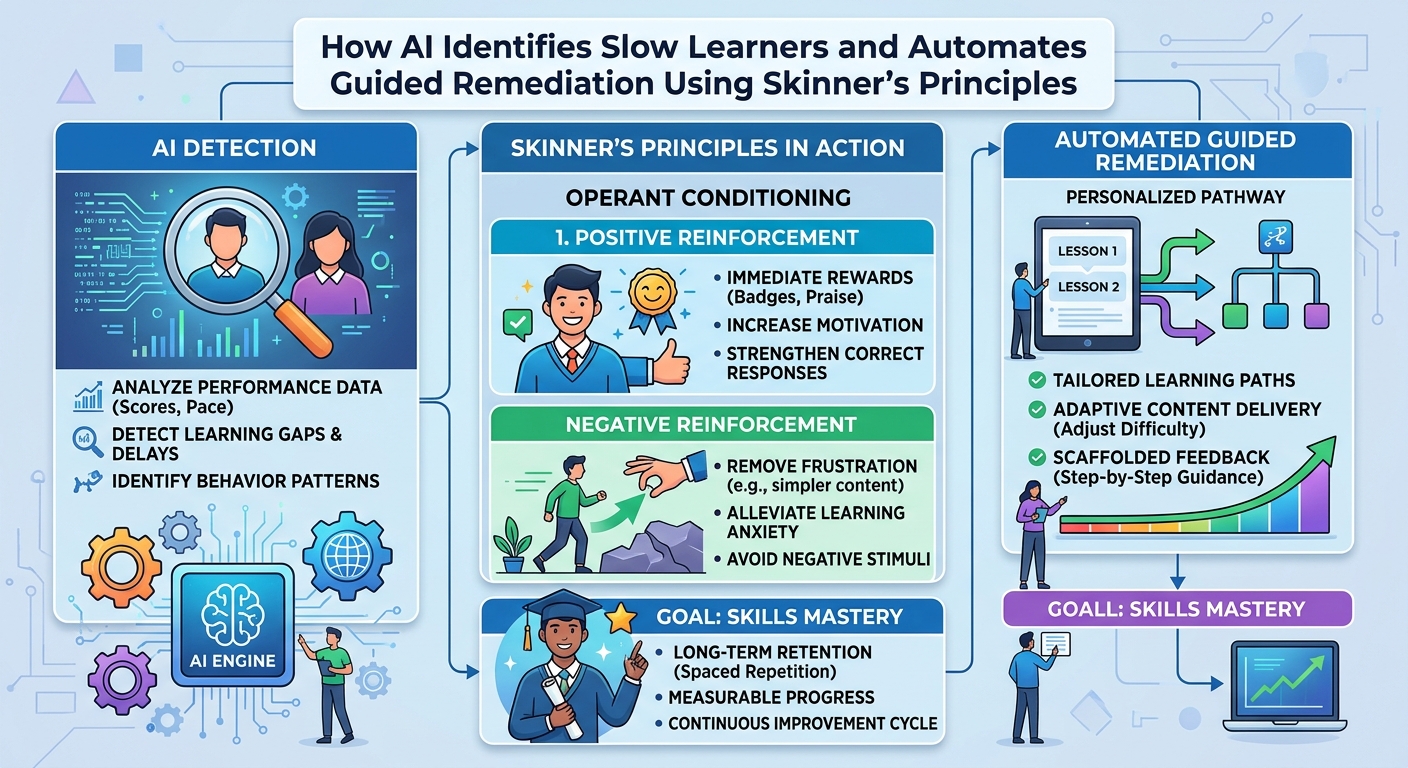
An AI-powered learning management software continuously monitors a multitude of data points as learners interact with content. This includes:
- Time spent on specific modules or topics
- Number of attempts to answer questions correctly
- Types of errors made (conceptual, factual, application)
- Navigation patterns and engagement levels
- Performance on quizzes and assessments
By analyzing these metrics in real-time, the enterprise learning management system can detect subtle indicators that a learner is not grasping the material effectively. For instance, repeatedly failing specific question types in an online medical billing and coding training or spending an unusually long time on a particular concept in training for retail employees signals a potential learning hurdle.
Predictive Analytics and Early Intervention
Beyond identifying current struggles, AI employs predictive analytics to foresee potential difficulties. Based on historical data and observed patterns, the system can flag learners who are at risk of falling behind before they even encounter a major roadblock. This proactive approach allows for early intervention, preventing minor misunderstandings from escalating into significant knowledge gaps. This capability is invaluable in high-stakes training, like that for mining, where foundational knowledge is critical for safety and operational efficiency.
Automating Guided Remediation with AI and Skinner’s Principles
Once a learning gap is identified, AI doesn’t just flag it; it automates the remediation process, delivering targeted support designed to reinforce correct behaviors and concepts, much like Skinner advocated.
Dynamic Content Delivery and Microlearning
AI-driven systems, often integrated within a Microlearning LMS, can dynamically deliver specific content segments tailored to the learner’s identified needs. If an employee struggles with a particular sales technique in pharmaceutical sales training, the AI immediately presents a bite-sized video, an interactive exercise, or a concise article focused solely on that one technique. This precise, on-demand content prevents information overload and provides immediate, relevant practice, reinforcing the correct response, a core tenet of Skinnerian learning.
Gamification and Positive Reinforcement
Skinner championed positive reinforcement to encourage desired behaviors. AI-powered Gamified LMS platforms masterfully apply this principle. As learners complete remedial modules, demonstrate mastery, or overcome challenges, they receive immediate rewards—points, badges, leader board recognition, or virtual currency. This instant gratification motivates learners, turns remediation into an engaging activity, and builds confidence, transforming the experience of catching up from a punitive task into a rewarding journey.
Adaptive Pathways and Feedback Loops
The true power of AI in remediation lies in its ability to create genuinely Adaptive Learning pathways. Instead of a linear progression, AI crafts a unique learning journey for each individual. If a learner masters a concept quickly, they can advance. If they struggle, the system provides additional explanations, different formats of content (e.g., text, video, simulation), or alternative practice scenarios. An AI Powered Authoring Tool further enables L&D teams to rapidly generate and adapt content to meet these diverse needs. Furthermore, AI ensures immediate, constructive feedback for every interaction, guiding learners toward the correct answers and behaviors, mirroring Skinner’s emphasis on immediate knowledge of results.
Benefits Across Industries
This AI-driven approach to identifying and remediating slow learners offers profound benefits across all segments:
- Compliance: In industries like banking and healthcare, where regulatory adherence is paramount, AI ensures all employees, regardless of initial learning pace, achieve and maintain necessary certifications and knowledge, reducing risk-focused training gaps. This is vital for american bankers association training and healthcare academy training.
- Sales & Retail: For pharmaceutical sales training and training for retail, AI ensures sales teams quickly master product knowledge, objection handling, and sales techniques, leading to increased revenue. Retail staff training becomes more efficient and effective.
- Technical & Operations: In complex fields such as training for oil and gas or training for mining, AI guarantees that all personnel possess critical operational and safety knowledge, reducing accidents and improving efficiency.
- Finance: For investment banking prep courses or general financial training, AI identifies specific areas of difficulty in complex financial models or regulations, providing targeted support to ensure complete comprehension.
- Healthcare Admin: For online medical billing and coding training, AI ensures precision and accuracy, minimizing errors that can lead to costly rejections and compliance issues.
Modern learning platforms like MaxLearn LMS, a comprehensive cloud based learning management system, embody these principles, offering robust learning content management system (LCMS) capabilities that integrate AI for a superior learning experience.
The Future is Here: Empowering L&D with AI
The integration of AI with Skinner’s enduring principles of individualized instruction and reinforcement is not merely an incremental improvement; it’s a fundamental shift in how organizations approach corporate learning. It empowers L&D leaders to create highly effective, equitable, and engaging training programs that cater to every employee’s unique needs. By embracing AI, you can ensure that no learner is left behind, every skill gap is addressed proactively, and your entire workforce operates at peak performance. It’s time to leverage the intelligence of AI to unlock the full potential of your human capital.
No responses yet