

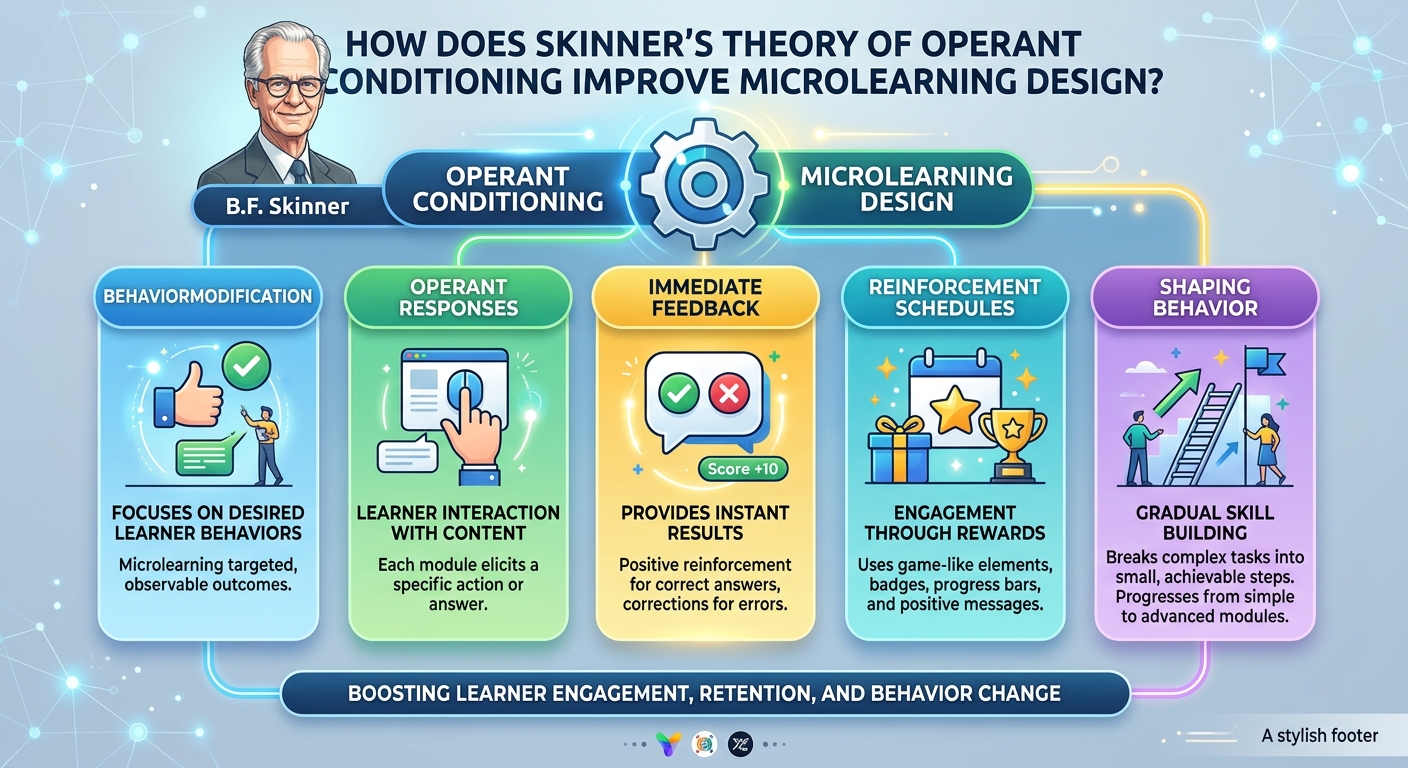
How Does Skinner’s Theory of Operant Conditioning Improve Microlearning Design?
In the fast-evolving landscape of corporate learning, L&D leaders are constantly seeking innovative strategies to enhance employee engagement, retention, and performance. As Vice Presidents, Directors, and Senior Managers, your focus is on scalable, impactful solutions that deliver tangible results across diverse industries from Compliance and Sales to Banking, Healthcare, and Oil and Gas. One such powerful synergy lies in combining B.F. Skinner’s seminal theory of Operant Conditioning with the modern pedagogical approach of microlearning.
Operant Conditioning, at its core, explains how behavior is shaped by its consequences. When applied thoughtfully to microlearning design, this behavioral psychology framework offers a robust blueprint for creating highly effective, engaging, and sticky learning experiences. Let’s delve into how this timeless theory can revolutionize your organization’s Microlearning LMS strategy.
Understanding Operant Conditioning: Skinner’s Legacy
B.F. Skinner, a pioneer in behaviorism, argued that learning is a function of change in overt behavior. This change is brought about by positive or negative reinforcement of desirable behavior, or by punishment for undesirable behavior. The core concepts include:
- Reinforcement: Any consequence that strengthens the likelihood of a behavior being repeated.
- Positive Reinforcement: Adding a desirable stimulus (e.g., praise, reward) after a behavior.
- Negative Reinforcement: Removing an undesirable stimulus (e.g., an annoying sound) after a behavior, thus increasing the likelihood of that behavior.
- Punishment: Any consequence that weakens the likelihood of a behavior being repeated.
- Positive Punishment: Adding an undesirable stimulus (e.g., a reprimand) after a behavior.
- Negative Punishment: Removing a desirable stimulus (e.g., taking away privileges) after a behavior.
- Shaping: Gradually molding behavior by reinforcing successive approximations of a desired behavior.
In a learning context, the goal is to reinforce desired learning behaviors and outcomes, creating a positive feedback loop that drives continuous improvement.
The Power of Microlearning
Microlearning is an approach to learning that delivers content in small, digestible chunks, typically 3-7 minutes in length. It’s designed to be focused, relevant, and accessible, fitting seamlessly into the busy schedules of modern professionals. This method is particularly effective for:
- Just-in-time learning
- Skill reinforcement
- Compliance training updates
- Product knowledge refreshers
When employees can access precise, relevant information exactly when they need it, their ability to apply that knowledge immediately improves. This immediate application is where the principles of Operant Conditioning truly shine.
The Synergy: Skinner Meets Microlearning Design
The inherent design principles of microlearning are perfectly aligned with the mechanisms of Operant Conditioning. Here’s how:
1. Immediate Feedback as Positive Reinforcement
One of the most powerful aspects of microlearning is the capacity for immediate feedback. After completing a short module, quiz, or simulation, learners receive instant validation or correction. This rapid response acts as positive reinforcement. For instance, in an online medical billing and coding training module, correctly categorizing a diagnostic code immediately confirms the learner’s understanding, reinforcing the correct behavior. A Gamified LMS can further amplify this by awarding points, badges, or unlocking new content for successful completion, providing continuous positive reinforcement.
2. Shaping Complex Behaviors through Incremental Learning
Skinner’s concept of shaping is perfectly embodied in microlearning’s modular nature. Instead of overwhelming learners with a vast course, microlearning breaks down complex topics into manageable steps. For example, in Adaptive Learning for investment banking prep course, a learner might first master bond valuation, then equity analysis, then portfolio management. Each successfully completed micro-module reinforces the foundational knowledge, gradually shaping their expertise towards the broader skill set. This systematic progression builds confidence and competence, vital for success in demanding fields like Finance and Pharma.
3. Removing Obstacles for Enhanced Engagement (Negative Reinforcement)
Traditional long-form training can be a barrier to learning due to time commitment and cognitive load. Microlearning, by contrast, removes these obstacles. The brevity and accessibility of micro-modules mean learners can engage without feeling overwhelmed. This removal of an undesirable ‘burden’ encourages participation and completion, acting as a form of negative reinforcement. Employees are more likely to seek out training for retail or Risk-focused Training when it’s easily digestible and fits into their workflow, rather than requiring extensive dedicated time away from their primary duties.
4. Targeted Correction and Reinforcement for Desired Outcomes
When a learner makes an error, microlearning can offer immediate, targeted correction. Instead of a broad re-explanation, it can point precisely to the misunderstood concept. This focused approach prevents the reinforcement of incorrect behaviors. In fields like healthcare academy training or Risk-focused Training for compliance, where accuracy is paramount, this precise corrective feedback is invaluable. It reduces the chance of learners practicing errors and ensures that only desired behaviors are reinforced.
Practical Applications Across Industries
The combination of Operant Conditioning and microlearning design is incredibly versatile, driving performance across numerous sectors:
- Compliance: For critical Risk-focused Training in banking, insurance, or pharma, micro-modules can reinforce specific regulations or ethical guidelines. Short quizzes after each section provide immediate feedback, ensuring understanding and compliance, which is crucial for organizations utilizing american bankers association training.
- Sales: AI Powered Authoring Tool can generate bite-sized content on new product features or sales techniques. Sales professionals in pharmaceutical sales training can quickly review objection handling strategies or product knowledge before a client meeting, receiving immediate feedback on practice scenarios.
- Retail & Hospitality: Quick refreshers on customer service protocols or new POS systems for training for retail employees. Positive reinforcement through recognition or sales incentives for implementing learned behaviors can significantly boost retail staff training effectiveness. This also applies to personal training insurance sales, where product knowledge retention is key.
- Industrial Sectors (Oil and Gas, Mining): Safety procedures and equipment operation benefit immensely from concise, visually rich microlearning. Training for oil and gas and training for mining can use simulations and immediate feedback to reinforce safe practices, minimizing risks in high-stakes environments.
Leveraging Technology for Enhanced Operant Conditioning in Microlearning
Modern learning management solutions (LMS) and learning content management systems (LCMS) are integral to implementing this strategy. An enterprise learning management or cloud based learning management system like MaxLearn LMS provides the infrastructure to deliver, track, and optimize microlearning experiences. With robust learning management software, L&D teams can:
- Automate feedback mechanisms.
- Track learner progress and provide targeted interventions.
- Implement gamification elements like leaderboards, badges, and points.
- Deploy Adaptive Learning paths that personalize reinforcement based on individual performance.
Intelligent Learning Experiences: Q&A
Here are some common questions L&D leaders have about optimizing learning:
Question: How can modern learning platforms ensure consistent training quality for a globally distributed workforce?
Answer: By leveraging centralized learning management systems, organizations can deploy standardized microlearning modules globally. These platforms ensure every employee, regardless of location, accesses the same high-quality, up-to-date content. Automated feedback and progress tracking guarantee consistent application of Operant Conditioning principles, reinforcing desired behaviors uniformly across all regions and promoting a cohesive learning experience.
Question: What strategies can L&D leaders employ to personalize learning experiences and boost engagement for diverse employee roles?
Answer: Personalization is key. Through Adaptive Learning paths and AI-driven content recommendations, learning platforms can tailor micro-modules to an individual’s role, prior knowledge, and performance gaps. This targeted approach ensures that reinforcement is highly relevant and impactful, making learning feel personal and engaging, thus maximizing its efficiency and effectiveness.
Question: How do leading organizations leverage advanced analytics to continuously refine their training programs and demonstrate ROI?
Answer: Robust analytics within an Microlearning LMS allow L&D leaders to track engagement, completion rates, performance improvements, and even correlate training data with business outcomes. By identifying which micro-modules lead to the strongest behavioral changes and positive reinforcement, organizations can continuously optimize content, delivery, and reinforcement strategies, clearly demonstrating the return on investment for their learning initiatives.
Conclusion
B.F. Skinner’s theory of Operant Conditioning provides a powerful psychological foundation for designing highly effective microlearning experiences. By strategically applying positive and negative reinforcement, and by carefully shaping behaviors through incremental learning, L&D professionals can create training programs that are not only engaging but also profoundly impactful. Whether you’re enhancing pharmaceutical sales training, ensuring compliance in banking, or boosting safety in mining, integrating these principles with a modern Microlearning LMS can lead to sustained behavioral change and measurable improvements in organizational performance. Embrace this synergy to unlock your workforce’s full potential.
No responses yet